About Global Finds
A personal, independently run site. Written and edited by Rob.
Who I am
I started detecting around the year 2000 with a basic Garrett that cost me £150, on permissions given by farmer friends in Derbyshire. It found enough to keep me interested, and when I moved up to a Minelab X‑Terra 70 the finds got better. Then work got in the way. I spent my career in the Emergency Services, and detecting became a fair‑weather hobby squeezed into whatever the shift pattern left me — which, if you have ever worked shifts, you will know is not much.
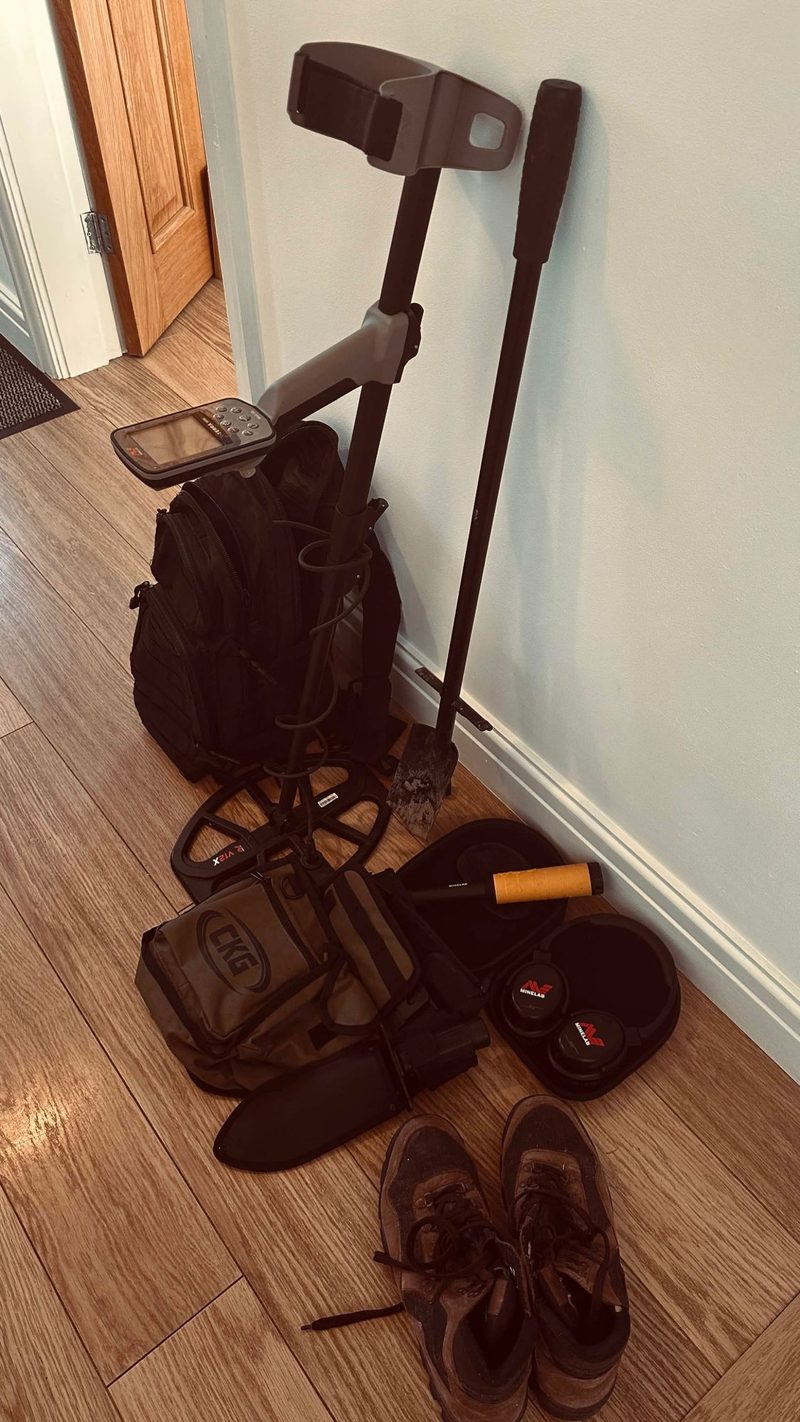
I moved to North Wales, and some time later discovered to my dismay that sea spray had worked its way into the X‑Terra's circuitry. It was dead, and obsolete enough that repair was not realistic. I retired from racing around with blue lights at fifty‑five, and marked it with a retirement present to myself: a Minelab X‑Terra Elite. I now detect almost daily, which after twenty‑five years of fitting it around work is still a novelty.
History, archaeology and geology have interested me for as long as I can remember. Detecting is simply the part of that you can do with muddy knees.
I’m a member of the National Council for Metal Detecting, which means I’m insured, and I follow its Code of Conduct: permission before I set foot on any land, holes filled in, and finds reported.
X‑Terra Elite target IDs for common UK finds
| Find | Target ID | Notes |
|---|---|---|
| Small silver & gold | ||
| Silver hammered (penny / halfpenny) | 28–42 | Very thin, near-pure silver. Can drop into the 20s if tiny or clipped. |
| Modern £1 coin (12-sided) | 45–50 | Nickel-brass outer ring, nickel-plated alloy inner. |
| Modern £2 coin | 52–57 | Nickel-brass outer ring, cupro-nickel inner. |
| Medium non-ferrous | ||
| Post-1947 sixpence | 59–61 | 75% copper, 25% nickel. A good benchmark coin. |
| Modern 5p / 10p (2012 onwards) | 60–65 | Nickel-plated steel, which can make the reading bounce. 1992–2011 issues are cupro-nickel. |
| Modern 20p / 50p | 64–68 | Cupro-nickel. |
| High conductors | ||
| Pre-decimal bronze penny | 70–76 | Thick copper/bronze. Screams out broad and loud. |
| Pre-1947 sixpence | 74–78 | 50% silver (1920–46) or 92.5% silver (pre-1920). Noticeably higher than post-1947. |
| Silver shilling / florin | 82–88 | More silver pushes the numbers up towards the 90s. |
| Large silver (half crown / crown) | 90–96 | The top of the scale: mass and high silver content. |
| Common rubbish | ||
| Iron ring / large nails | −19 to 0 | Ferrous range. Usually a broken or grunting tone. |
| Ring pulls / can tabs | 32–48 | Aluminium. Frustratingly overlaps with modern £1 coins and gold rings. |
| Large foil scraps | 20–35 | Highly variable depending on size and shape. |
Compiled from widely shared figures and my own time on the machine. Typical ranges, not promises. A reading shifts with the coil, the settings, the depth, the ground and how the target is lying — a coin on its edge can read quite differently from the same coin lying flat.
Why this site exists
Global Finds began as somewhere to record the discoveries that make the headlines, because they were scattered across hundreds of local newspapers and archaeology bulletins and nowhere in particular. It grew into something I wanted it to be: a free resource for other budding coil‑swinging finders of history, wherever they are in the world.
There is no subscription and there never will be. If the site eventually carries advertising or affiliate links, that is to cover its costs, and it will never decide what gets published here.
How a story gets onto this site
I would rather be open about the process than have you guess at it.
- It arrives. The site pulls news feeds into an inbox — a queue of candidate stories from publications around the world.
- I read the inbox. Most of it is not for us. I pick the stories I think would genuinely interest detectorists, which is a judgement, not an algorithm.
- The original is always credited and linked. Every find page names the publication that reported it and links to their article. If you want the full story, go and read theirs — they did the reporting.
- I add what the original left out. An approximate position for the map, the historical period, and the detector used where the article mentions it.
- I research it and write an editor's note. This is the part that is mine: context on the object, the period, the law that applies, or what the find actually tells us. It is where I try to add something to the story rather than repeat it.
Find spots are given as approximate areas only, never precise locations. That is deliberate, and it is not negotiable.
Corrections
I get things wrong. If I have misidentified an object, mangled a date, misattributed a find or credited the wrong person, tell me and I will correct it — quickly, and on the page itself rather than quietly.
Submit a find
Found something worth sharing? Send it in. Your own finds are welcome, and so are stories you have spotted that I have missed.
Contact
Email me — I read everything, and I answer most things. You can also use the submission form, which reaches me just the same.
See also our privacy & cookies policy.