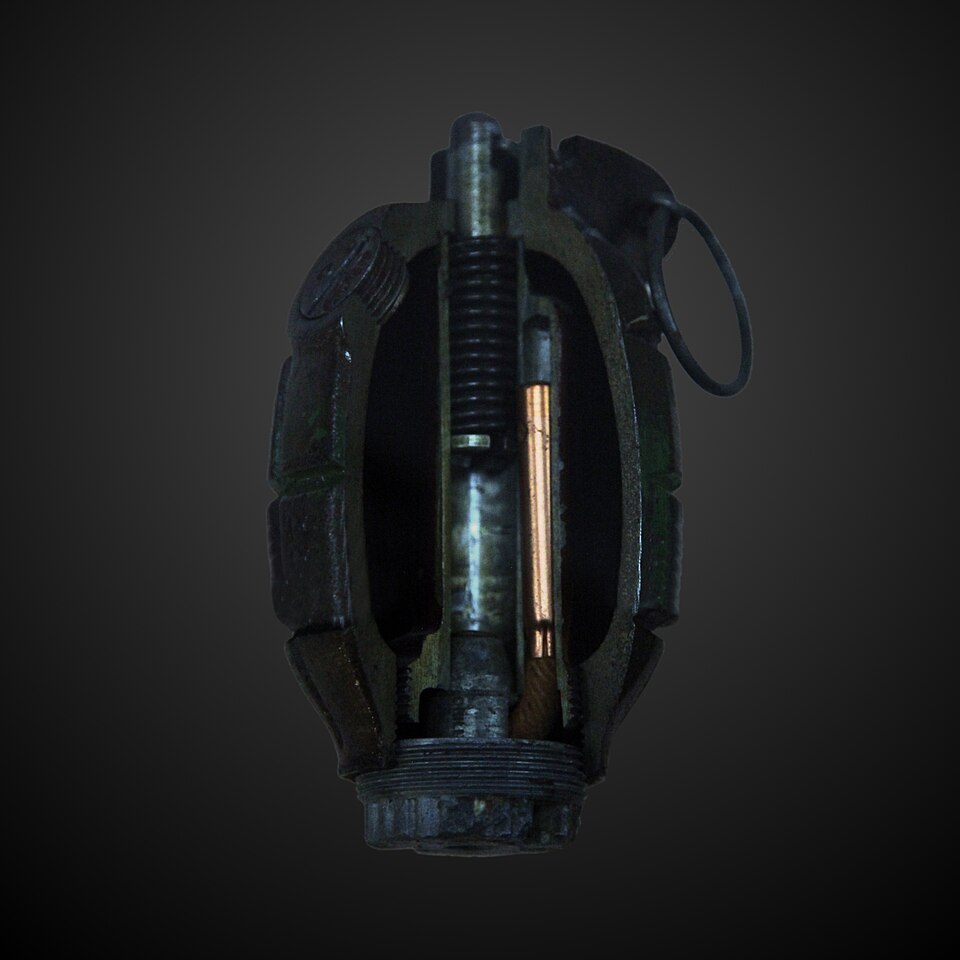
A cutaway Mills bomb at the Musée de l'Armée, Paris, Rama, Wikimedia Commons, CC BY-SA 3.0 FR.
Members of a Northumberland detecting club found two Mills grenades in a field at Blyth. The Army's bomb disposal team identified them and destroyed them in a controlled explosion.
On a Sunday morning, members of the detecting club True North Detecting were searching a farmer's field off South Newsham Road in Blyth, Northumberland, when two of them found hand grenades.
One club member, who did not want to be named, said they looked like Second World War grenades of the "pineapple" type, and that having been disturbed after lying in the ground so long, they were likely to be more dangerous, not less.
The police were called, along with the Army. The Ministry of Defence confirmed that the objects were two Mills grenades, and an Army Explosive Ordnance Disposal team from 521 Squadron responded. The squadron is part of the 11 Explosive Ordnance Disposal and Search Regiment of the Royal Logistic Corps.
An EOD operator identified the grenades, and at about 2 pm they were destroyed in a controlled explosion.
The Mills bomb was the standard British hand grenade from 1915, in service through both World Wars, with its familiar segmented "pineapple" body. Millions were made, and they still turn up in fields where soldiers trained or were stationed.
Reported by Chronicle Live (2026). Written for Global Finds from that report. Photo: a cutaway Mills bomb at the Musée de l'Armée, Paris, Rama, Wikimedia Commons, CC BY-SA 3.0 FR.
Those four are for England and Wales, where the Portable Antiquities Scheme records finds and the Treasure Act decides what must be reported.
Scotland runs its own system, and every find is reportable there — not only treasure. Treasure Trove Unit ›
The Republic of Ireland is different again, and severely so. Searching for archaeological objects without the Minister’s written consent is a criminal offence carrying fines or imprisonment, and the definition is broad enough to cover coins, buttons and buckles of almost any age. Do not assume British rules travel with you. The law, from the National Museum ›
Northern Ireland is stricter still. The Treasure Act applies and finds go to National Museums NI within fourteen days, but any searching that involves digging — metal detecting expressly included — needs a licence, and licences are only granted for archaeological projects. National Museums NI ›
This site covers discoveries from all over the world, and so does the variation in the law — from a recording scheme that thanks you, to a criminal offence. Wherever you are searching, find out what applies there before you go, not after.