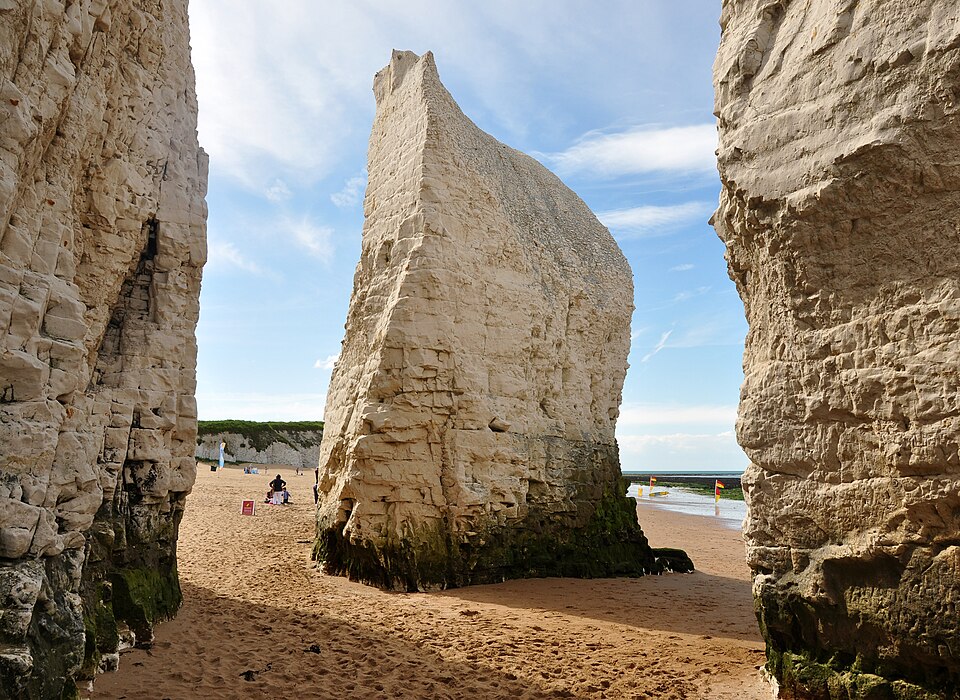
Cliffs and beach at Botany Bay, Kent, Nilfanion, Wikimedia Commons, CC BY-SA 4.0.
A visitor lost her wedding ring on the beach at Botany Bay. A new community noticeboard, a WhatsApp chain and five hours of searching by Thanet Metal Detecting got it back.
On 25 August 2026, Grace Brockhus went swimming at Botany Bay, near Broadstairs in Kent, leaving her wedding ring in a sunglasses case on the beach. When she came back, the ring had gone.
A passer-by pointed her to one of the new information signs put up by Friends of The Gallops, a residents' group in nearby Cliftonville, and she emailed the group asking whether anyone with a metal detector could help.
Her appeal went round local WhatsApp groups and, through local councillor Barry Manners, reached members of Thanet Metal Detecting. Several came to search. One member, Hayley, spent about five hours going over the sand with her detector. Another, Steve, came over from Faversham with his wife, and Grace's husband joined in too. At about 3.30 pm, the ring turned up in the sand.
Grace said she was blown away by the kindness and generosity of local people, and gave £30 to the Friends of The Gallops appeal for the upkeep of the land. Christina Cleworth, one of the group's directors, said community was exactly what the group was about, which made it a very special outcome.
Reported by The Isle of Thanet News (1 September 2026). Written for Global Finds from that report. Photo: cliffs and beach at Botany Bay, Kent, Nilfanion, Wikimedia Commons, CC BY-SA 4.0.
Those four are for England and Wales, where the Portable Antiquities Scheme records finds and the Treasure Act decides what must be reported.
Scotland runs its own system, and every find is reportable there — not only treasure. Treasure Trove Unit ›
The Republic of Ireland is different again, and severely so. Searching for archaeological objects without the Minister’s written consent is a criminal offence carrying fines or imprisonment, and the definition is broad enough to cover coins, buttons and buckles of almost any age. Do not assume British rules travel with you. The law, from the National Museum ›
Northern Ireland is stricter still. The Treasure Act applies and finds go to National Museums NI within fourteen days, but any searching that involves digging — metal detecting expressly included — needs a licence, and licences are only granted for archaeological projects. National Museums NI ›
This site covers discoveries from all over the world, and so does the variation in the law — from a recording scheme that thanks you, to a criminal offence. Wherever you are searching, find out what applies there before you go, not after.