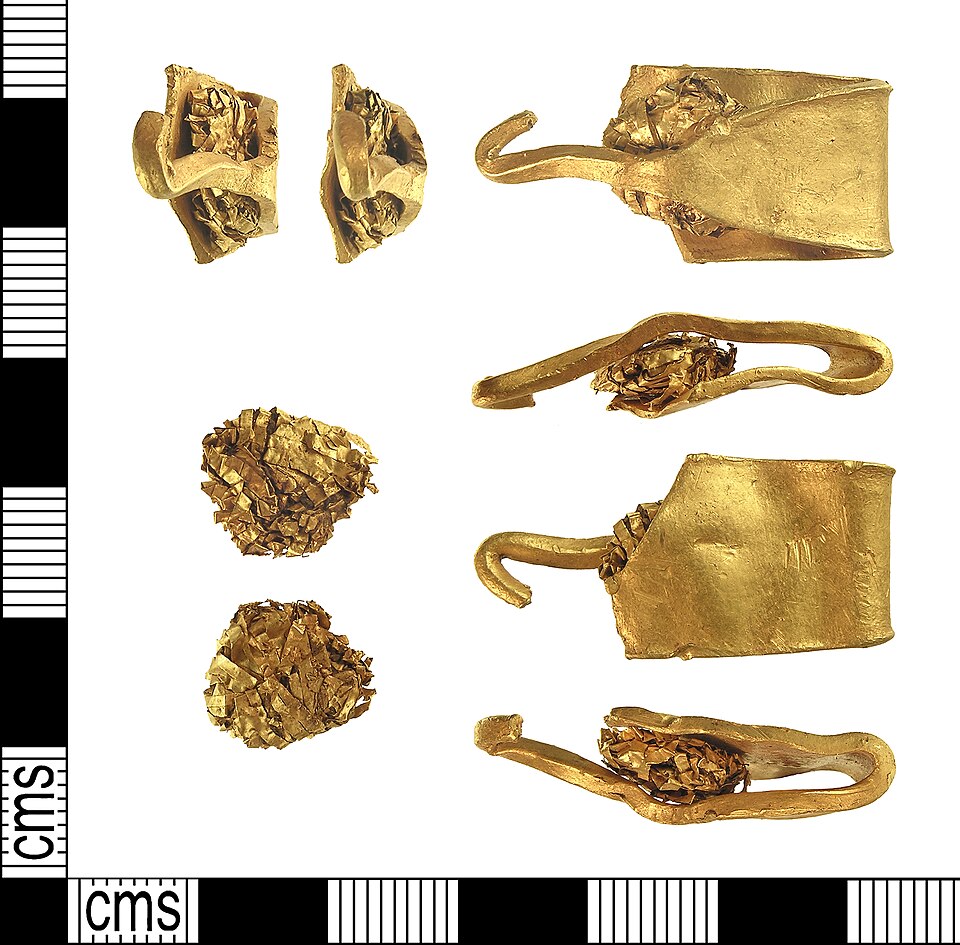
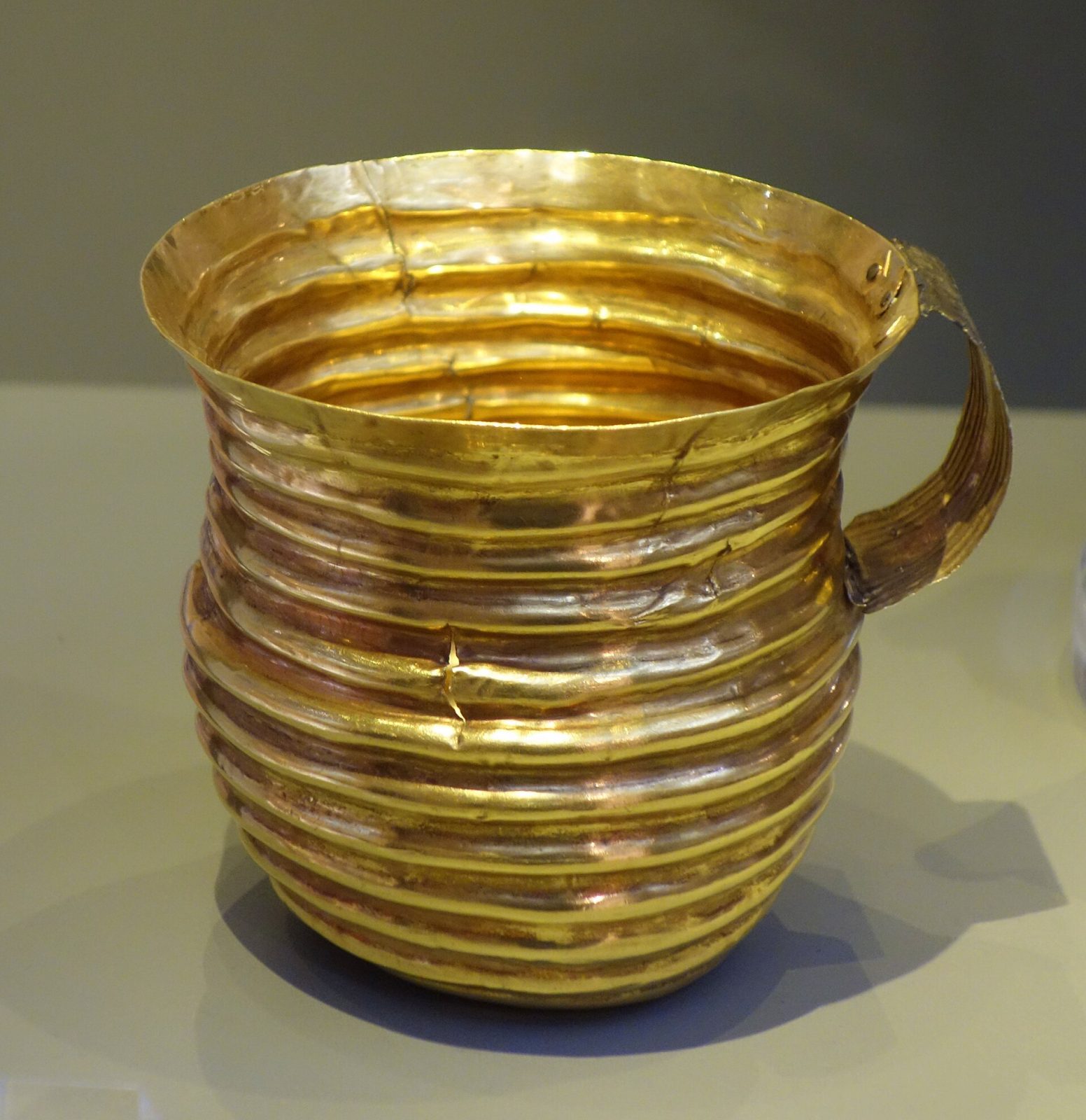
A Bronze Age gold bracelet recorded with the Portable Antiquities Scheme (not this find), The Portable Antiquities Scheme, Frank Basford, Wikimedia Commons, CC BY-SA 2.0.
A thin strip of Bronze Age gold, found near Hilborough in Norfolk in 2025, has been declared Treasure. It probably came from a bracelet or torc worn 3,000 years ago, and Norwich Castle Museum hopes to acquire it.
On 20 September 2025, metal detectorist Paul Davis was searching farmland near Hilborough, in Norfolk, with the landowner's permission, when he found a narrow strip of gold.
It is a fragment of hammered gold ribbon, still gently curved, weighing just 4.26 grams. For most of its length it is only about 0.2 millimetres thick, thickening to around 0.9 millimetres in places. The edges are neatly squared off by hammering, and it tapers to a squared point.
In a report for the coroner, the British Museum dated it to between about 1400 and 700 BC, the Middle to Late Bronze Age. Gold ribbon of this kind was used in Bronze Age Britain to make torcs, bracelets and smaller fittings. This piece is most likely part of a large penannular bracelet or torc, an open ring with a gap, or possibly one end of a ribbon torc of the Late Bronze Age.
At a Treasure inquest at Norfolk Coroner's Court in July 2026, the assistant coroner, Maeve Sykes, ruled that it is Treasure, as an object more than 300 years old containing at least 10 per cent precious metal. Norwich Castle Museum has said it would like to acquire it for its archaeology collection. If it does, the next step is an independent valuation, and the reward would go to the finder and the landowner.
Reported by the Eastern Daily Press (11 July 2026). Written for Global Finds from that report. Photo: a Bronze Age gold bracelet recorded with the Portable Antiquities Scheme (not this find), The Portable Antiquities Scheme, Frank Basford, Wikimedia Commons, CC BY-SA 2.0.
Those four are for England and Wales, where the Portable Antiquities Scheme records finds and the Treasure Act decides what must be reported.
Scotland runs its own system, and every find is reportable there — not only treasure. Treasure Trove Unit ›
The Republic of Ireland is different again, and severely so. Searching for archaeological objects without the Minister’s written consent is a criminal offence carrying fines or imprisonment, and the definition is broad enough to cover coins, buttons and buckles of almost any age. Do not assume British rules travel with you. The law, from the National Museum ›
Northern Ireland is stricter still. The Treasure Act applies and finds go to National Museums NI within fourteen days, but any searching that involves digging — metal detecting expressly included — needs a licence, and licences are only granted for archaeological projects. National Museums NI ›
This site covers discoveries from all over the world, and so does the variation in the law — from a recording scheme that thanks you, to a criminal offence. Wherever you are searching, find out what applies there before you go, not after.