'Extremely rare' 14th century gold ring found by detectorists in Suffolk
14th century · Found in 2024 See it on the timeline →
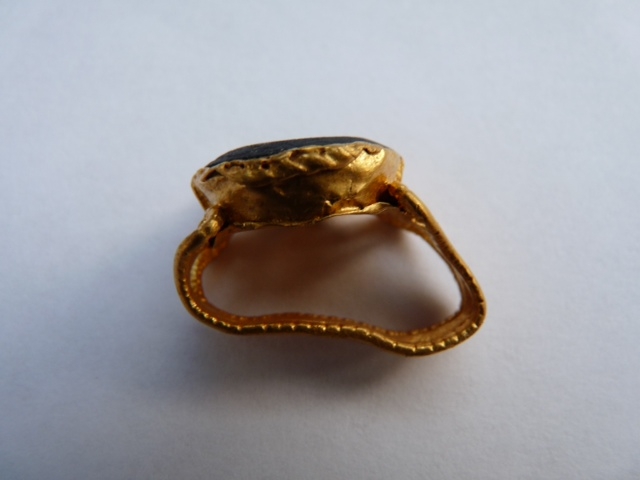
Two friends about to give up for the day found a 14th-century gold seal ring in a Suffolk field. Its griffin intaglio and inscription may link it to Matilda of Lancaster, Countess of Ulster.
In April 2024, friends Aaron Pizzey, 30, an engineering lecturer at a college in West Suffolk, and James Race, 39, were metal detecting near Stoke Ash in Suffolk. They had searched two fields that morning and found nothing, and decided to try one more.
Mr Pizzey's headset was playing up, and he was about to throw it into a hedge. Mr Race told him it was a good omen and he might find gold. Thirty seconds later, Mr Pizzey's Minelab Equinox 800 gave a strong signal, and in a clod of earth he saw the colour of gold. He shouted to his friend, who ignored him, thinking it was a joke, until he saw him waving the ring.
It is a gold seal ring of the 14th century. Its oval bezel holds a carnelian intaglio engraved with a griffin walking to the left, and the flat border around it is inscribed in Lombardic letters: GRIFFVnMATILIELEMATILIOVR. Nigel Mills of the auction house Noonans reads it as "griffin, Matilda the maternal countess", which could point to Matilda of Lancaster, who became Countess of Ulster. In 1347 or 1348 she became a canoness of the Augustinian priory at Campsey, near Wickham Market, about 20 miles from where the ring was found. A seal ring was used to stamp wax seals on documents, so it was a personal and closely guarded object.
The friends reported the ring to the local Finds Liaison Officer for recording. It was offered at Noonans in Mayfair on 22 September 2026 with an estimate of £10,000 to £12,000, and the finders will share the proceeds with the landowner. They plan to spend their share on a new detector and work on their homes.
Reported by BBC News (21 September 2026) and the East Anglian Daily Times. Written for Global Finds from those reports. Photo: a medieval gold finger ring set with a stone, recorded with the Portable Antiquities Scheme (not this find), Northamptonshire County Council, Julie Cassidy, Wikimedia Commons, CC BY-SA 4.0.
Detector usedMinelab Equinox 800
Approximate location52.29, 1.10View on map
Source: BBC News
Also reported by