The Leekfrith Torcs: Britain's oldest Iron Age gold, found in a Staffordshire field
Famous find Made about 400 to 250 BC · Found in 2016 See it on the timeline →
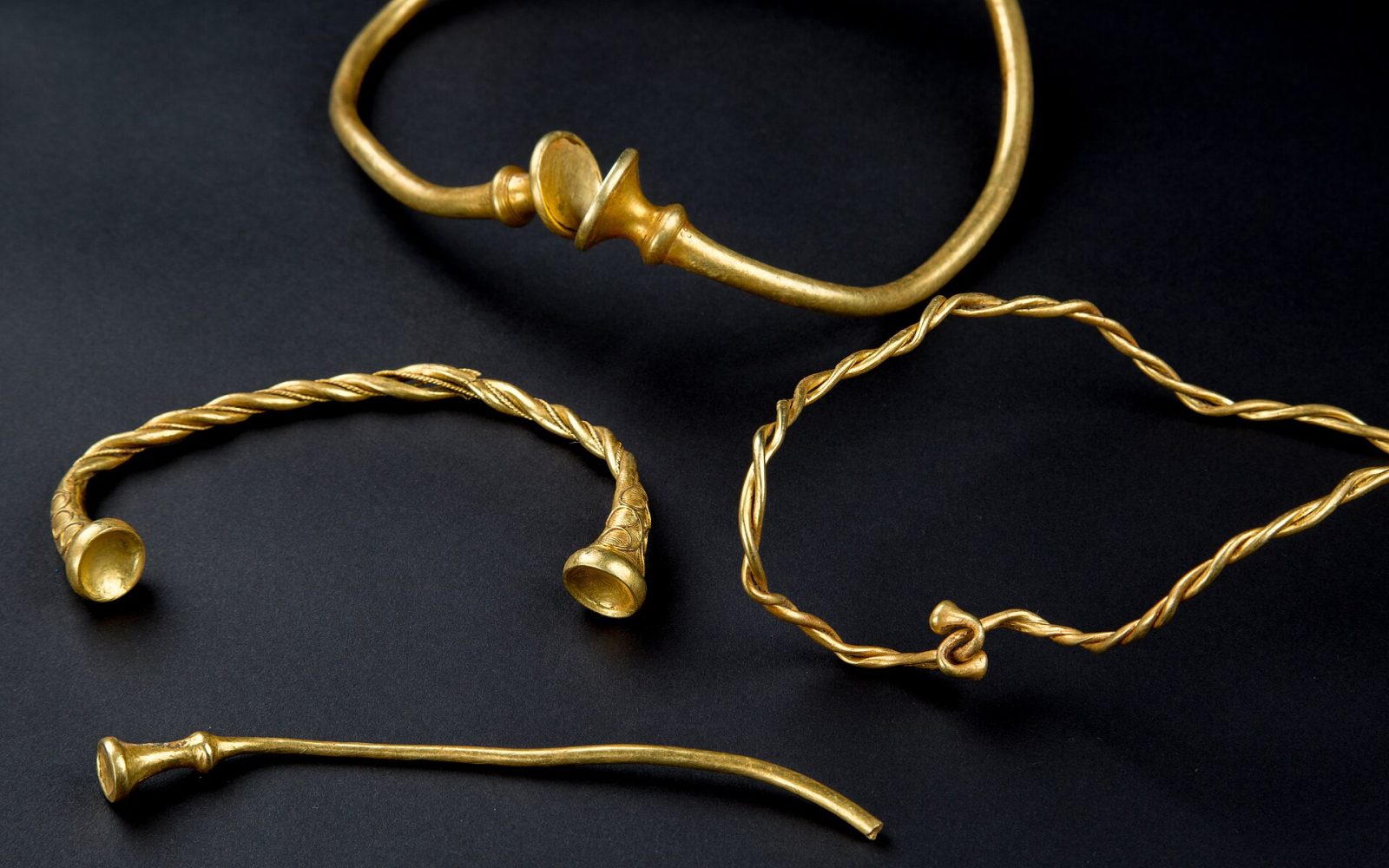
In December 2016 two detectorists searching a field near Leek in Staffordshire found three gold torcs and a bracelet. Made around 400 to 250 BC, they are thought to be the earliest Iron Age gold ever found in Britain.
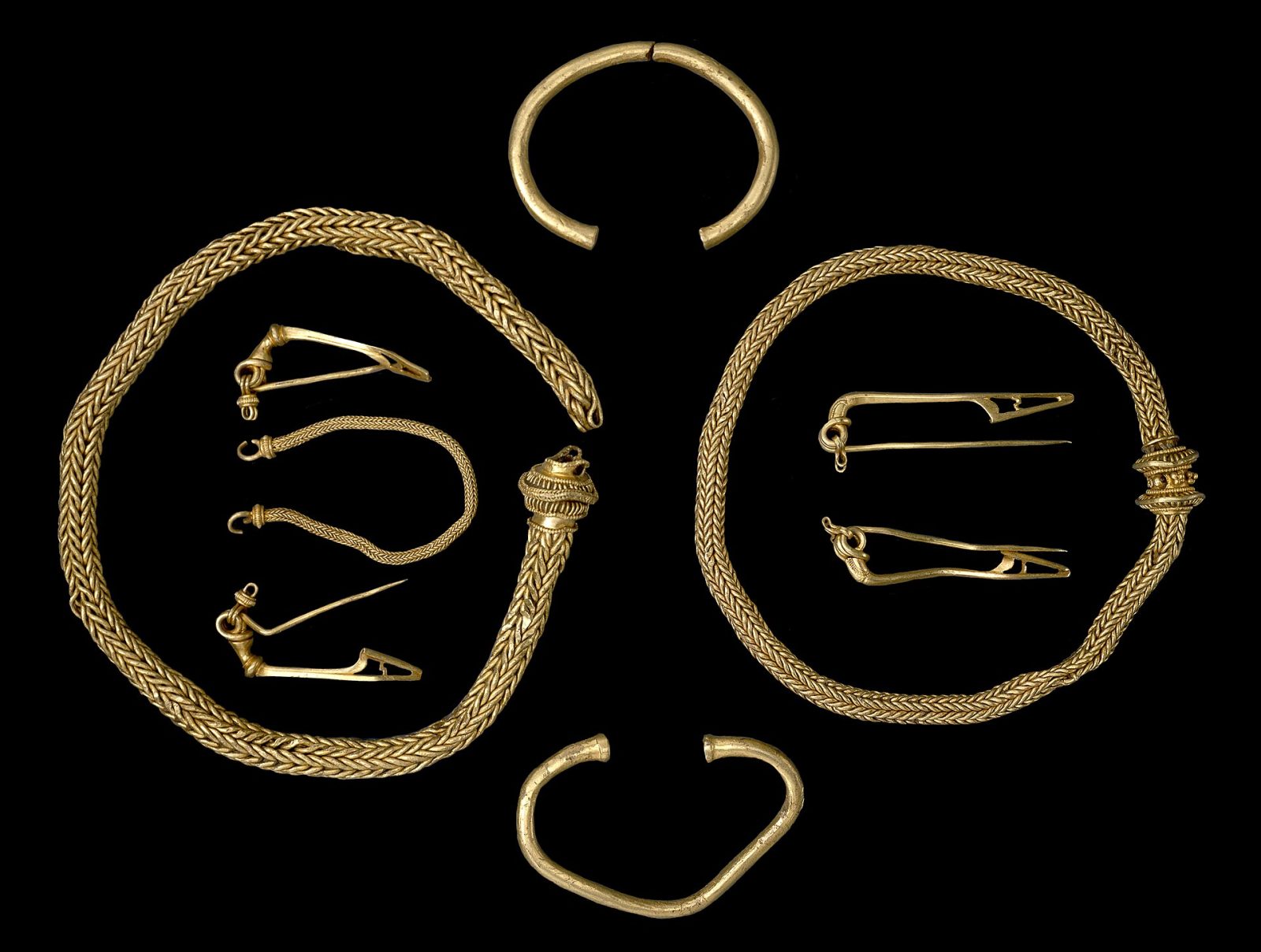
On 11 December 2016, Mark Hambleton and Joe Kania were metal detecting on farmland in the parish of Leekfrith, just north of Leek in the Staffordshire Moorlands. Around midday they found pieces of gold lying close together about 15 centimetres down: three neck torcs and a bracelet. One torc was broken in two, and its other half turned up on a later visit to the field.
The four pieces weigh about 370 grams in all and are made of gold mixed with silver. The largest torc, with ornate ends, weighs about 230 grams. The others are slighter, one of them made of twisted wire, and the bracelet is decorated in the early style of Celtic art. Dr Julia Farley of the British Museum, who wrote the Treasure report, dated them to about 400 to 250 BC, most likely the 4th century BC. That makes them the earliest Iron Age gold yet found in Britain, and among the earliest Celtic art. They were probably made on the Continent, in what is now Germany or France.
The report concluded that a plough struck the group some time in the 1980s, bending the torcs and dragging the pieces apart down the slope. Signs of wear suggest they had been worn, probably by women, and that they were buried with care, the smaller pieces nested inside the large torc. One idea is that they belonged to women from the Continent who married into local families.
At an inquest in February 2017 the torcs were declared Treasure, and they were valued at £325,000. The Potteries Museum & Art Gallery in Stoke-on-Trent raised the money with grants from the National Heritage Memorial Fund, the Art Fund, the Arts Council England/V&A Purchase Grant Fund and the Headley Trust, and the reward was shared between the finders and the landowner. The torcs have been on permanent display at the museum since December 2017.
Written for Global Finds from the National Heritage Memorial Fund, the Portable Antiquities Scheme's Treasure report and other published accounts. Photo: the Leekfrith Torcs, Staffordshire County Council, Wikimedia Commons, CC BY-SA 4.0.
Approximate location53.15, -2.02View on map
Source: National Heritage Memorial Fund