The Middleham Jewel: a gold and sapphire pendant found by a Yorkshire detectorist
Famous find Made in the late 1400s · Found in 1985 See it on the timeline →
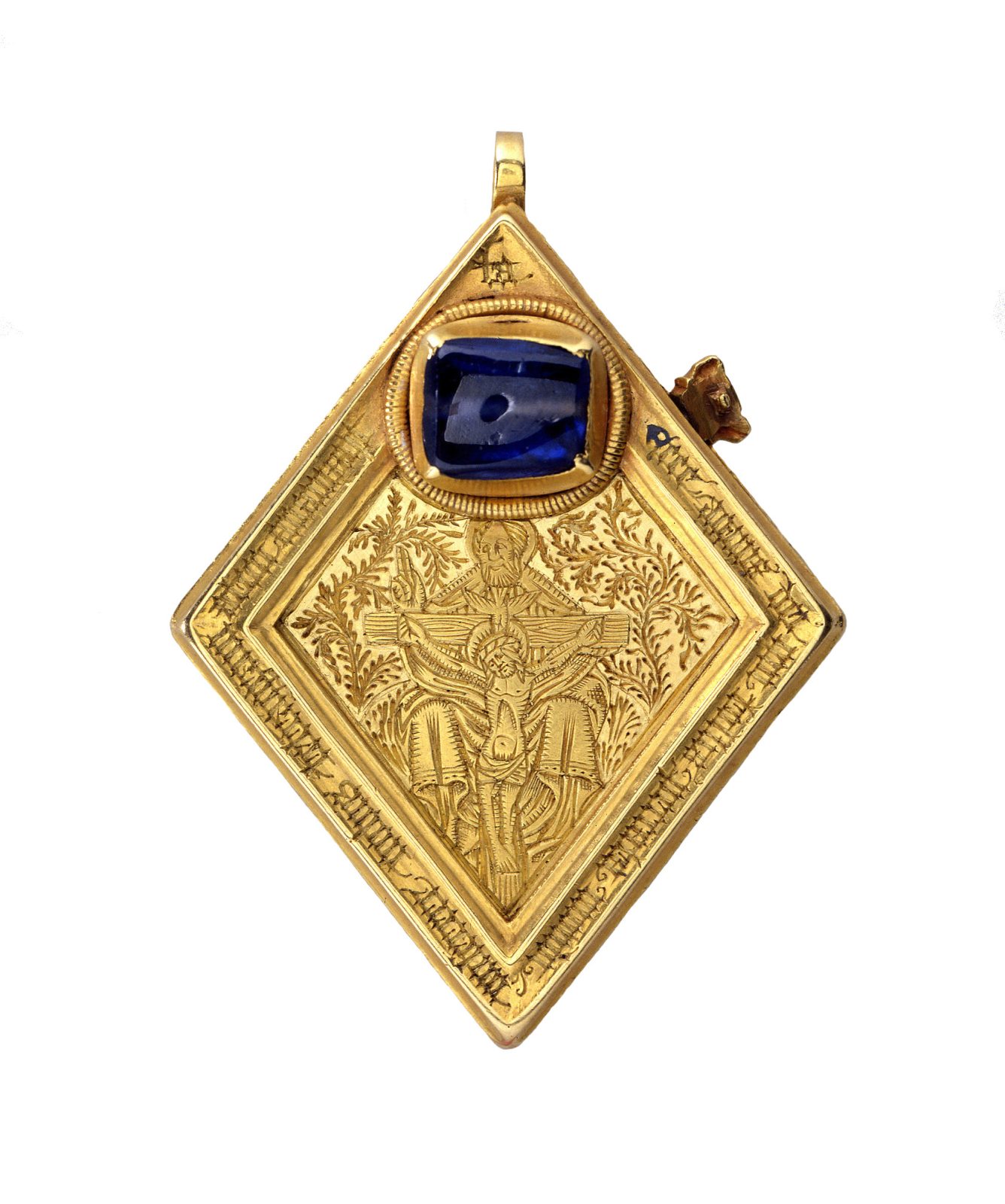
In 1985 a metal detectorist searching beside a bridle path near Middleham Castle in Wensleydale found a 15th-century gold pendant set with a sapphire. It sold for £1.3 million, and the Yorkshire Museum raised £2.5 million to keep it.
In September 1985, Ted Seaton was metal detecting near Middleham Castle in Wensleydale, North Yorkshire, once a stronghold of the Neville family and a home of the future Richard III, when he found a gold pendant beside a bridle path.
The Middleham Jewel is a diamond-shaped gold pendant set with a large blue sapphire. The Yorkshire Museum gives its size as 6.4 centimetres tall and 4.8 centimetres wide, and its weight as 62.7 grams. The front is engraved with the Trinity, with Christ on the cross, and the back with the Nativity surrounded by saints. A sliding panel on the back opens onto a small hollow, which may have held something precious to the wearer. Around the edge runs the Latin prayer Ecce Agnus Dei qui tollis peccata mundi miserere nobis (Behold the Lamb of God who takes away the sins of the world, have mercy on us), followed by the words tetragrammaton and ananyzapta, charm words thought to protect against illnesses such as epilepsy. The museum dates it to the last quarter of the 15th century.
Under the treasure trove law of the time, a find belonged to the Crown only if it had been hidden by someone who meant to come back for it. An inquest decided the jewel had been lost, not hidden, so it belonged to the finder and the landowner. Seaton had already agreed how any proceeds would be shared, and in December 1986 the jewel sold at Sotheby's for about £1.3 million, around five times its estimate.
The government then withheld an export licence to give a British buyer the chance to match the price. The Yorkshire Museum in York raised about £2.5 million, with £1.7 million from the National Heritage Memorial Fund, gifts from John Paul Getty Jr, the National Art Collections Fund and others, and donations from the public, and bought the jewel in the early 1990s.
Nobody knows who owned it. The sapphire and the female saints have led to suggestions that it was worn by a woman for protection in pregnancy and childbirth, perhaps a woman of the Neville family, but that cannot be proved. It is on display in the Yorkshire Museum's medieval gallery.
Written for Global Finds from York Museums Trust and other published accounts. Photo: the Middleham Jewel, York Museums Trust, Wikimedia Commons, CC BY-SA 4.0.
Approximate location54.28, -1.81View on map
Source: York Museums Trust