England · Jewellery · Medieval ·

Lord of the Rings: Gold treasure discovered in Rugby borough by metal detectorist is now on show

14th century · Found in 2023 See it on the timeline →

Medieval jewellery, England
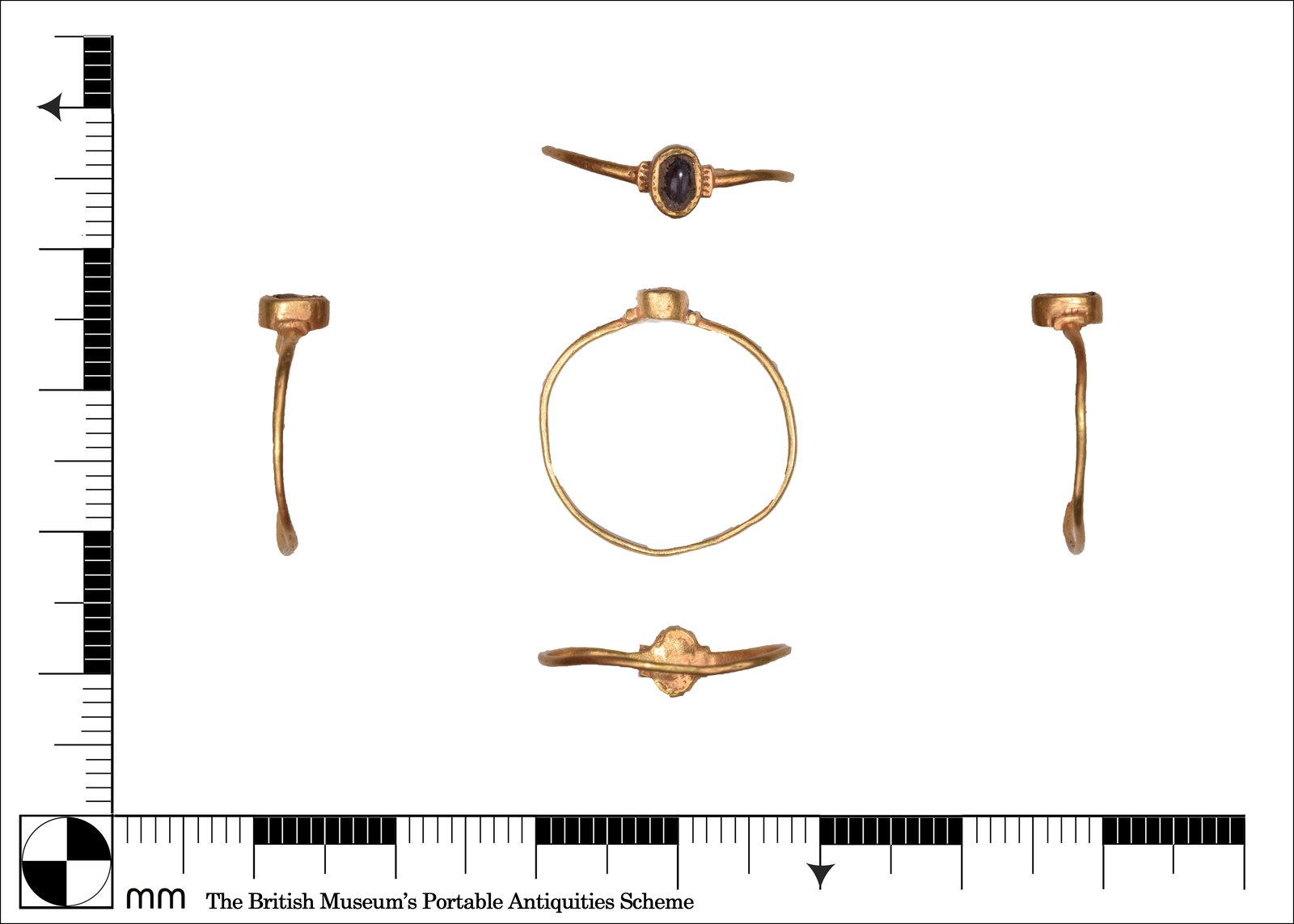
The ring itself, recorded with the Portable Antiquities Scheme as DENO-38A23C, © Derby Museums Trust, CC BY.

A 14th-century gold finger ring found by a detectorist near Rugby in 2023 has been declared Treasure, recorded with the PAS, and bought by Rugby Art Gallery and Museum.

In October 2023, a metal detectorist searching in the parish between Bourton-on-Dunsmore and Draycote, in the borough of Rugby in Warwickshire, found a medieval gold finger ring. The exact find spot has not been published. The ring dates from the 14th century. Its oval bezel has an opening decorated with small incised circles, and inside it are the remains of a dark red cabochon stone, a stone polished into a smooth dome rather than cut into facets. On each shoulder of the ring is a small panel decorated with a row of horizontal grooves. The find was recorded with the Portable Antiquities Scheme and declared Treasure because it is more than 300 years old and made of gold. Rugby Art Gallery and Museum then acquired it, and it is now on display in the "Archaeology Now" section of the museum's archaeology gallery. Councillor Maggie O'Rourke of Rugby Borough Council said it was the latest in a run of local detecting finds, following a medieval scabbard fitting from Kings Newnham and a medieval gold and silver brooch from Birdingbury. The same gallery holds finds excavated at Tripontium, a Roman town near Rugby, which the Rugby Archaeology Society gave to the museum in 2025, the museum's 25th anniversary year. Reported by WarwickshireWorld (9 July 2026). Written for Global Finds from that report. Photo: (1) the ring itself, recorded with the Portable Antiquities Scheme as DENO-38A23C, © Derby Museums Trust, CC BY. (2) Rugby Art Gallery, Museum and Library, G-13114, Wikimedia Commons, CC0.
Approximate location52.33, -1.36View on map

Source: WarwickshireWorld

Before you dig

Finding things is the easy part. These are the people who make a find count for something.

Scotland, Ireland and Northern Ireland

Those four are for England and Wales, where the Portable Antiquities Scheme records finds and the Treasure Act decides what must be reported.

Scotland runs its own system, and every find is reportable there — not only treasure. Treasure Trove Unit ›

The Republic of Ireland is different again, and severely so. Searching for archaeological objects without the Minister’s written consent is a criminal offence carrying fines or imprisonment, and the definition is broad enough to cover coins, buttons and buckles of almost any age. Do not assume British rules travel with you. The law, from the National Museum ›

Northern Ireland is stricter still. The Treasure Act applies and finds go to National Museums NI within fourteen days, but any searching that involves digging — metal detecting expressly included — needs a licence, and licences are only granted for archaeological projects. National Museums NI ›

This site covers discoveries from all over the world, and so does the variation in the law — from a recording scheme that thanks you, to a criminal offence. Wherever you are searching, find out what applies there before you go, not after.

Found something? What to do next › · Buying or selling a find? What is legal to sell, and where ›