The Snettisham Treasure: Iron Age gold from a Norfolk field
Famous find Made about 150 to 50 BC; buried around 50 BC · Found in 1950 See it on the timeline →
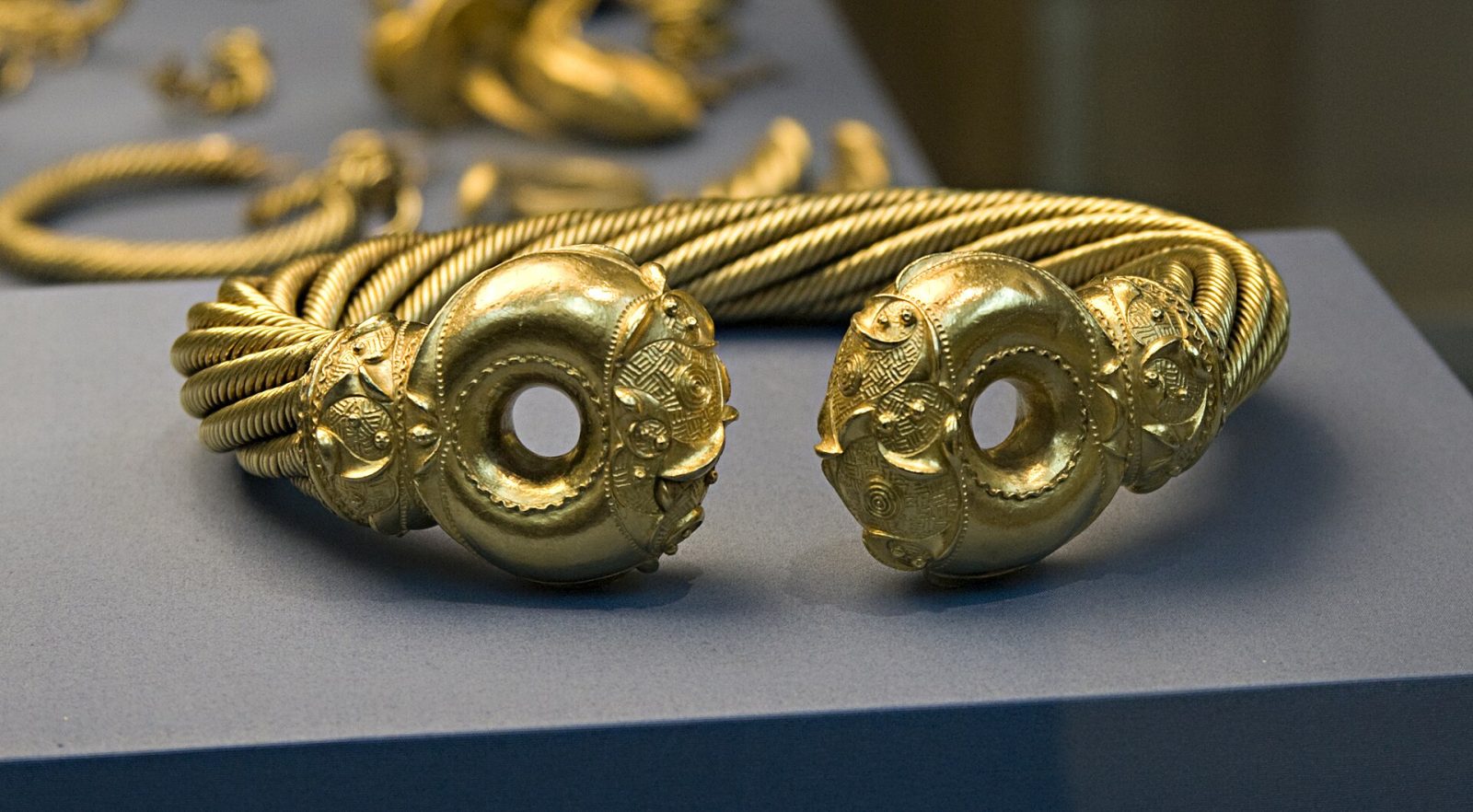
Over more than 40 years, ploughing and metal detecting at Ken Hill near Snettisham in Norfolk turned up at least 14 hoards of Iron Age gold and silver, among them the Great Torc, a masterpiece of Celtic art.
The fields at Ken Hill, near Snettisham in north-west Norfolk, have produced the largest collection of Iron Age gold jewellery found anywhere in Europe. The first find came in 1948, when a tractor ploughing the field brought up gold neck-rings, known as torcs. Two years later, in 1950, ploughman Tom Rout turned up the most famous piece of all: the Great Torc.
It is made of gold alloyed with silver and copper and weighs just over a kilogram. The neck-ring is made of 64 wires twisted into eight ropes, which are twisted together again, and it ends in two ring-shaped terminals decorated with the swirling patterns of Celtic art. A small gold coin was later found inside one of them. The British Museum dates the torc to between about 150 and 50 BC and thinks it was buried around 50 BC, though other estimates are a little earlier.
The finds kept coming. In 1990, a metal detectorist, Charles Hodder, found more than 500 fragments of gold and silver, and the British Museum excavated the site from 1990 to 1992. At least 14 separate hoards have now been found, more than 1,200 metal objects in all, including dozens of complete torcs, bracelets, ingots and coins.
Nobody knows for certain why so much gold was buried in one place. Ken Hill may have been a sacred site, or a treasury for the people who lived in the area, perhaps the Iceni, the tribe later led by Boudica. The Great Torc was declared treasure trove and bought by the British Museum, where it is on display. Other Snettisham finds are in Norwich Castle Museum.
Written for Global Finds from the British Museum, Current Archaeology and other published accounts. Photo: the Snettisham Great Torc in the British Museum, Ealdgyth, Wikimedia Commons, CC BY-SA 3.0.
Approximate location52.87, 0.51View on map
Source: British Museum