A farmer lost a hammer in his field and went looking for it with a metal detector — instead he found nearly 15,000 Roman coins
Famous find Buried shortly after AD 407 · Found in 1992 See it on the timeline →
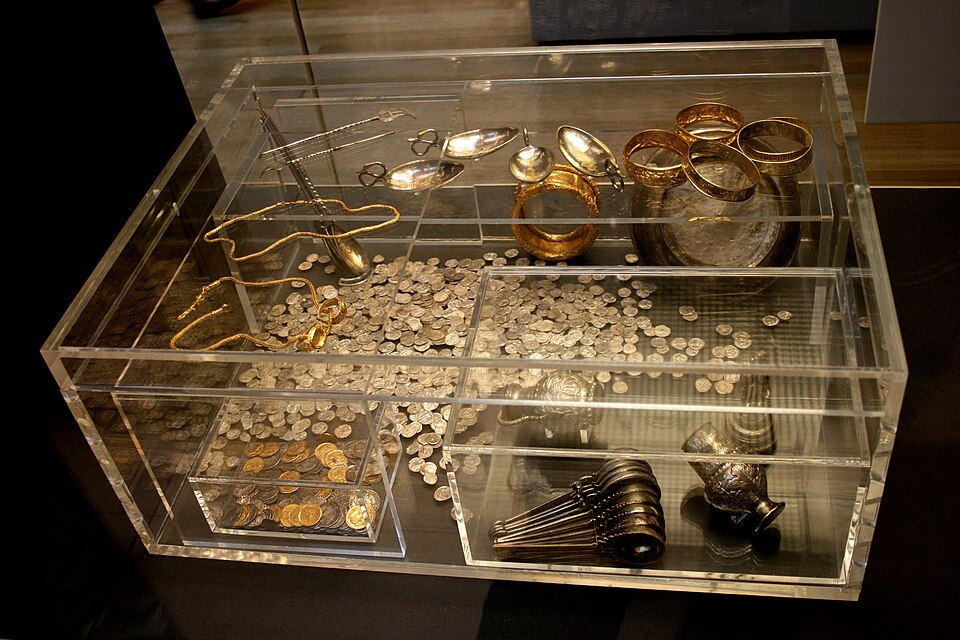
In 1992 a farmer lost a hammer and asked a friend with a metal detector to find it. He found the Hoxne Hoard instead: nearly 15,000 Roman coins and 200 pieces of gold and silver, now in the British Museum.
On 16 November 1992, the farmer Peter Whatling lost a hammer in one of his fields at Hoxne, in Suffolk, and asked his friend Eric Lawes, a retired gardener with a metal detector, to help him find it. Searching for the hammer, Mr Lawes found silver spoons, gold jewellery and coins.
He did something that made all the difference: he stopped. He and the farmer reported the find, and the next day archaeologists from Suffolk County Council excavated it, lifting the hoard in blocks of earth so that the way it had been packed could be studied.
It was the largest hoard of late Roman gold and silver ever found in Britain: 14,865 gold, silver and bronze coins and about 200 other objects, including gold jewellery and silver tableware. The remains showed it had been packed into a wooden chest, with some items in smaller boxes and wrapped in cloth. The latest coins date the burial to shortly after AD 407, around the time Roman rule in Britain was coming to an end.
In 1993, the hoard was valued at £1.75 million. The British Museum acquired it, and the reward was shared between Mr Lawes and Mr Whatling. The farmer's hammer was found as well, and it is in the British Museum too.
Hoxne is also remembered for its part in changing the law. The old law of treasure trove, which it was decided under, was widely seen as unsatisfactory, and Hoxne is often cited as one of the cases that led to the Treasure Act 1996.
Reported by ScienceBlog (2026). Written for Global Finds from that report and other published accounts of the hoard. Photo: the Hoxne Hoard on display at the British Museum, Mike Peel (www.mikepeel.net), Wikimedia Commons, CC BY-SA 4.0.
Approximate location52.35, 1.20View on map
Source: Science Blog