The Ishango Bone: a notched tool from the Congo that may be one of the oldest records of counting
Famous find Nearly 20,000 years old · Found in 1950 See it on the timeline →
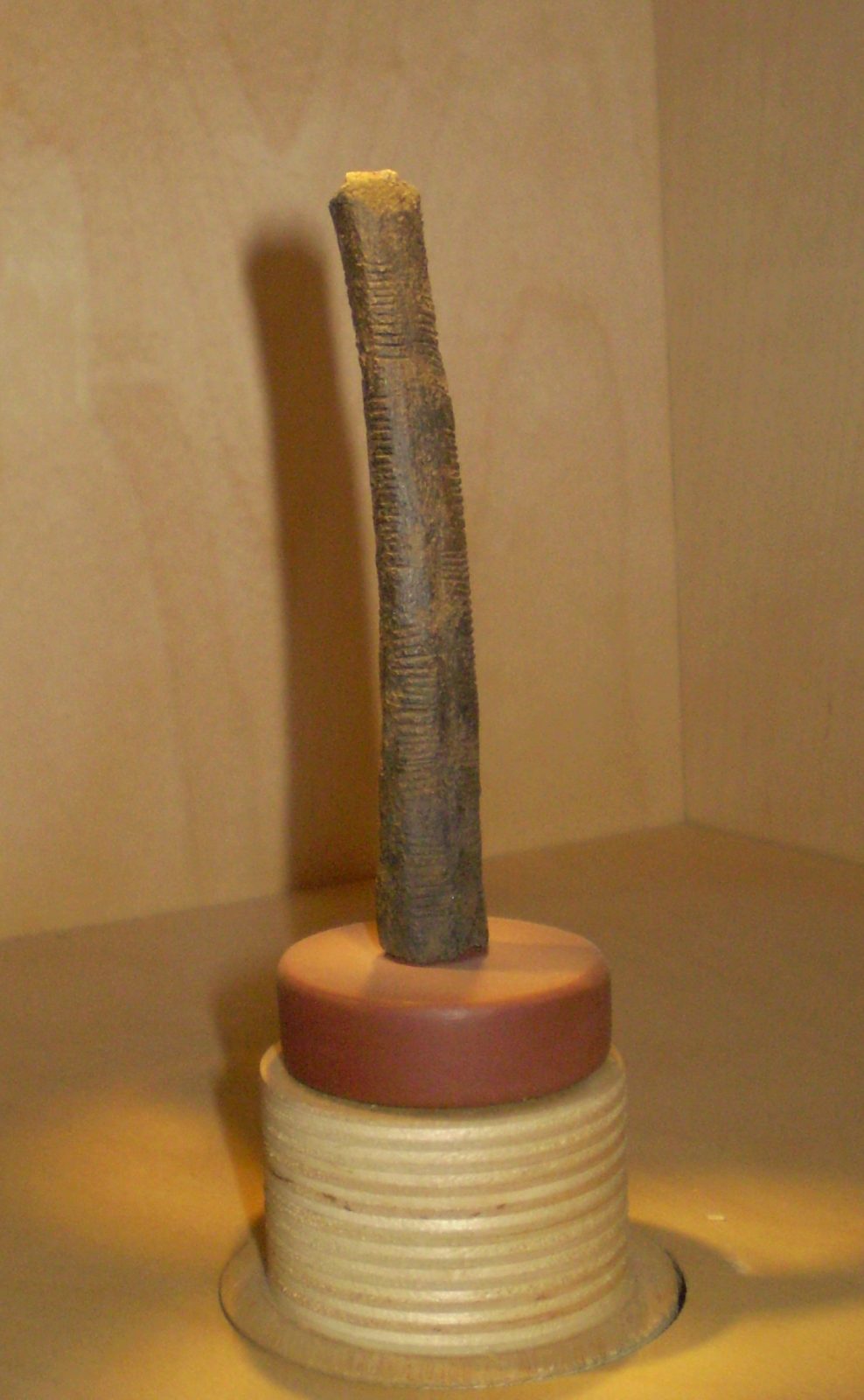
In 1950 the Belgian geologist Jean de Heinzelin excavated a small bone tool at Ishango, on the shore of Lake Edward in what is now the DR Congo. Nearly 20,000 years old, it carries 168 notches in groups that may record counting, a calendar, or neither.
In 1950, the Belgian geologist Jean de Heinzelin de Braucourt led excavations at Ishango, on the shore of Lake Edward where the Semliki River flows out of it, in what was then the Belgian Congo and is now the Democratic Republic of the Congo. Among the finds was a small, dark bone handle about 10 centimetres long, with a fragment of quartz still fixed into one end.
The quartz made it a tool for cutting or engraving, and complete prehistoric tools made from more than one material are extremely rare. But the bone is famous for something else: 168 notches cut along its sides in groups, arranged in three columns. On one face the groups run in pairs of 3 and 6, 4 and 8, and 5 and 10, each number followed by its double. The bone is often said to come from a baboon, though that is not certain.
De Heinzelin suggested that the notches showed a knowledge of arithmetic. Others have read them as a lunar calendar, and sceptics argue that they may be a tally or decoration with no deeper meaning. Two of the columns each add up to 60, and one contains the groups 11, 13, 17 and 19, the prime numbers between 10 and 20, which a recent study suggests may have been a teaching aid. None of these readings can be proved. The bone was first thought to be about 9,000 years old, but the institute that holds it now dates it to nearly 20,000 years ago.
De Heinzelin took the bone to Brussels, where it belongs to the Royal Belgian Institute of Natural Sciences. It is on display in the museum's 250 Years of Natural Sciences gallery. The site of Ishango now lies within Virunga National Park.
Written for Global Finds from the Royal Belgian Institute of Natural Sciences and J. Baur (2025, arXiv). Photo: the Ishango bone in the Museum of Natural Sciences, Brussels, Ben2, Wikimedia Commons, CC BY-SA 3.0.
Approximate location-0.13, 29.60View on map