Ötzi's Copper Axe: the only complete Copper Age axe ever found, carried by a murdered man across the Alps
Famous find Made about 3350 to 3100 BC · Found in 1991 See it on the timeline →
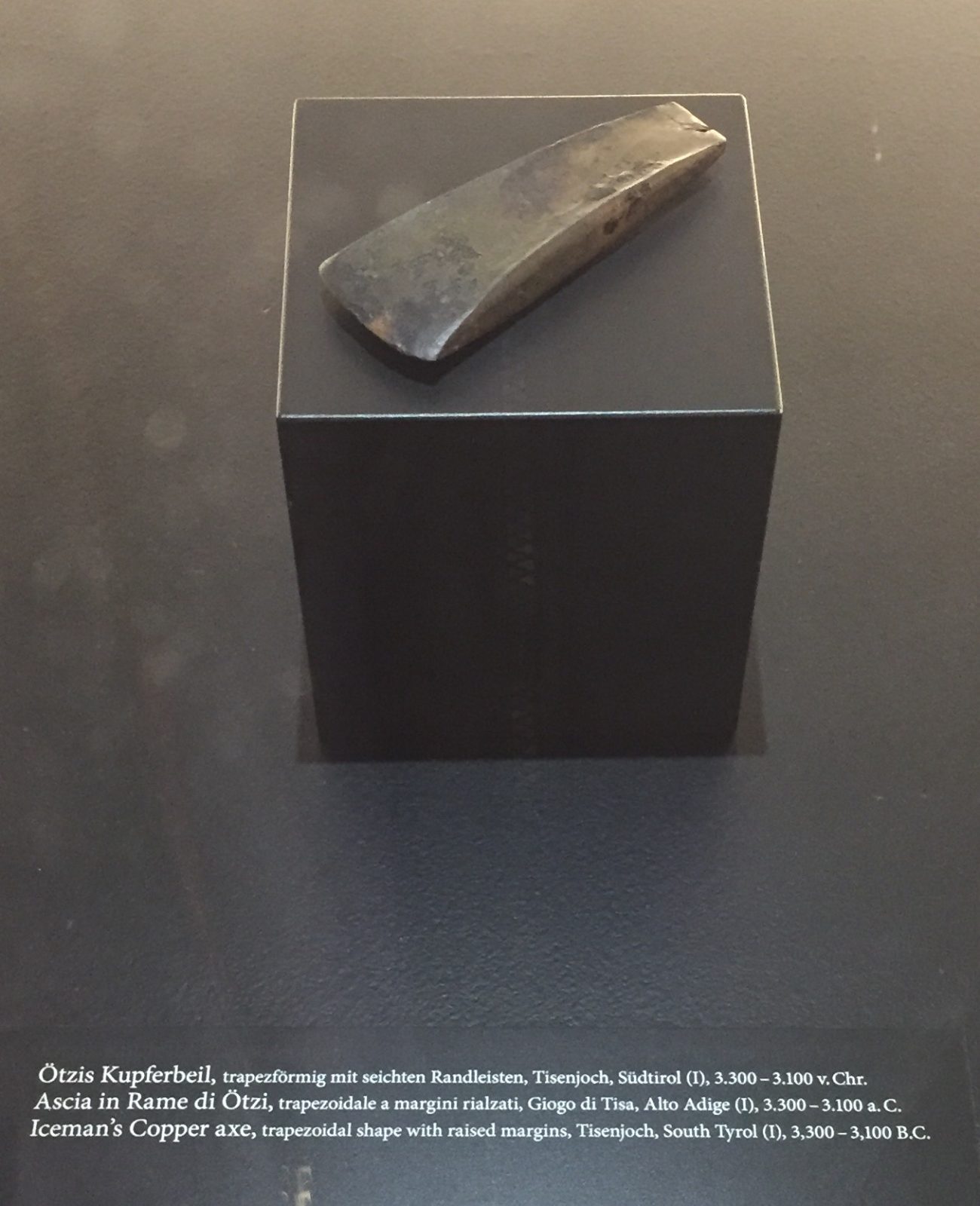
In September 1991 two German hikers found a body melting out of the ice high in the Alps. It was Ötzi, a man killed about 5,300 years ago, and with him was the only complete Copper Age axe ever found, its blade made of copper from Tuscany.
On 19 September 1991, Erika and Helmut Simon, hikers from Nuremberg, were coming down from the Fineilspitze in the Ötztal Alps when they saw a body emerging from the melting ice at the Tisenjoch pass, 3,210 metres up at the head of the Schnals valley. A first attempt to recover it the next day failed, and only an axe was brought down. The body was freed on 23 September and taken to Innsbruck, and when the archaeologist Konrad Spindler saw the axe he judged from its shape that the man had died at least 4,000 years earlier. A later survey showed that he had lain 92.56 metres inside Italy, so the find passed to South Tyrol.
The axe has a bent haft of yew about 60 centimetres long, with a blade of 99.7 per cent copper, cast and then hammered, fixed into the forked end with birch tar and tight leather straps. Wear shows it had been used and resharpened. It is the only Copper Age axe ever found complete with its haft. In 2017 researchers analysed a tiny sample from the blade and found that the copper came from southern Tuscany, around Campiglia Marittima, hundreds of kilometres away, although they could not tell whether the metal or the finished axe had made the journey.
The man, now known as Ötzi, carried an unfinished yew bow 1.82 metres long, a deer-hide quiver holding fourteen arrows, only two of them finished, a flint dagger with an ash handle in a sheath of lime bark, birch-bark containers that had carried glowing embers wrapped in maple leaves, and a fire-lighting kit of tinder fungus, flint and pyrite. Radiocarbon dating places him between about 3350 and 3100 BC. He had been killed, yet his killer left the valuable axe behind, which makes robbery an unlikely motive.
Ötzi and his original equipment have been displayed at the South Tyrol Museum of Archaeology in Bolzano since 1998. After years of legal argument, the province paid Erika Simon a finder's fee of €175,000 in 2010.
Written for Global Finds from the South Tyrol Museum of Archaeology and G. Artioli and colleagues in PLOS ONE (2017). Photo: the copper blade of Ötzi's axe in the South Tyrol Museum of Archaeology, АлександрЛаптев, Wikimedia Commons, CC BY-SA 4.0.
Approximate location46.78, 10.84View on map