The Dunaverney flesh-hook: turf-cutters in an Antrim bog found a Bronze Age feasting tool decorated with ravens and swans
Famous find Late Bronze Age, about 1050-900 BC · Found in 1829 See it on the timeline →
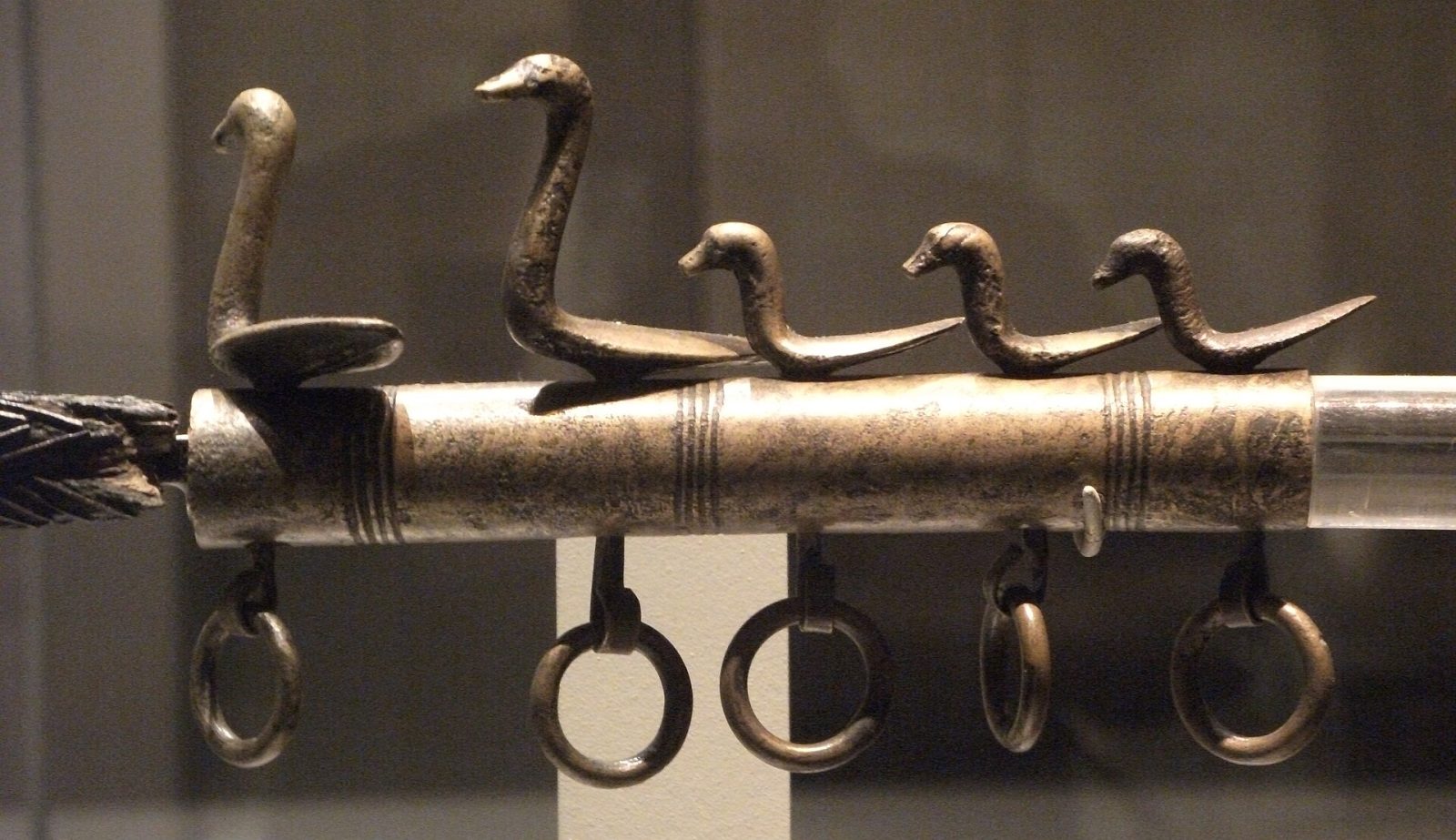
In 1829 men cutting turf in a bog at Dunaverney, near Ballymoney in County Antrim, found pieces of bronze decorated with ravens and a family of swans. It is a Late Bronze Age flesh-hook, used to lift meat from a cauldron at feasts, and is now in the British Museum.
In 1829 men cutting turf in a bog at Dunaverney, just north of Ballymoney in County Antrim, dug up some strange pieces of bronze. They were tubes, a double hook, and a row of small cast birds. By March that year the Bishop of Down had shown the find to the Royal Irish Academy in Dublin. Four years later a writer in the Dublin Penny Journal admitted he was "totally unable" to say what it had been for.
It is made of three cast-bronze tubes that once fitted over a wooden shaft, and a piece of the oak shaft survives. At one end is a double hook. Along the tubes perch two birds of the crow family, probably ravens, and a group of five waterbirds, often read as a swan with her young. The birds sit on loose pins with small rings hanging beneath them, so they could move, and perhaps jingle, when the hook was used. They were cast by the lost-wax method, rare in the British Isles at the time.
It is now known as a flesh-hook, a tool for lifting joints of meat out of a bronze cauldron at a feast. Feasting mattered a great deal in the Late Bronze Age, and cauldrons and flesh-hooks were among the finest metalwork of the time. In 2007 Sheridan Bowman and Stuart Needham published a full study of it. Only about three dozen flesh-hooks are known from the Atlantic Bronze Age, from Ireland to Iberia, and none other has birds like these. Radiocarbon dates from the oak place it between about 1050 and 900 BC. Like much fine bronze metalwork of the period, it may have been put into the bog on purpose.
After its discovery the flesh-hook passed through private hands, and the British Museum acquired it in 1856. It was lent to the Ulster Museum in Belfast until 2005, and is now in the British Museum's displays of prehistoric Europe.
Written for Global Finds from Bowman and Needham, The Antiquaries Journal (2007), the Dublin Penny Journal (1833), the Northern Ireland Archive and Stone Pages (2004). Photo: the swans on the Dunaverney flesh-hook, British Museum, Johnbod, Wikimedia Commons, CC BY-SA 4.0.