The Surgeon's House at Rimini: the largest set of Roman surgical instruments, sealed when the house burned
Famous find In use until the house burned, about AD 260 · Found in 1989 See it on the timeline →
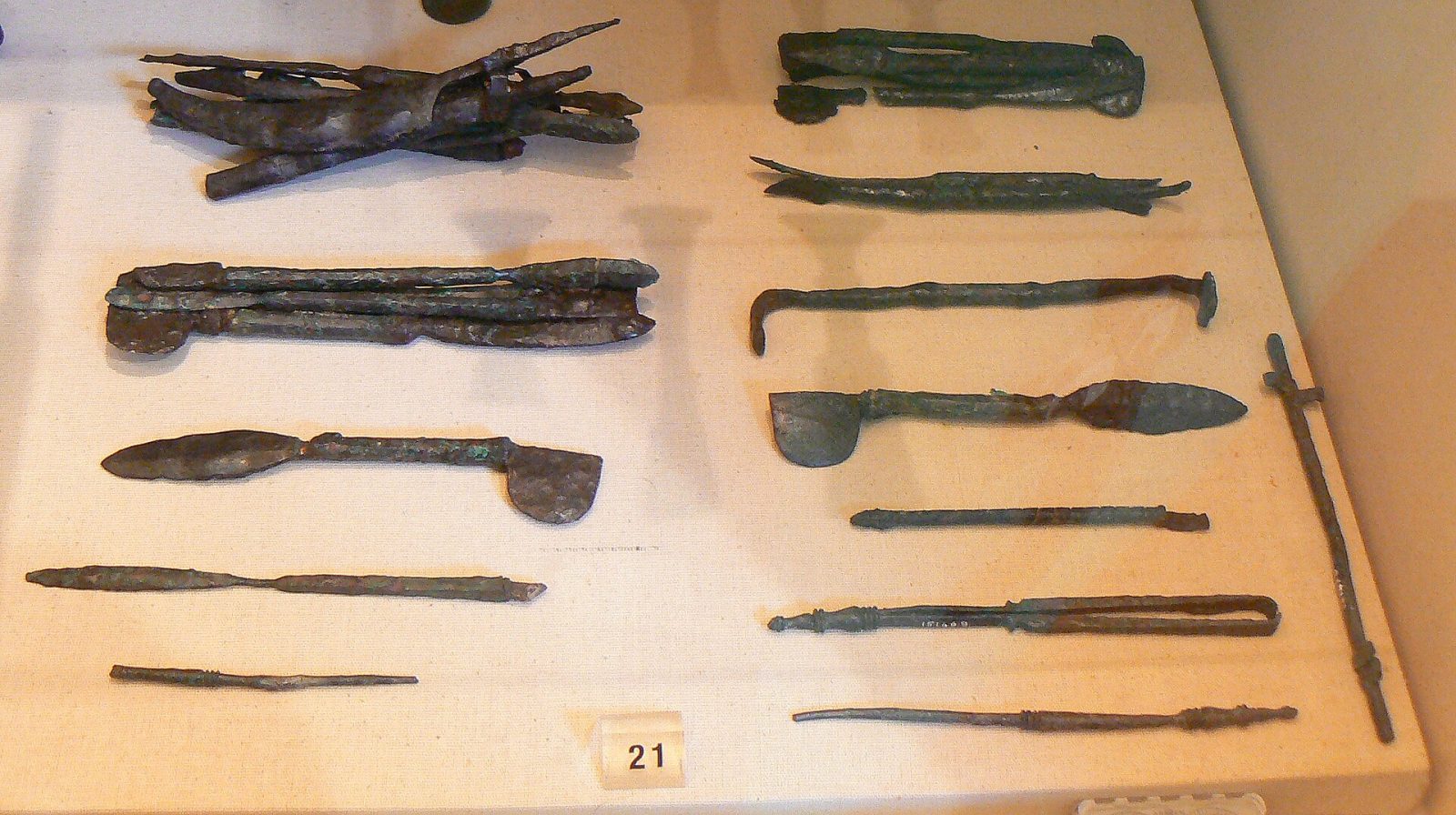
In July 1989 redevelopment work in Piazza Ferrari, Rimini, uncovered a Roman house that had burned in the mid-3rd century AD. Inside was the medical practice of a doctor probably called Eutyches, with about 150 surgical instruments, the richest set known from the ancient world.
In July 1989, redevelopment work in Piazza Ferrari, in the centre of Rimini on Italy's Adriatic coast, uncovered the remains of a Roman house. The excavation that followed, led by the archaeologist Jacopo Ortalli, lasted about ten years.
The house had two storeys and was built in the second half of the 2nd century AD, close to the walls of the Roman town of Ariminum and its harbour. It was both a home and a medical practice, with a surgery and a room where patients could recover. In the middle of the 3rd century it burned down, perhaps around AD 260, when raiders from beyond the frontier attacked northern Italy. Later a palace of the 5th and 6th centuries and then a medieval cemetery were built over the ruins, which helped to preserve them.
In the room with a mosaic of Orpheus, the excavators found about 150 instruments of bronze and iron, among them forceps, probes and spatulas, together with mortars, pestles and containers for medicines. It is the richest set of surgical instruments known from the ancient world. Many of the tools were for treating wounds and broken bones, which has led to the suggestion that the doctor had once served with the army. Two clay jars are labelled in Greek with the names of plants, and a rare picture made of coloured glass, showing three fish, came from the eastern Mediterranean. A graffito reading "Eutyches homo bonus", "Eutyches, a good man", suggests that the doctor was probably called Eutyches.
The instruments are displayed in the city's Museo della Città, beside a reconstruction of the surgery. The house itself, known as the Domus del Chirurgo, has been open to visitors under a glass and steel cover since 2007, and remained open while conservation work began in 2025.
Written for Global Finds from the Musei Comunali di Rimini, Visit Rimini, Medicina nei Secoli (2009) and La Piazza Rimini (2025). Photo: surgical instruments from the Domus del Chirurgo in the Museo della Città, Rimini, Paperoastro, Wikimedia Commons, CC BY-SA 4.0.
Approximate location44.06, 12.57View on map
Source: Musei Comunali di Rimini