The Hurbuck Hoard: a Viking-age toolkit and a gold-inlaid sword, spotted by a farmer fishing in a Durham stream
Famous find Buried around AD 900 · Found in 1870 See it on the timeline →
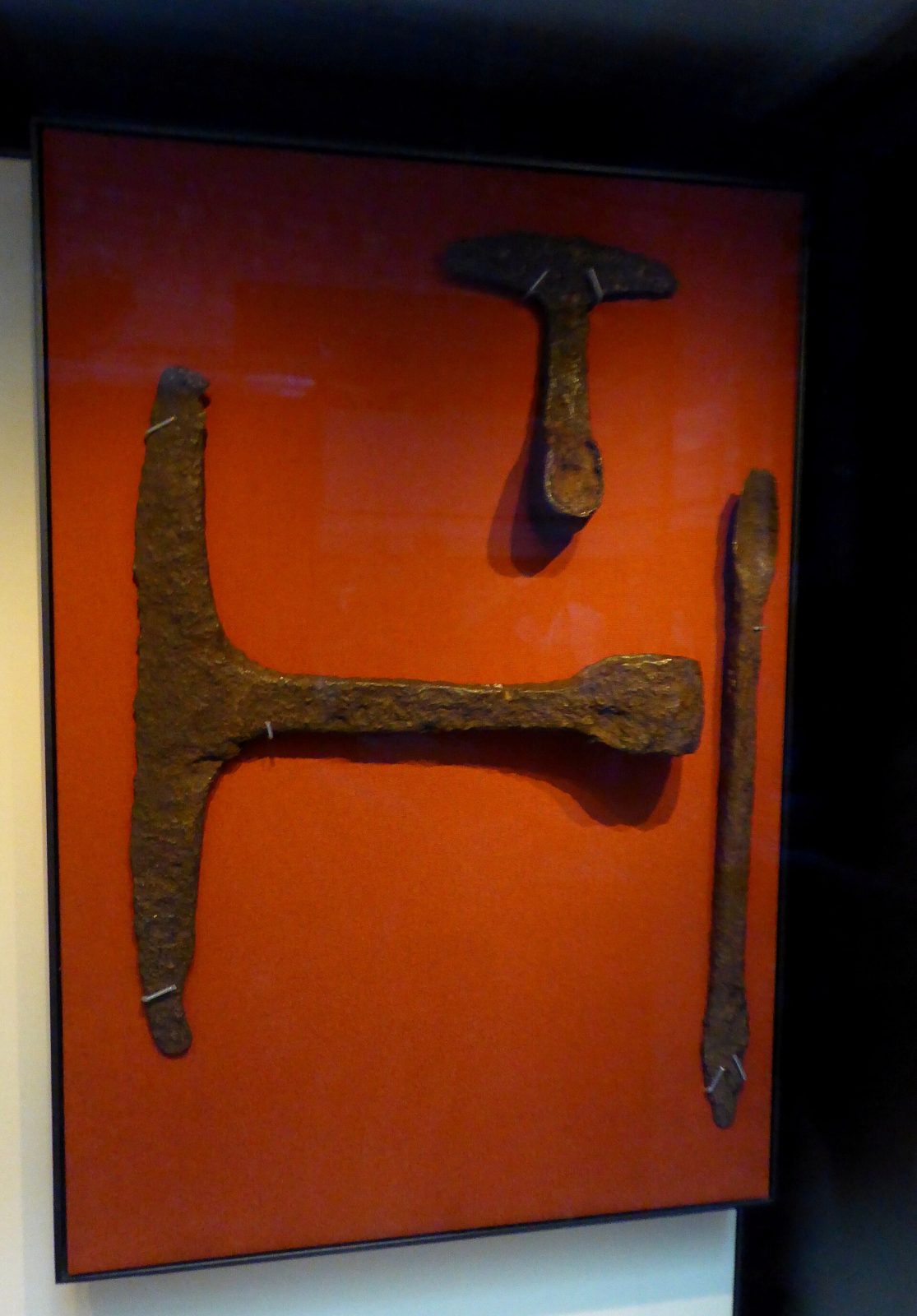
In 1870 David Balleny, the farmer at Hurbuck near Lanchester in County Durham, was fishing in the Smallhope Burn when he spotted iron objects in the bank. They were a hoard of swords, axes, scythe blades and woodworking tools buried around AD 900, now in the British Museum.
In 1870, David Balleny, the owner of the farm at Hurbuck, near Lanchester in County Durham, was fishing in the Smallhope Burn, about two miles west of the village, when he noticed iron objects in the stream bank. According to the Victoria County History of Durham, published in 1905, the find came to light that year; a later county record gives the date as 1861, but the earlier account is the more detailed.
The hoard was a collection of iron tools and weapons. There were two swords, the better a double-edged blade nearly 90 centimetres long and the other with traces of gold inlay, a single-edged knife known as a seax, four scythe blades, several axe heads of different forms, a pick shaped exactly like a miner's, an adze, a spoon bit and a borer for drilling wood, two bars, rings and a spear ferrule. The British Museum describes the sword as pattern-welded, its blade forged from twisted bars of iron, and inlaid with copper alloy.
The sword and seax date the hoard to the decades around AD 900, the time of Viking settlement in northern England. Whose it was, and why it was put in the ground, is not recorded. It may have been a smith's or a carpenter's stock, hidden for safety, and the woodworking tools are remarkable because they differ so little from Roman ones, and from tools still in use centuries later.
After Balleny's death most of the hoard stayed with his family at Little Greencroft, while two axes went to the Durham antiquary Canon William Greenwell and a scythe and an axe to a Newcastle doctor, whose pieces were lost by 1905. The British Museum bought the family's seventeen objects from Greenwell in 1912, and his own two axes came to the museum with his collection. The tools were on display in the museum's gallery of early medieval Europe in 2018.
Written for Global Finds from the Victoria County History of Durham (1905), the British Museum and Keys to the Past (Durham and Northumberland Historic Environment Records). Photo: woodworking tools from the Hurbuck Hoard in the British Museum, Ethan Doyle White, Wikimedia Commons, CC BY-SA 4.0.
Approximate location54.83, -1.78View on map