Bronze Age gold ingot found on an organised dig at Market Bosworth declared Treasure
Probably Bronze Age · Found in 2025 See it on the timeline →
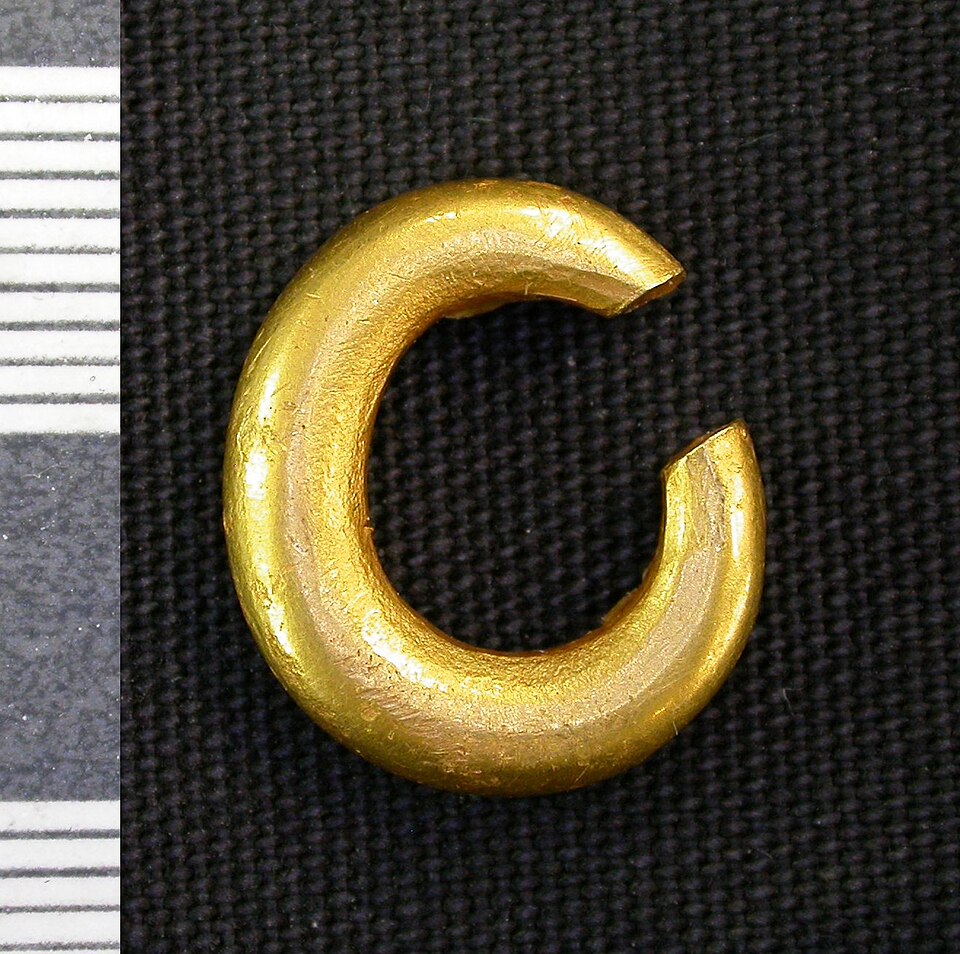
Metal detectorist Steve McKnight found a tiny coiled gold ingot on an organised dig at Market Bosworth, Leicestershire, in September 2025. A coroner has declared it Treasure, and Leicester Museum hopes to acquire it.
On 14 September 2025, Steve McKnight was taking part in an organised metal-detecting dig at Market Bosworth, in west Leicestershire, when a small gold object came out of the ground. Mr McKnight, 66, from nearby Newbold Verdon, has been detecting for about twelve years. "I'm wandering around having a look and a few little things are coming up, artefacts, broken things," he told the BBC. "And then that came out of the ground."
The object is a gold ingot: a solid cylinder of gold that has been bent into a circle of two coils. It weighs just four grams and measures 17.63 by 15.86 millimetres, and 2.07 millimetres thick. The report by the Finds Liaison Officer said that it could date from either the Bronze Age or the early medieval period, but that a prehistoric date was most likely. Small coiled and penannular gold rings of this kind are known from Bronze Age Britain, and they may have been worn, or used as a convenient way to carry and trade gold by weight.
At an inquest on Tuesday 30 September 2026, Louise Pinder, senior coroner for Rutland and North Leicestershire, declared the ingot Treasure under the Treasure Act 1996, because it is more than 300 years old and at least ten per cent precious metal. She told the inquest that Leicester Museum had expressed an interest in acquiring it. The same day, separate inquests also declared Treasure a hoard of 27 silver coins found at Ashby-de-la-Zouch and another gold ingot found at Hoton.
Mr McKnight said he was happy to see the find go to a museum. "I'm definitely going to see the one in Leicester when it gets in there," he said. "What I don't want is, you know, you give in a piece of treasure and it ends up in a drawer for ten years and then gets lost." He said he took up detecting for his love of history, with exercise coming second: "I just love the history, to think if someone dropped something 3,000 years ago and you're the first one to see it since."
Reported by BBC News (1 October 2026). Written for Global Finds from that report.
(Photo line, to add at the very end of the story, if you use the stand-in suggested below: Photo: a comparable Bronze Age gold penannular ring ('ring money') found in Leicestershire and recorded with the Portable Antiquities Scheme, not the Market Bosworth find, Leicestershire County Council, Wendy Scott, Wikimedia Commons, CC BY-SA 2.0.)
Approximate location52.62, -1.40View on map
Source: BBC News
Also reported by