The Phaistos Disc: a clay disc stamped with signs nobody can read, the oldest printed text in the world
Famous find Made about 1700 to 1650 BC · Found in 1908 See it on the timeline →
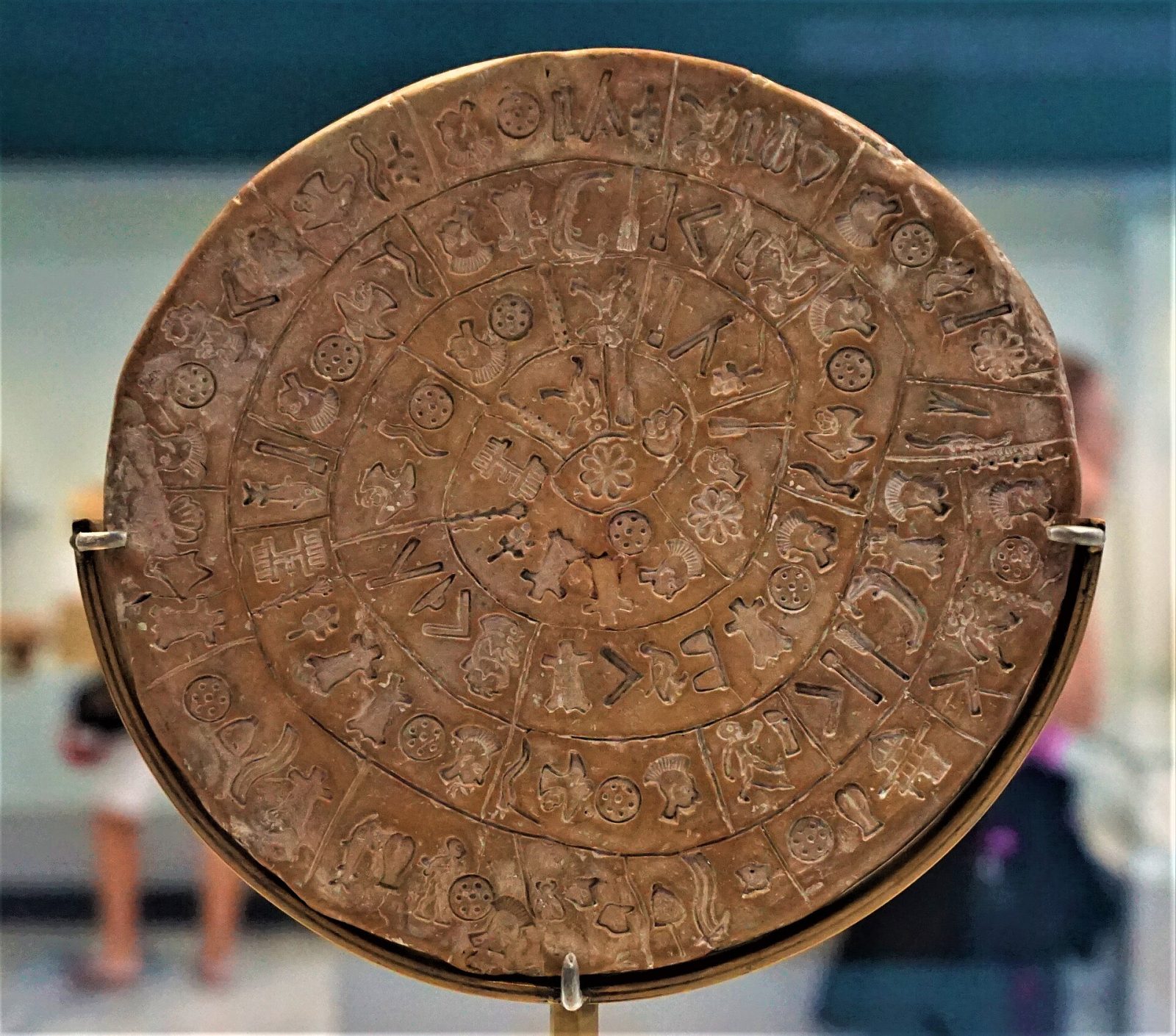
On 3 July 1908 Italian archaeologists excavating the Minoan palace of Phaistos in Crete found a small clay disc covered on both sides with a spiral of 241 stamped signs. More than a century later, nobody has read it, and a few doubt that it is genuine.
On 3 July 1908, the Italian archaeologist Luigi Pernier and his team, excavating the Minoan palace of Phaistos in southern Crete, found a small clay disc in the basement of a room in a building on the north-east side of the palace, in a dark layer of earth with burnt animal bones.
The disc is made of fired clay, about 16 centimetres across and 2 centimetres thick, and slightly egg-shaped. Both sides are covered with signs arranged in a spiral that runs from the rim to the centre, 241 of them in all, divided into 61 groups by short incised lines. A line with five dots marks the start on each side. There are 45 different signs, among them a walking man, a head with a crest of feathers, a child, birds, fish, a ship, plants and tools.
What makes the disc unique is how the signs were made. They were not drawn but pressed into the wet clay with a set of stamps, one for each sign, before the disc was fired. That makes it the oldest known text printed with movable type, more than 3,000 years before Gutenberg, and since a set of stamps implies that more than one text was made, it is all the stranger that no other has ever been found.
Nobody can read it. The signs do not match the other scripts of Bronze Age Crete, Linear A and Cretan hieroglyphic, closely enough to help, and with only one example there is no way to test a decipherment, although hundreds have been proposed. Some groups of signs repeat, which the museum suggests may point to a hymn or an incantation.
The Heraklion museum dates it to about 1700 to 1650 BC, and most scholars put it somewhere between 1850 and 1600 BC. A few have argued that it is a modern fake: in 2008 the antiquities dealer Jerome Eisenberg claimed that Pernier forged it himself. It has never been dated scientifically, but most archaeologists accept it as genuine.
The disc is displayed in the Heraklion Archaeological Museum in Crete, in the gallery of the period of the new palaces.
Written for Global Finds from the Heraklion Archaeological Museum, its online catalogue and J. Eisenberg in Minerva (2008). Photo: the Phaistos Disc in the Heraklion Archaeological Museum, Joyofmuseums, Wikimedia Commons, CC BY-SA 4.0.
Approximate location35.05, 24.81View on map
Source: Heraklion Archaeological Museum