The Norton Disney Dodecahedron: a perfect Roman puzzle dug up by community volunteers in Lincolnshire
Famous find Buried in the late 3rd or 4th century AD · Found in 2023 See it on the timeline →
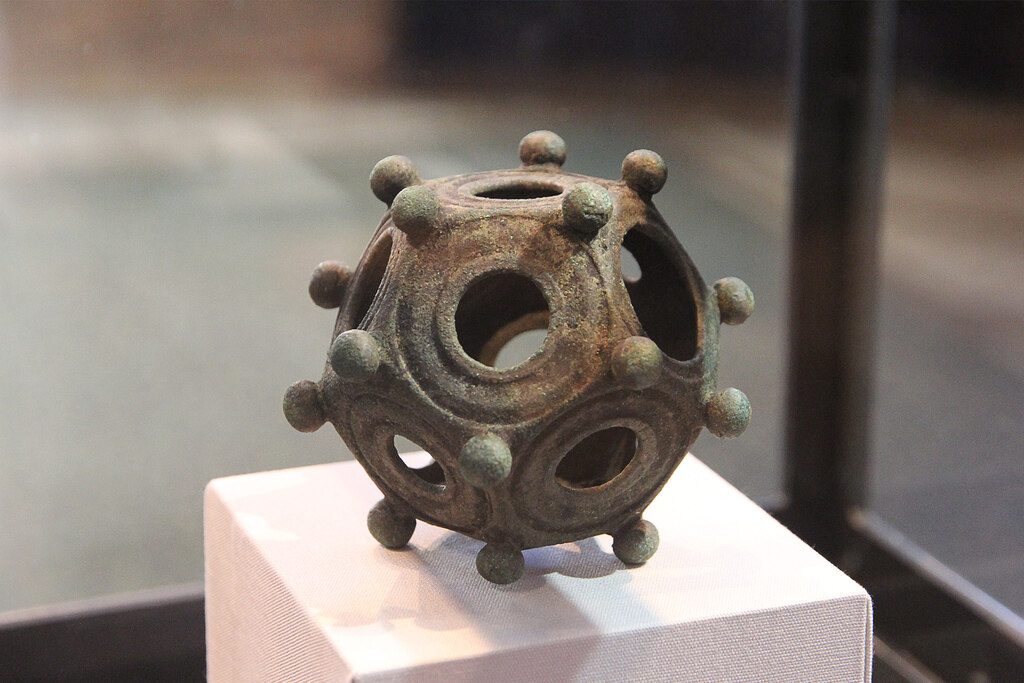
In June 2023 a volunteer on a community dig near Norton Disney in Lincolnshire uncovered a complete Roman bronze dodecahedron, a hollow twelve-sided object whose purpose nobody knows. It is one of only 33 found in Britain, and one of very few with a recorded findspot.
In June 2023, volunteers from the Norton Disney History and Archaeology Group were digging with Allen Archaeology on Potter Hill, near the Lincolnshire village of Norton Disney, a few hundred metres from a Roman villa and close to the Fosse Way. Near the end of the dig, in a trench opened only days before, a volunteer, Richard Watts, uncovered a twelve-sided bronze object about a metre down in the fill of a Roman sand-quarry pit. It was found by careful hand excavation; no metal detector was used.
The object is a Roman dodecahedron: a hollow shape with twelve five-sided faces, each pierced by a round hole of a different size, with small knobs at the corners. It is about eight centimetres across, weighs 245 grams and is complete and undamaged, with no sign of wear. It is the 33rd found in Britain and the first from the Midlands; about 130 are known from across the Roman Empire, mostly from its north-western provinces. A coin of the emperor Claudius II, struck in 268 to 270, lay above it in the pit, suggesting it was buried in the late 3rd or early 4th century AD.
Nobody knows what Roman dodecahedra were for. Suggestions include a surveying instrument, a tool for knitting gloves, a candle holder and a toy. The Norton Disney group favours a ritual or religious use. Part of the problem is that most dodecahedra have no recorded context, which makes this one, found in a dated layer on a known site, especially valuable. The archaeologist Alice Roberts called it one of the most mysterious objects she had seen up close when it featured on the BBC's Digging for Britain in January 2024.
The dodecahedron is not Treasure and has not been sold; it is lent by its owners. After spells at Lincoln Museum and the University of Nottingham Museum, it has been on display at the National Civil War Centre in Newark since January 2026.
Written for Global Finds from the National Civil War Centre, the Norton Disney History and Archaeology Group, the University of Nottingham, Current Archaeology (2025) and The Conversation (2024). Photo: the Norton Disney dodecahedron on display in Lincoln, Richard Croft, Wikimedia Commons, CC BY-SA 2.0.
Approximate location53.12, -0.68View on map