The Tomb of Philip II at Vergina: a gold chest of royal bones and a wreath of gold leaves, found unlooted in 1977
Famous find Buried in 336 BC, or about 316 BC if the tomb is Philip III's · Found in 1977 See it on the timeline →
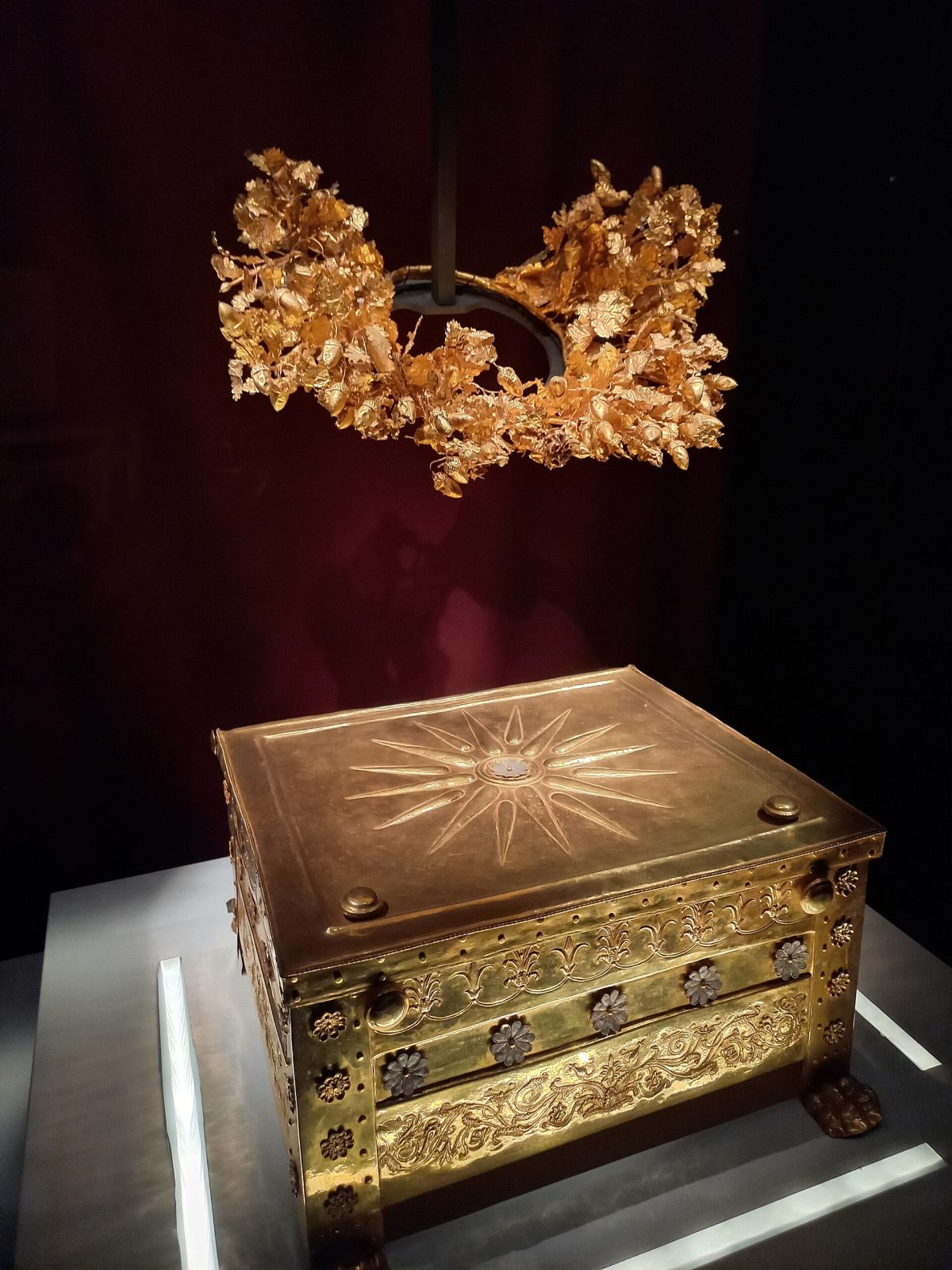
On 8 November 1977 archaeologist Manolis Andronikos entered an unlooted royal tomb beneath the Great Tumulus at Vergina in northern Greece. Inside were a gold chest of cremated bones, a gold oak wreath and armour, attributed to Philip II of Macedon, father of Alexander the Great.
On 8 November 1977, the archaeologist Manolis Andronikos of the University of Thessaloniki and his team entered an untouched tomb beneath the Great Tumulus at Vergina in northern Greece, the site of Aigai, the ancient royal capital of Macedon. The mound, about 13 metres high and 110 metres across, covered four tombs, and two of them had never been reached by robbers.
In the main chamber of the richer one, known as Tomb II, stood a marble chest. Inside it was a gold larnax, a box for bones, resting on lion's feet, with a sixteen-rayed star on its lid. It held the cremated bones of a man and a gold wreath of 313 oak leaves and 68 acorns. In the antechamber was a second, smaller gold larnax with a twelve-rayed star, holding a woman's bones wrapped in gold and purple cloth, with a gold myrtle wreath and a diadem. The tomb also held an iron cuirass decorated with gold, an iron helmet, a gold quiver, a ceremonial shield, a pair of gilded greaves of unequal length, silver vessels and small ivory heads from a funeral couch. A painted hunting scene 5.6 metres long decorated the façade.
Andronikos identified the man as Philip II of Macedon, father of Alexander the Great, who was murdered in 336 BC, and the uneven greaves have been linked to a leg wound Philip is known to have suffered. Other scholars, notably the anthropologist Antonis Bartsiokas, have argued that Tomb II holds Philip III Arrhidaeus, Alexander's half-brother, and his wife, reburied around 316 BC, and that Philip II lies in Tomb I. The Greek Ministry of Culture rejected that claim in 2015, and the debate continues. The sixteen-rayed star, known as the Vergina Sun, has become a national symbol.
The finds belong to the Greek state and are displayed in the Museum of the Royal Tombs of Aigai, built over the tombs in the shape of a mound. Aigai became a UNESCO World Heritage Site in 1996.
Written for Global Finds from the Greek Ministry of Culture (Cultural Egnatia), National Geographic (2015), Live Science (2024) and the Hellenic Philatelic and Postal Museum. Photo: the gold larnax and oak wreath from Tomb II in the Museum of the Royal Tombs of Aigai, Andres.bustillo, Wikimedia Commons, CC BY-SA 4.0.
Approximate location40.48, 22.32View on map