The Kensington Runestone: a Viking message dated 1362, pulled from tree roots on a Minnesota farm and argued over ever since
Famous find Dated 1362 on its face; probably carved in the 1890s · Found in 1898 See it on the timeline →
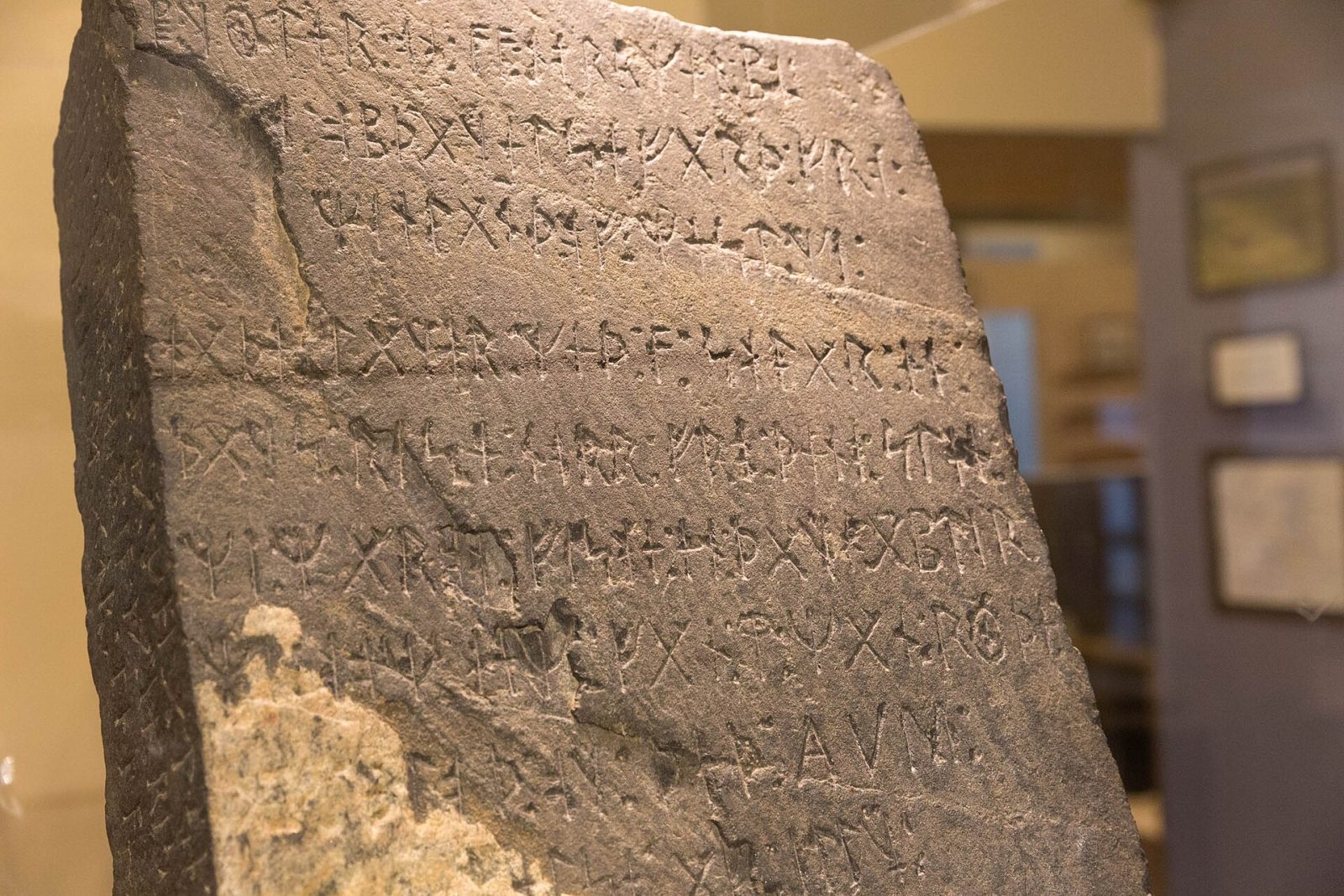
In November 1898 Swedish immigrant farmer Olof Öhman found a stone carved with runes in the roots of a tree on his Minnesota farm. It told of Norse explorers massacred in 1362. Most experts think it was carved in the 1890s, but it has never been proved.
In November 1898, Olof Öhman, a Swedish immigrant farmer, and his men were clearing tree stumps on a knoll on his land near Kensington, in Douglas County, Minnesota. The state historical society's committee later gave the date as 8 November. Under the roots of a poplar lay a flat slab of stone, face down about six inches deep, with the roots wrapped around it. When it was turned over, its face and one edge were found to be covered in runes.
The stone is a slab of greywacke about 30 inches tall, weighing around 200 pounds. Translated, the inscription tells of eight Goths, meaning Swedes, and 22 Norwegians on a journey of exploration west from Vinland. They camped by a lake, went fishing for a day, and came back to find ten of their men red with blood and dead. It invokes the Virgin Mary, says that ten more men had been left with the ships fourteen days' journey away, and gives the year as 1362.
If it were genuine, Norse explorers would have reached the middle of North America 130 years before Columbus. Scholars said no almost at once. In 1899 runologists dismissed it as a modern carving, pointing to runes, grammar and words that belonged to 19th-century Scandinavian speech rather than the 14th century.
The stone did not go away. In 1907 the historian Hjalmar Holand acquired it and championed it for decades, and a Minnesota Historical Society committee that reported in 1910 leaned towards accepting it. It was shown at the Smithsonian Institution and at the New York World's Fair of 1964 to 1965. In 2003 the geologist Scott Wolter argued that the weathering of the carving showed it to be more than 200 years old, a claim that others strongly dispute.
Most experts think it was carved in the 1880s or 1890s. Suspicion has fallen on Öhman himself, who owned books on runes, perhaps with his friend Sven Fogelblad, a former pastor, but Öhman never admitted to a hoax and nothing has been proved. The stone is displayed in the Runestone Museum in Alexandria, Minnesota.
Written for Global Finds from MNopedia (Minnesota Historical Society), the Minnesota Historical Society committee report (1910) and MinnPost (2020). Photo: the Kensington Runestone in the Runestone Museum, Alexandria, Lorie Shaull, Wikimedia Commons, CC BY 2.0.
Approximate location45.81, -95.67View on map