The Nanteos Cup: the Welsh 'Holy Grail', half eaten by the sick, stolen from a sickbed and handed back on neutral ground
Famous find Made in the 14th or 15th century See it on the timeline →
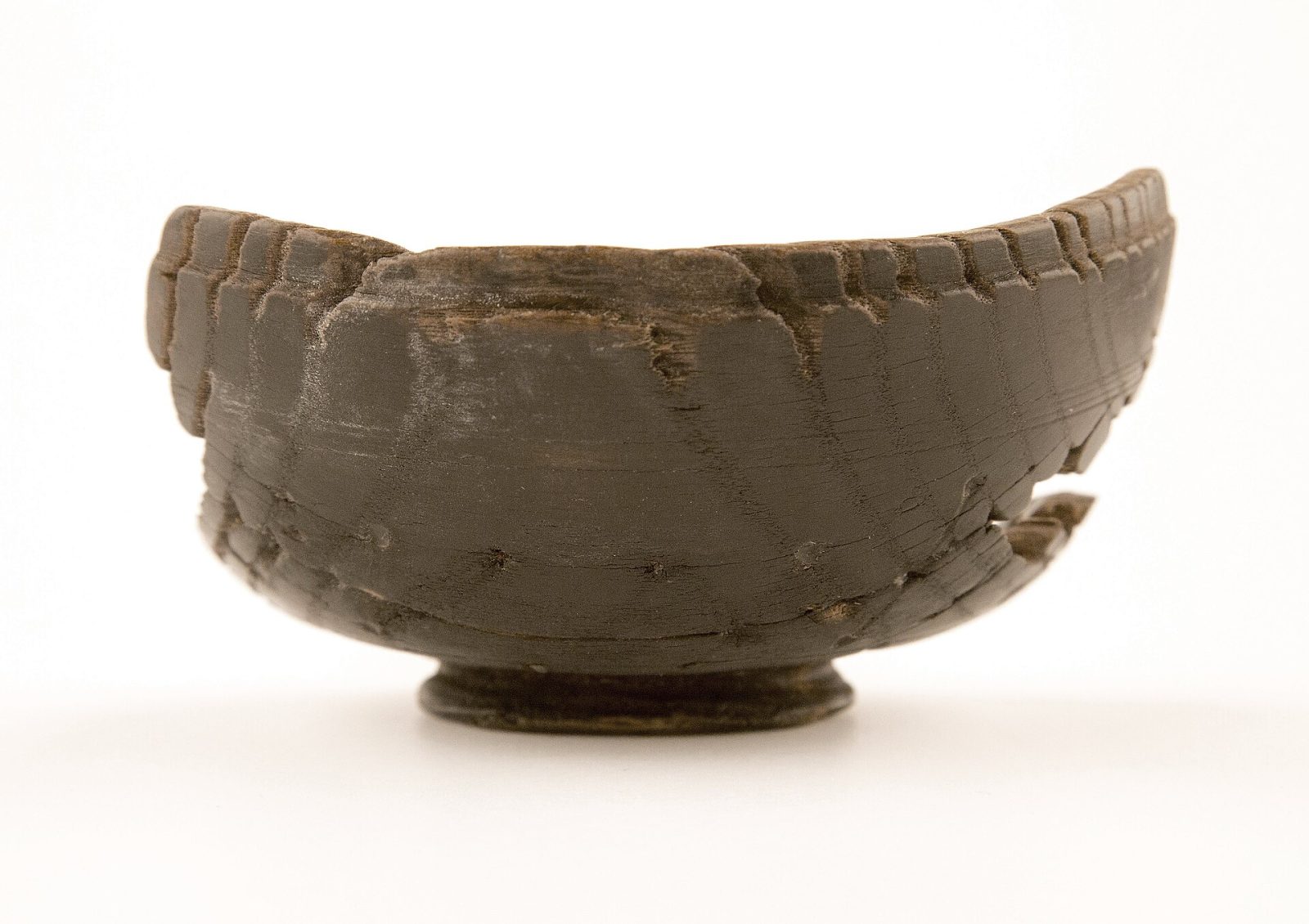
The Nanteos Cup is the broken half of a medieval wooden bowl, kept for generations at Nanteos mansion near Aberystwyth and lent to the sick to drink from. Legend made it the Holy Grail; experts call it a 14th or 15th-century mazer. Stolen in 2014, it was returned in 2015.
The Nanteos Cup is a little under half of a small turned wooden bowl, about 12 centimetres across, made of wych elm. It has a flat foot and a groove around the lip where a metal rim once sat. Its edges are ragged because, for generations, sick people who borrowed it bit splinters from the rim to keep as relics.
Legend says that seven Cistercian monks carried it from Strata Florida Abbey to Nanteos, a mansion near Aberystwyth, when the abbey was dissolved in 1539, and that the last of them gave it to the family of the house. A later version had the monks coming from Glastonbury with a cup carved from the True Cross, and by the 1890s people were calling it the Holy Grail. The experts are less romantic. The cup was first shown in public in 1878, at a meeting of the Cambrian Archaeological Association, which catalogued it as a medieval mazer, an ordinary drinking bowl of the kind used in monasteries from the 11th to the 16th century. The folklorist Juliette Wood thinks it most likely turned up during 19th-century repair work at Strata Florida and was kept as a curiosity; the National Library of Wales dates it to between 1300 and 1500, and the historian Richard Barber has written that no evidence for the legend has ever been produced. Nobody recorded when or where it was found.
What is certain is that from at least the mid-1800s the family lent it to the sick, against a pledge such as a gold watch. The paper slips survive, recording each borrower, the pledge, the date of return and the cure, which was always reported as successful.
In July 2014 the cup was stolen in a burglary from a house near Ross-on-Wye, where it had been lent to a seriously ill woman. After a BBC Crimewatch appeal, it was handed to the police on neutral ground on 19 June 2015, and nobody was ever charged. The Powell family placed it in the care of the National Library of Wales in Aberystwyth, where it went on display in 2016. The Library says it will be off display until spring 2027.
Written for Global Finds from the National Library of Wales, J. Wood (The Healing Cup of Nanteos), BBC News (2015) and the Ross Gazette (2016). Photo: the Nanteos Cup, photographed by the National Library of Wales, Wikimedia Commons, CC0.
Approximate location52.39, -4.03View on map
Source: National Library of Wales