Saddle Ridge Hoard: 1,427 gold coins found on a California property
Famous find Coins dated 1847 to 1894; buried some time after · Found in 2013 See it on the timeline →
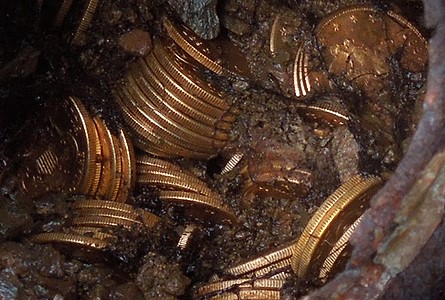
Walking their dog on their own land in 2013, a California couple spotted a rusty can sticking out of the ground. It was the first of eight, holding 1,427 gold coins worth about $10 million.
In February 2013, a couple in northern California, who have only ever been identified by the names John and Mary, were walking their dog along a path on their own property, one they had walked hundreds of times. Where the ground had eroded, they noticed the rusty lid of a metal can sticking out.
The can was full of gold coins. Over the following days, using hand tools and a metal detector, they found eight cans in all, holding 1,427 American gold coins: 1,373 twenty-dollar pieces, 50 ten-dollar pieces and four five-dollar pieces, dated from 1847 to 1894. Their face value was $27,980.
What made them extraordinary was their condition. Many had hardly circulated, and the coin grading service PCGS found more than a dozen to be the finest or joint-finest known examples of their kind. The hoard, named Saddle Ridge after the spot, was valued at about $10 million, the largest buried hoard of American gold coins ever found.
There was speculation that it was loot from a theft at the San Francisco Mint in 1901, but the US Mint said it had no information linking the coins to any theft. Who buried them, and why, is still unknown.
Because the land was theirs, the coins belonged to the couple. Through the coin dealer Kagin's, most were sold, largely through Amazon, while the family kept a few as heirlooms and planned to use the money to pay off debts and give to charity.
Reported by ScienceBlog (2026). Written for Global Finds from that report and published accounts of the hoard. Photo: Saddle Ridge Hoard coins in their can as found, Kagin's Inc., Wikimedia Commons, CC BY-SA 3.0.
Approximate location37.00, -120.00View on map
Source: National Geographic
Also reported by