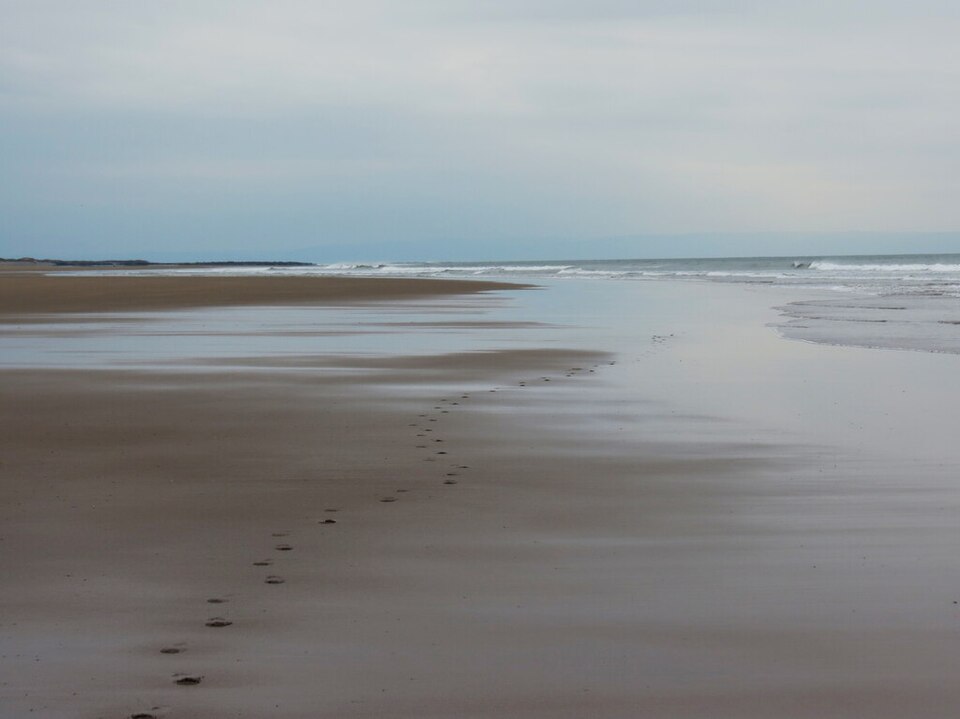
Margam beach, Alan Richards, geograph.org.uk via Wikimedia Commons, CC BY-SA 2.0.
Over 21 years and more than 1,000 visits to Margam beach, detectorist Peter Hughes recovered around 870 coins from a ship wrecked in 1583. The collection is now on show in Swansea.
In 1583 the Ann Francis carried a cargo of grain to Spain. On the way home, carrying the payment, she was caught in a violent storm on 28 December 1583 and wrecked off Margam, in what is now Neath Port Talbot.
More than four centuries later, metal detectorist Peter Hughes began finding her cargo. His first find, in 1996, was a Portuguese gold coin, a São Vicente struck between 1555 and 1557 under King John III. He at first took it for a token, until he turned it over and saw the shield of Portugal.
Over the next 21 years, Mr Hughes went back to Margam beach more than 1,000 times, searching whenever storms stripped away the sand that covered the wreck site. Most visits found nothing. In all, he recovered around 870 gold and silver coins, including gold coins of Ferdinand and Isabella of Spain, along with personal belongings, cooking, eating and drinking utensils, a boatswain's whistle and a brass combination lock from one of the ship's chests. The lock's code has never been cracked.
It is thought that only about a quarter of the money on board has been found. Mr Hughes contacted Amgueddfa Cymru, the national museum of Wales, and the collection has now gone on public display for the first time at the National Waterfront Museum in Swansea. The museum says there are contemporary records of the wreck too, telling of sailors, looters, local lords, a smuggler and a woman accused of witchcraft.
The stretch of beach is now a protected site, to preserve whatever remains of the ship, so it is no longer legal to search there.
Reported by BBC News (5 July 2026). Written for Global Finds from that report. Photo: Margam beach, Alan Richards, geograph.org.uk via Wikimedia Commons, CC BY-SA 2.0.
Those four are for England and Wales, where the Portable Antiquities Scheme records finds and the Treasure Act decides what must be reported.
Scotland runs its own system, and every find is reportable there — not only treasure. Treasure Trove Unit ›
The Republic of Ireland is different again, and severely so. Searching for archaeological objects without the Minister’s written consent is a criminal offence carrying fines or imprisonment, and the definition is broad enough to cover coins, buttons and buckles of almost any age. Do not assume British rules travel with you. The law, from the National Museum ›
Northern Ireland is stricter still. The Treasure Act applies and finds go to National Museums NI within fourteen days, but any searching that involves digging — metal detecting expressly included — needs a licence, and licences are only granted for archaeological projects. National Museums NI ›
This site covers discoveries from all over the world, and so does the variation in the law — from a recording scheme that thanks you, to a criminal offence. Wherever you are searching, find out what applies there before you go, not after.