The Lewis Chessmen: medieval chess pieces hidden in a Hebridean sandbank
Famous find Made about 1150 to 1200 · Found in 1831 See it on the timeline →
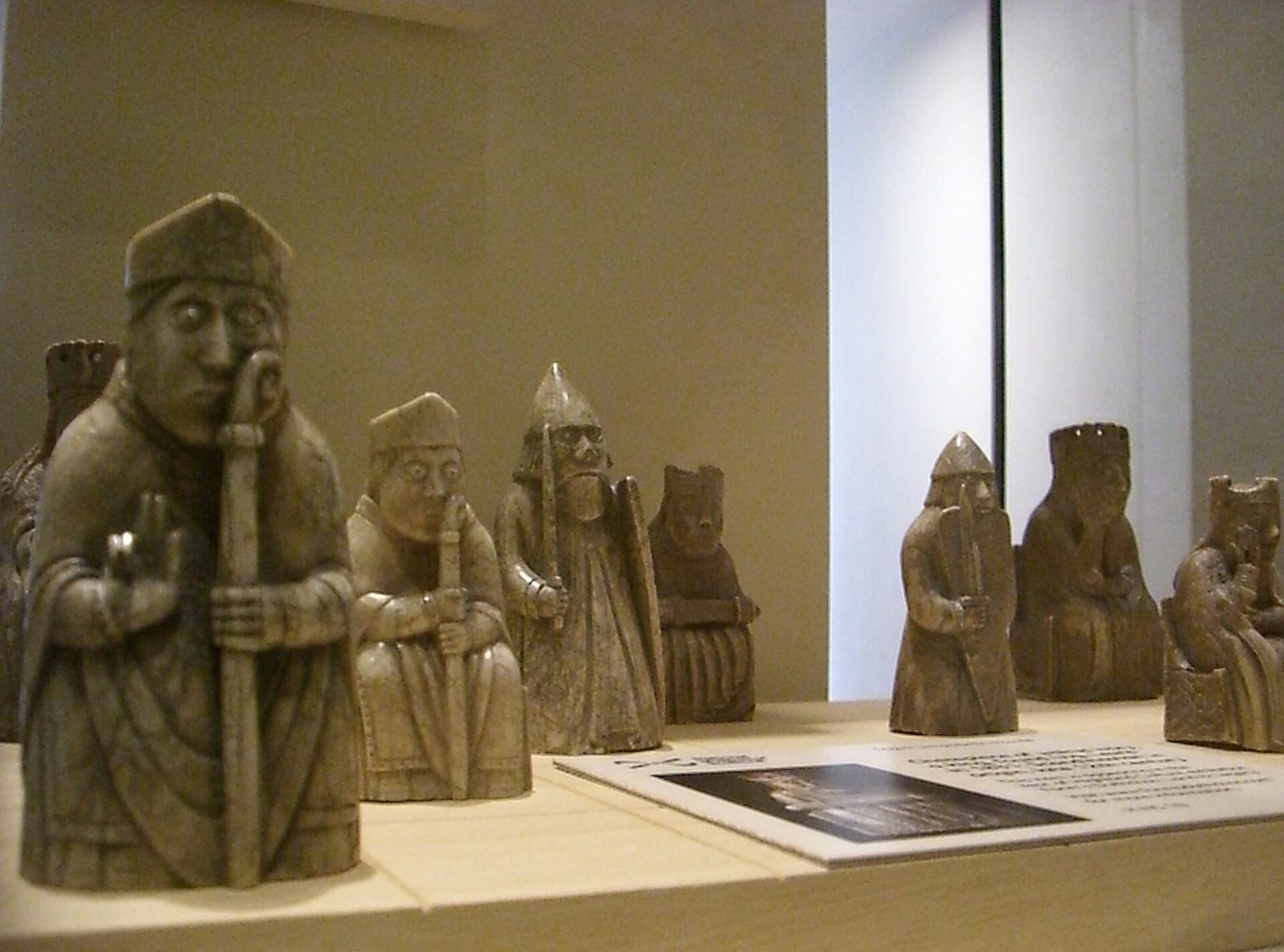
Found on the Isle of Lewis by 1831, the Lewis Chessmen are 93 pieces carved from walrus ivory and whale tooth in the late 1100s, among them the famous shield-biting warriors. They are now split between London and Edinburgh.
Some time before April 1831, a hoard of carved chess pieces came to light in the parish of Uig, on the west coast of the Isle of Lewis in the Outer Hebrides. They had been hidden in a small stone chamber in a sandbank. How they were found, and by whom, is not certain: the finder was later named as Malcolm MacLeod, but that name was first written down more than 30 years afterwards, and scholars still debate the exact spot.
They were shown to the Society of Antiquaries of Scotland in Edinburgh in April 1831. Today there are 93 pieces: 78 chessmen, 14 plain discs for another board game, and a buckle. The chessmen include kings, queens, bishops, knights, warders and pawns, mostly carved from walrus ivory and some from whale tooth. Their faces are unforgettable: glum kings with swords across their knees, queens resting their cheeks on their hands, and warders biting the tops of their shields like the berserker warriors of Norse saga.
They were made between about 1150 and 1200, dated by the style of their carving, and were probably carved in Norway, perhaps in Trondheim. The Hebrides were ruled by Norway at the time, and stayed so until 1266. Why enough pieces for several sets were hidden in a sandbank on Lewis is unknown; a merchant's stock is one suggestion.
The British Museum bought 82 pieces in 1831. The other 11 went into a private collection and reached what is now National Museums Scotland later in the century. The split has led to calls for the chessmen to be reunited in Scotland, and some of the British Museum's pieces have been lent to the museum at Lews Castle in Stornoway. In 2019 a previously unknown warder, thought to be one of the pieces missing from the original find, was sold at Sotheby's for £735,000.
Written for Global Finds from the British Museum, National Museums Scotland and other published accounts. Photo: Lewis chessmen in the British Museum, Jessica Spengler, Wikimedia Commons, CC BY 2.0.
Approximate location58.19, -6.96View on map
Source: British Museum