The Vulchitrun Treasure: twelve kilograms of Bronze Age gold from a Bulgarian vineyard, snipped with shears to test it
Famous find Made about 1500 to 1000 BC · Found in 1924 See it on the timeline →
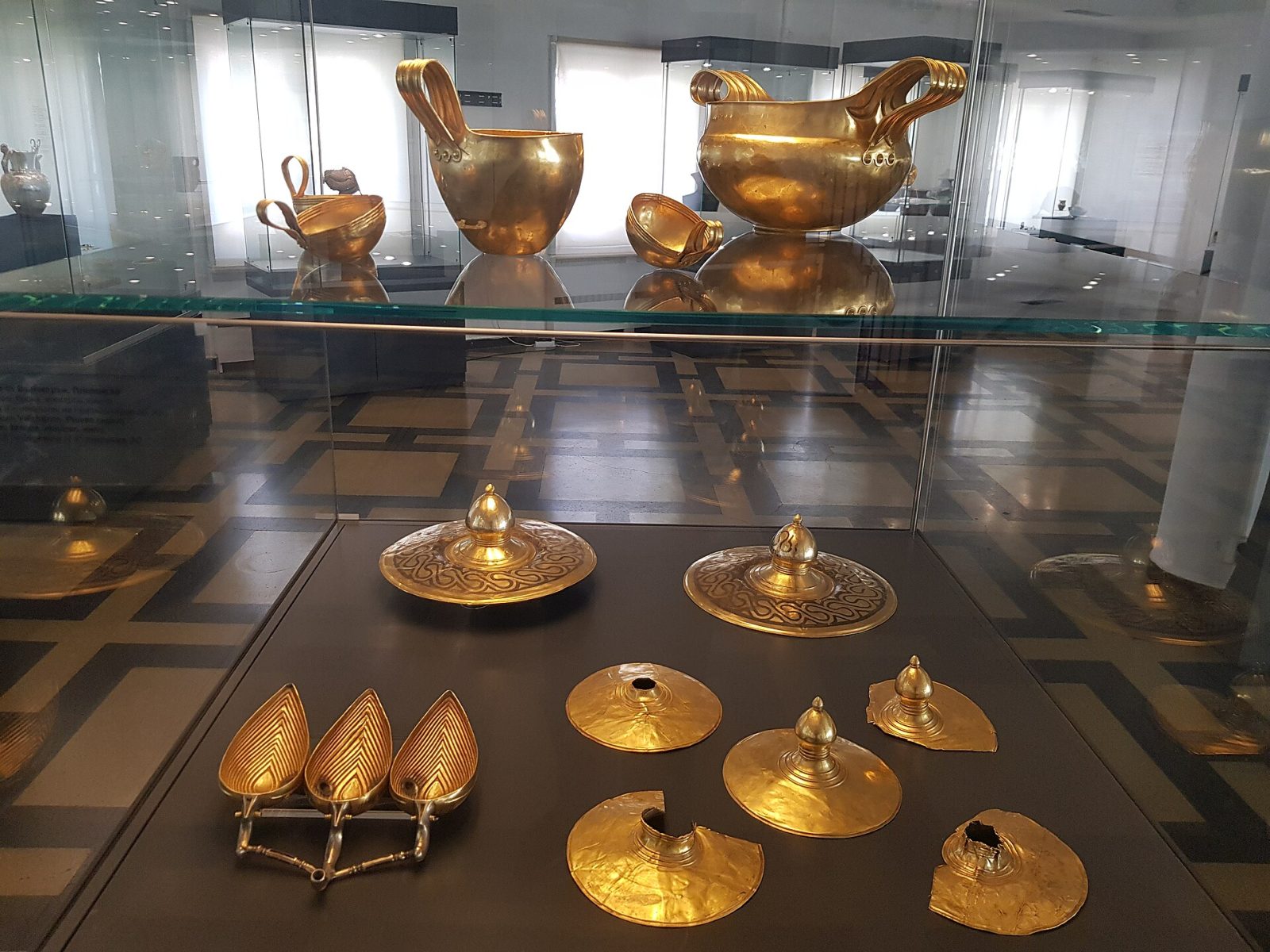
On 28 December 1924 two brothers working their vineyard near Valchitran in northern Bulgaria dug up thirteen gold vessels weighing about 12.5 kilograms. Unsure it was gold, they cut pieces off with vineyard shears. It is the heaviest Thracian gold treasure ever found in Bulgaria.
On 28 December 1924, the brothers Todor and Nikola Tsvetanov were working in their vineyard near the village of Valchitran, about 22 kilometres south-east of Pleven in northern Bulgaria, when their tools struck metal only about 30 centimetres down. They dug out a set of yellow metal vessels.
They were not sure it was gold, and to find out they cut pieces off some of the lids with their vineyard shears. A popular story adds that the largest bowl served for a while as a pig trough. A goldsmith in Pleven confirmed that the metal was gold and told the National Archaeological Museum, and on 7 January 1925 the treasure was taken to Sofia. The pieces cut off with the shears were never recovered.
There are thirteen vessels, weighing about 12.5 kilograms in all, of gold about 88 per cent pure. The largest is a two-handled cup that weighs about 4.5 kilograms on its own. With it are four one-handled cups, one large and three small, seven lids or discs of different sizes, the two biggest decorated with dark spirals, and the strangest piece of all: a triple vessel of three leaf-shaped cups joined to one another by small tubes and lifted by a single handle.
When and where the vessels were made is still argued over. The J. Paul Getty Museum dates them to about 1500 to 1000 BC, in the Late Bronze Age; some Bulgarian scholars place them earlier, between 2000 and 1600 BC, and their origin has been sought in the lands of the middle Danube, in Anatolia and in Mycenaean Greece. They are generally thought to have been made for ceremonies rather than everyday use, perhaps for pouring offerings or for feasting.
The treasure is held by the National Archaeological Institute with Museum in Sofia, and it travels. It was shown at the National History Museum in Sofia in 2022, and in November 2024 it went to the Getty Villa in Los Angeles, where the exhibition closed early in January 2025 when the Palisades fire forced the museum to shut. The regional museum in Pleven displays a replica.
Written for Global Finds from the J. Paul Getty Museum (2025), BNT (2022) and the Bulgarian News Agency. Photo: the Vulchitrun Treasure in the National Archaeological Museum, Sofia, Јакша, Wikimedia Commons, CC BY-SA 4.0.
Approximate location43.33, 24.87View on map
Source: J. Paul Getty Museum