Detectorist who found the Peebles Hoard finds a second Bronze Age hoard seven miles away
Late Bronze Age, about 1150 to 850 BC · Found in 2022 See it on the timeline →
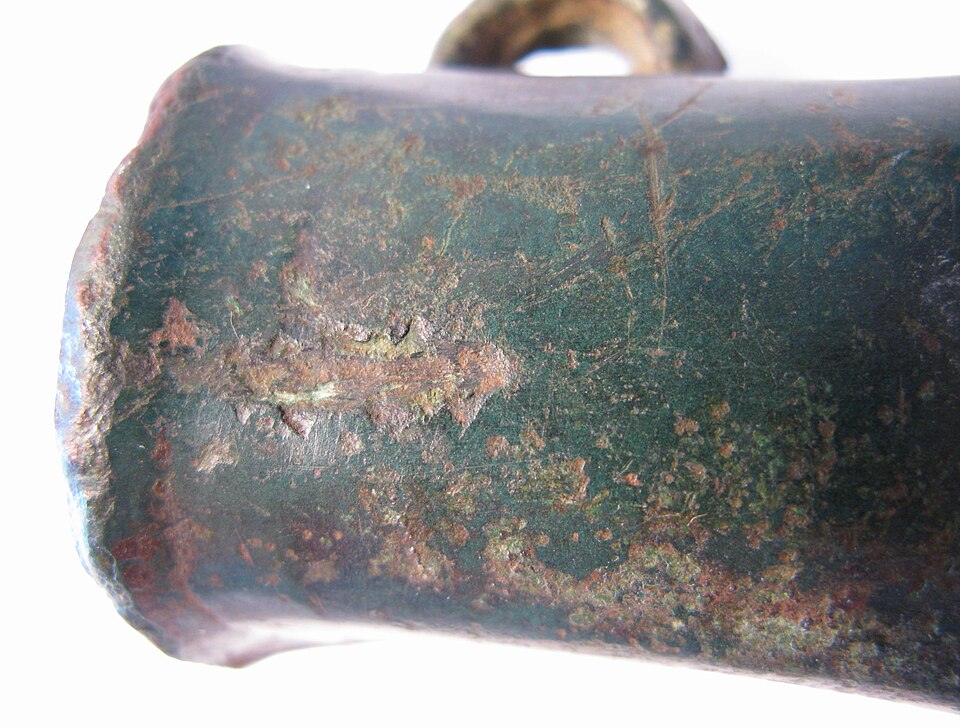
Mariusz Stepien, who found the famous Peebles Hoard in 2020, has revealed a second Late Bronze Age hoard found in 2022 seven miles away in the Scottish Borders. The Blyth Hoard includes bronze axe-heads, clay moulds and Scotland's first complete copper ingot.
In 2020, metal detectorist Mariusz Stepien found a Bronze Age hoard in a field near Peebles, in the Scottish Borders, that turned out to include a complete horse harness. Two years later, in 2022, at a spot about seven miles away, he made another discovery. He has now revealed it, and he calls it "quite extraordinary".
After first detecting a bronze axe-head, Mr Stepien saw other bronze objects in the ground. He stopped and reported the find to Scotland's Treasure Trove Unit, which called in archaeologists from National Museums Scotland. Their excavation also uncovered an ancient stone cairn.
The new find, named the Blyth Hoard, dates from the Late Bronze Age, between about 1150 and 850 BC. It contains two bronze axe-heads and a complete copper ingot, said to be the first of its kind found in Scotland. It also contains clay moulds, which may have been used to cast some of the unusual bronze fittings in the Peebles Hoard. Dr Matthew Knight, curator of Bronze Age collections at National Museums Scotland, said: "This is one of those classic archaeological finds that initially doesn't look like much, but is actually really incredible and has many stories to tell." He added that it is "really rare for mould materials to survive at all", and that the link with the Peebles Hoard "makes it all the more extraordinary".
The Peebles Hoard was excavated over 22 days in 2020, while Mr Stepien and his friends camped beside the site to protect it. As well as the harness, it held a sword still in its scabbard, decorated straps, buckles, rings, ornaments and chariot wheel axle caps, and it was saved for the nation in 2024. The Blyth Hoard is now at the National Museums Collection Centre in Edinburgh for conservation and analysis. Researchers hope that the copper ingot will show where the metal for the bronzes in both hoards came from.
"Having previously discovered the Peebles Hoard, it is quite extraordinary to think that two discoveries I made so close to one another could be connected," Mr Stepien said.
Reported by BBC News and ITV News from PA Media (6 October 2026). Written for Global Finds from those reports.
Photo: a Late Bronze Age socketed axe-head recorded with the Portable Antiquities Scheme, not from the Blyth Hoard, Birmingham Museums Trust, Peter Reavill, Wikimedia Commons, CC BY-SA 2.0.
Approximate location55.70, -3.38View on map
Source: BBC News (via Yahoo News)
Also reported by