The Hinstock axe head: a weak signal by a Shropshire hedgerow turned out to be a 3,000-year-old axe with no known British match
about 1140 to 950 BC · Found in 2026 See it on the timeline →
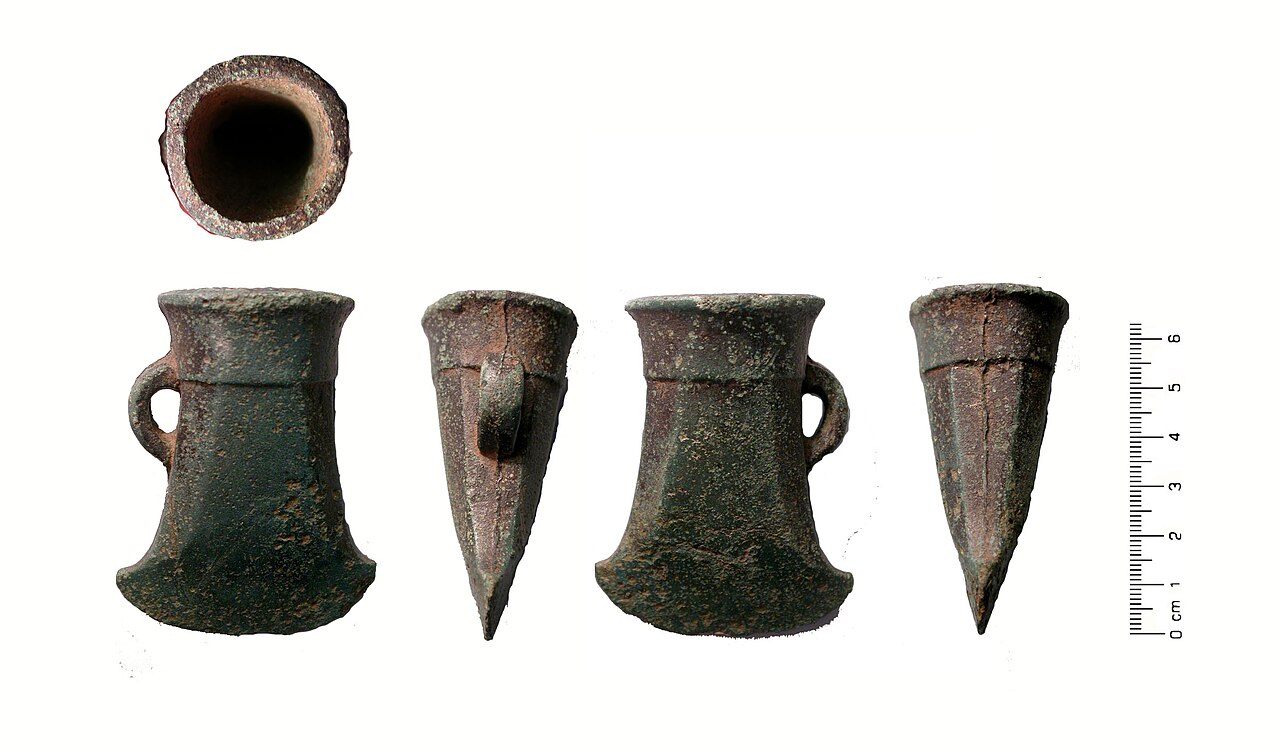
At a club dig in North Shropshire in October 2026, Willenhall detectorist Paul Pritchard dug a complete Bronze Age socketed axe head of about 1140-950 BC. Experts who examined it say its shape is unusual and has no known parallel in Britain. It was his second big find of the year, after a gold coin of Henry VI in February.
Paul Pritchard, 49, from Willenhall, took up metal detecting about six years ago with his sister Sadie, after the death of their mother. In October 2026 the pair went to a dig run by the Shrewsbury and Shropshire Metal Detecting Club at Hinstock, in North Shropshire, along with more than 40 other members. The first field was slow, with only a Georgian coin to show for it, so Paul moved on to the next one and walked a straight line along the hedgerow towards some farm buildings.
The signal he got there was weak, and on a better day he might have walked past it. With nothing else in the bag, he dug. The signal grew stronger as he turned the soil, and when he lifted a spadeful he saw the end of a bronze socketed axe sticking out. His first worry was whether it was broken. It wasn't: the axe head was complete, nearly 3,000 years after it was made. A more experienced club member, standing only a few metres away, looked at it and said straight away that it was an unusual shape. Within minutes other detectorists were coming over to see it, and when the club put it on Facebook the post was flooded with comments.
Socketed axes were the everyday cutting tool of the Late Bronze Age. They were cast in bronze in two-piece moulds, with a hollow socket for a bent wooden handle and often a small loop on the side to help lash it on. Hundreds have been found in Britain, many of them broken or in hoards of scrap metal, which is why a complete one is a good find. This one has been dated to about 1140-950 BC, and the people who examined it say its form is "unusual for socketed axe heads", that it has no British parallel and that it was probably a specialist tool rather than an ordinary woodworking axe.
It was Paul's second big find of 2026. In February, while he and Sadie were detecting their way back to the car on a cold hillside at Church Preen, south of Shrewsbury, Sadie went off to check on a sheep she thought was ill. While she was gone, Paul's detector found a gold quarter-noble from the first reign of Henry VI, struck between 1422 and 1427: the same kind of coin as the one found in Newfoundland Henry VI coin, Newfoundland. The sheep, it turned out, was fine. Paul says the axe head was the bigger surprise. A gold coin is exciting, he told the paper, but a complete socketed axe is something every detectorist hopes to find one day.
Reported by the Express & Star (24 November 2026). Written for Global Finds from that report. Photo: a Late Bronze Age faceted socketed axe, about 950-750 BC, recorded with the Portable Antiquities Scheme (not from this find), Birmingham Museums Trust, Peter Reavill, Wikimedia Commons, CC BY-SA 4.0.
Related guide: How to read a metal detector's signals
Source: Express & Star
Also reported by