The Nemi Ships: Caligula's floating palaces, raised by draining a lake and lost to fire in 1944
Famous find Built about AD 37 to 41 · Found in 1929 See it on the timeline →
For five centuries people snagged timbers from two vast Roman ships at the bottom of Lake Nemi near Rome. In 1928 to 1932 the lake was partly drained and Caligula's ships were raised whole. They burned in 1944, but their bronze fittings survive in Rome.
For five hundred years, people knew that something enormous lay at the bottom of Lake Nemi, a small crater lake in the Alban Hills south of Rome. In 1446 Cardinal Prospero Colonna and the architect Leon Battista Alberti located one wreck at a depth of about 18 metres and tore pieces off it with hooks. In 1535 Francesco De Marchi went down in an early diving apparatus and brought up bricks, marble, metal and timber, and in 1895 Eliseo Borghi showed that there were two wrecks and raised a number of bronze fittings.
In 1928 Mussolini ordered the lake to be drained. Engineers led by Guido Ucelli began pumping on 20 October 1928, sending the water out through the lake's ancient Roman drainage tunnel. On 28 March 1929 the first ship broke the surface. More than 40 million cubic metres of water were pumped out and the level fell by over 20 metres; a collapse of mud halted the work in 1931, and the second ship was finally recovered in October 1932.
They were floating palaces, about 71 and 73 metres long and more than 20 metres wide, built for the emperor Caligula, who reigned from AD 37 to 41; a lead water pipe from one of them is stamped with his name. They had running water in lead pipes, bilge pumps with crank handles, rotating platforms on caged bronze balls, an early form of ball bearing, and an iron anchor of a modern-looking pattern. After Caligula's murder they were stripped and sunk.
A museum was built around the hulls on the lake shore. On the night of 31 May 1944, days before Rome was liberated, a fire destroyed them. An inquiry blamed German soldiers who had set up a gun battery nearby, but recent research suggests Allied shelling may have started it, and the cause is still disputed.
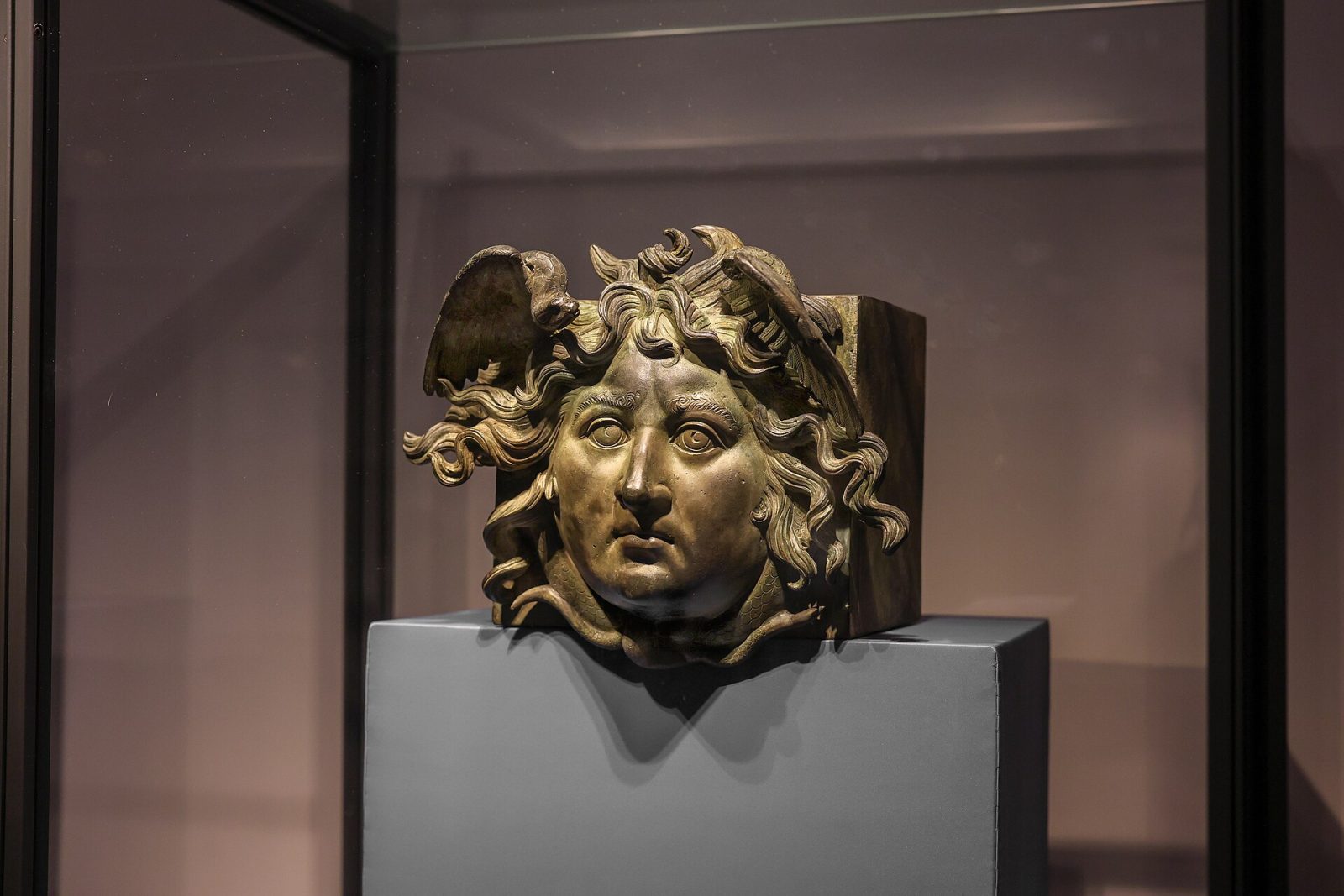
The bronze fittings survived because they had been taken to Rome: a Medusa head, and the heads of lions, wolves and panthers holding mooring rings. They are displayed in the Palazzo Massimo of the National Roman Museum. A floor panel from one of the ships turned up in New York in 2017, in use as a coffee table, and went home to Italy.
Written for Global Finds from the Italian Ministry of Culture and F. Altamura and M. Paolucci in Engramma (2023). Photo: a bronze Medusa head from the first Nemi ship, Palazzo Massimo, Rome, Fabrizio Garrisi, Wikimedia Commons, CC0.
Source: Italian Ministry of Culture