The Praeneste Fibula: a gold brooch with the oldest Latin words, accused of being a fake for a hundred years
Famous find Made in the early 7th century BC See it on the timeline →
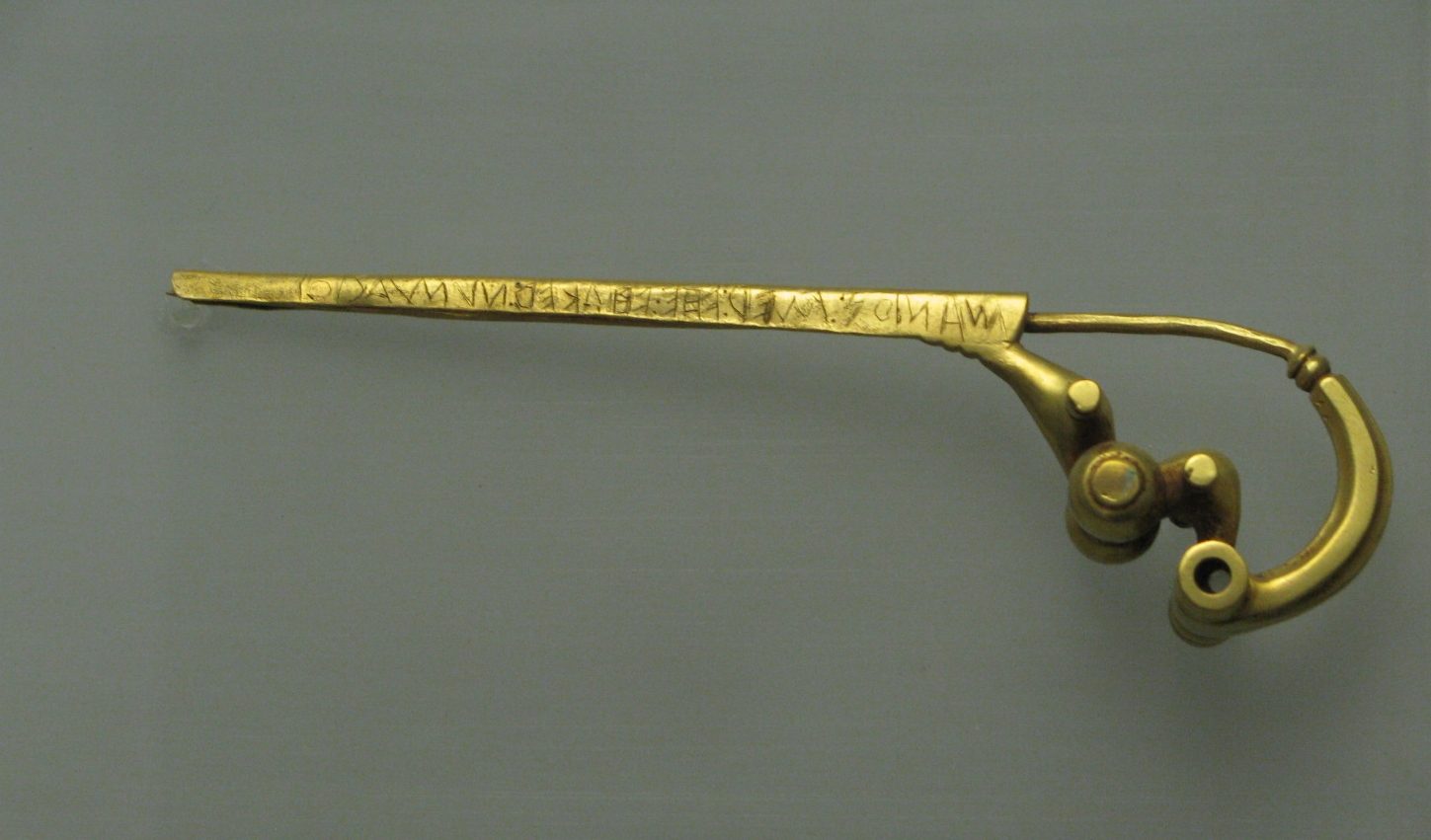
In 1887 the archaeologist Wolfgang Helbig unveiled a gold brooch from Palestrina, near Rome, inscribed 'Manius made me for Numerius', the oldest known Latin. A century later it was branded a forgery by Helbig and a dealer, until microscope tests in 2011 found it genuine.
On 7 January 1887, the German archaeologist Wolfgang Helbig showed a small gold brooch to a meeting of scholars in Rome. It had come, he said, from a tomb at Palestrina, the ancient town of Praeneste east of Rome, and had been bought there by a friend in 1871. Along its catch-plate, written from right to left in early Latin letters, ran four words: MANIOS MED FHEFHAKED NUMASIOI, "Manius made me for Numerius". If genuine, it was the oldest Latin inscription ever found, from the 7th century BC.
The brooch is a gold fibula, a kind of safety pin used to fasten clothes, 10.7 centimetres long and weighing 36.7 grams. Its inscription quickly became famous among linguists, because it shows Latin long before Rome was powerful, with older forms of words and the letters FH used for the sound F. In 1889 the antiquities dealer Francesco Martinetti gave it to the new Villa Giulia museum in Rome.
But its history was murky. Helbig later told a colleague privately that Martinetti had bought it from the foreman of an excavation of the rich Bernardini tomb at Palestrina in 1876, who had stolen it. Doubts about the inscription began in its first year, and in 1980 the Italian scholar Margherita Guarducci published a full-scale attack, arguing that Helbig and Martinetti, who was known to have dealt in fakes, had forged it together. For thirty years many textbooks treated the oldest Latin as a probable hoax.
In 2010, scientists from Italy's National Research Council, Daniela Ferro, and the goldsmithing expert Edilberto Formigli examined the brooch under an electron microscope. They found that the gold had the crystal structure of ancient metal, that old polishing marks ran across the letters, and that a crack in the catch-plate had been repaired in antiquity with thin gold foil. Announcing the results in June 2011, they concluded that both the brooch and its inscription are genuine. Most scholars now accept it, though a few doubters remain.
The Praeneste fibula is displayed in the Museo delle Civiltà, in the Pigorini collections, in the EUR district of Rome.
Written for Global Finds from E. Mangani, Bullettino di Paletnologia Italiana 99 (2011–14), J. Gippert (2020) and Archaeology magazine. Photo: the Praeneste fibula in the Pigorini Museum, Pax:Vobiscum, Wikimedia Commons, CC BY-SA 3.0.
Source: E. Mangani, Bullettino di Paletnologia Italiana (2011–14)