Offa's Gold Dinar: an English king's name stamped upside down inside an Islamic gold coin
Famous find Made about AD 774 to 796 See it on the timeline →
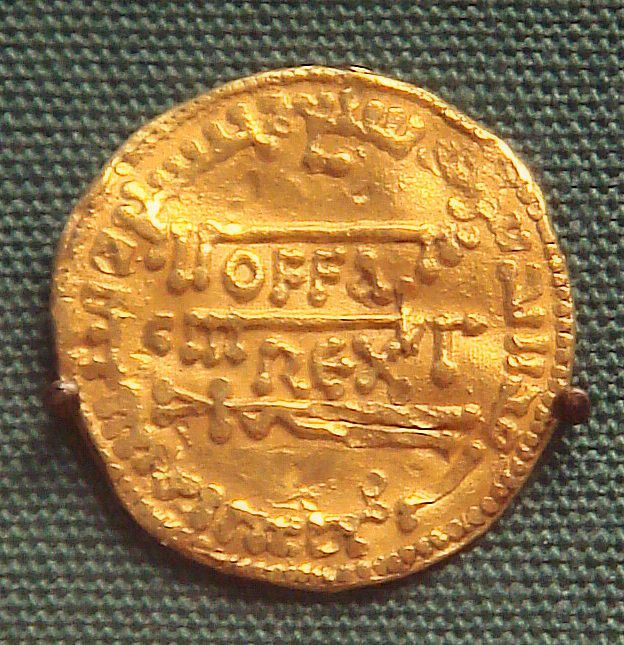
A gold coin first recorded in Rome and published in 1841 copies an Islamic dinar of AD 774, Arabic declaration of faith and all, but adds the words OFFA REX: Offa, king of Mercia. It is the only one known, and nobody knows why it was made.
In 1841, the French scholar Adrien de Longpérier published a gold coin unlike any other. It had been acquired in Rome by the Duc de Blacas, a French nobleman and collector. At first glance it was an Islamic gold dinar of the Abbasid caliph al-Mansur, dated to the year 157 of the Islamic calendar, AD 773 or 774, with Arabic inscriptions including the declaration of faith. But in the middle, upside down in relation to the Arabic, are the words OFFA REX: King Offa.
Offa ruled the Anglo-Saxon kingdom of Mercia from 757 to 796 and was the most powerful king in England in his day; his silver pennies set the pattern for English coins for centuries. This gold coin is a copy of a dinar, and the copy has mistakes in the Arabic, which suggests the man who cut the die could not read it. It weighs 4.28 grams and is 20 millimetres across, and no other example is known.
Why it was made is a mystery. Offa is recorded as promising the pope 365 gold coins, mancuses, every year, and the coin's appearance in Rome has led some to link it with that payment. The British Museum's own view is that it was made for trade, since Islamic gold dinars were the international currency of the Mediterranean, and others have suggested it was carried by pilgrims. Whatever the reason, it is one of only three gold coins to survive from Offa's time, and it shows how far the trade links of 8th-century England reached.
Where it was found was never recorded. After passing through the hands of dealers, it was bought in 1907 by the collector Philip Carlyon-Britton, who published it in the British Numismatic Journal, and it entered the British Museum in 1913.
It has been lent to the British Library's Anglo-Saxon Kingdoms exhibition and the British Museum's Silk Roads exhibition, and in early 2026 it was on display in the museum's Money gallery, Room 68.
Written for Global Finds from the British Museum and P. W. P. Carlyon-Britton in the British Numismatic Journal (1908). Photo: Offa's gold dinar in the British Museum, PHGCOM, Wikimedia Commons, public domain.