The Willersey swords: a novice at his second detecting rally found two Roman cavalry swords, and they led archaeologists to a lost settlement
Famous find 2nd-3rd century AD · Found in 2023 See it on the timeline →
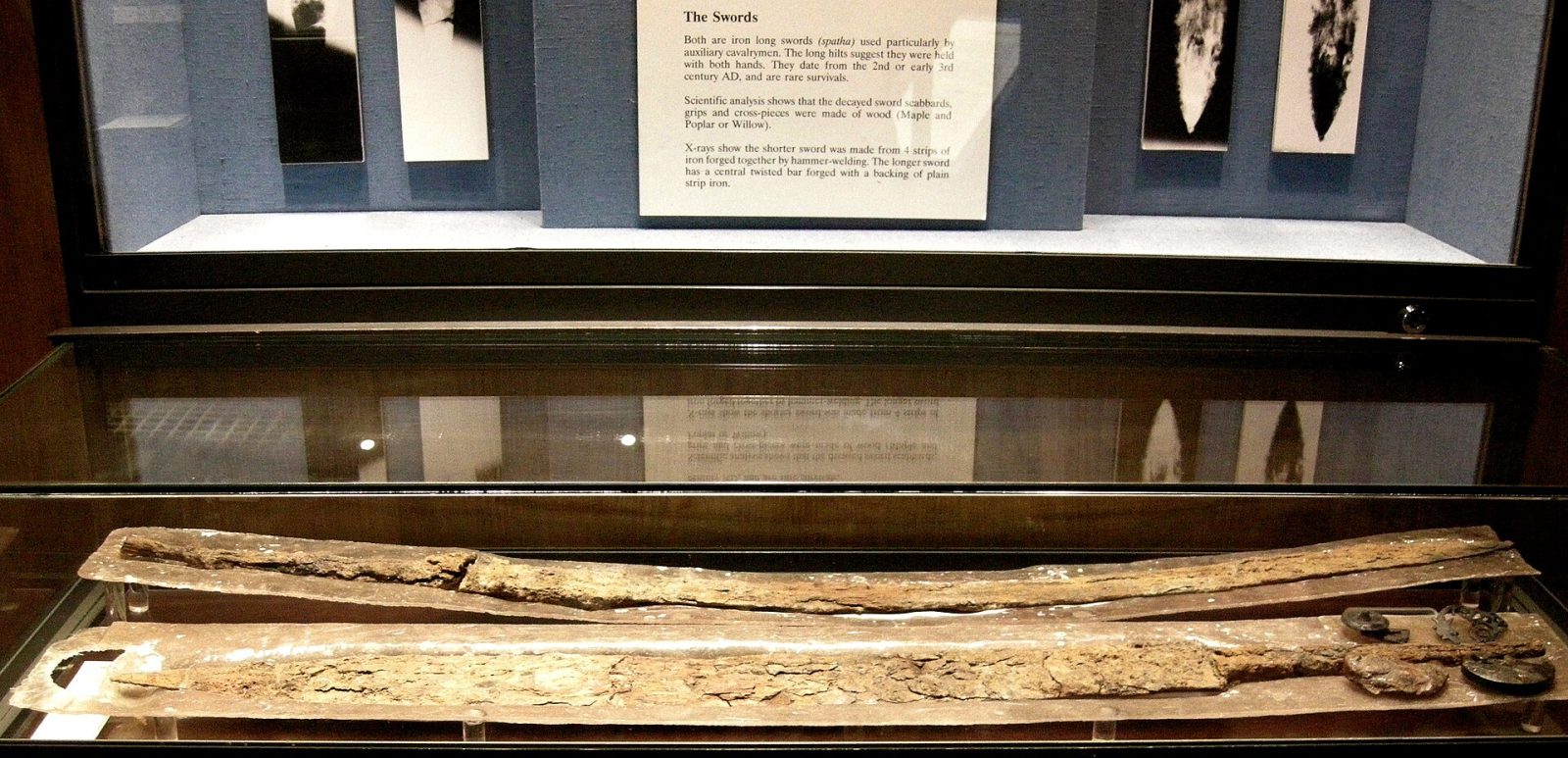
In March 2023 novice detectorist Glenn Manning found two Roman cavalry swords at a rally near Willersey, in the north Cotswolds. Buried with a broken bowl, they are a very rare pair, and they led archaeologists to a settlement running from the Iron Age to the Roman period.
In March 2023 Glenn Manning went to a metal-detecting rally in the north Cotswolds. He was a novice, and by most accounts it was only his second rally. He later said that he'd had a feeling that morning that he would find something special. In a field off Badsey Lane near Willersey, just on the Gloucestershire side of the Worcestershire border, he found two long iron swords and a broken copper-alloy bowl, by one account only about an inch down. He reported them to the Finds Liaison Officer, Kurt Adams, and Professor Simon James of the University of Leicester identified them as spathae, the long swords of Roman cavalry.
They had been buried in wooden scabbards. Only fragments of the wood survive, but the copper-alloy chapes and fittings remain. X-rays at Historic England's laboratory at Fort Cumberland showed that one blade is pattern-welded, a costlier and higher-status way of making a sword, while the other is plain. Professor James dates such swords from about the 160s AD into the third century, although other reports say from the early second century. He knows of only one other pair from Roman Britain, found at Canterbury in 1977 with two men in a pit, in what he calls "almost certainly a double murder".
The swords changed how the field was seen. Historic England carried out a geophysical survey in November 2023, and in January and February 2025 it funded an excavation with Cotswold Archaeology. They found a settlement running from the Iron Age to the second century AD, with three or four ring ditches up to 18.5 m across and an enclosure of 68 by 55 m. Its ditch was about 5 m wide and over 1.5 m deep. Roof tile, box-flue tile and painted plaster point to a Roman building of some quality, and the survey suggests a possible villa, which has not been excavated. The swords lay in a small cut over the enclosure ditch, with no human remains, so they are not grave goods. Nobody knows why they were buried there. Ideas include valuables hidden by a family in debt.
With no gold or silver present, the swords were not Treasure. Mr Manning and the landowner donated them to the Corinium Museum in Cirencester, where they went on display in August 2025.
Written for Global Finds from The Past, Cotswold District Council, Archaeology Magazine, Euronews and the Badsey Society. Photo: two iron Roman swords in the Roman Museum, Canterbury (not the Willersey swords), Linda Spashett (Storye book), Wikimedia Commons, CC BY 3.0.
Related guide: Permission to detect: who to ask, and what to agree
Source: The Past (Current Archaeology)