The Nebra Sky Disc: a Bronze Age map of the heavens, dug up by looters
Famous find Buried about 1600 BC · Found in 1999 See it on the timeline →
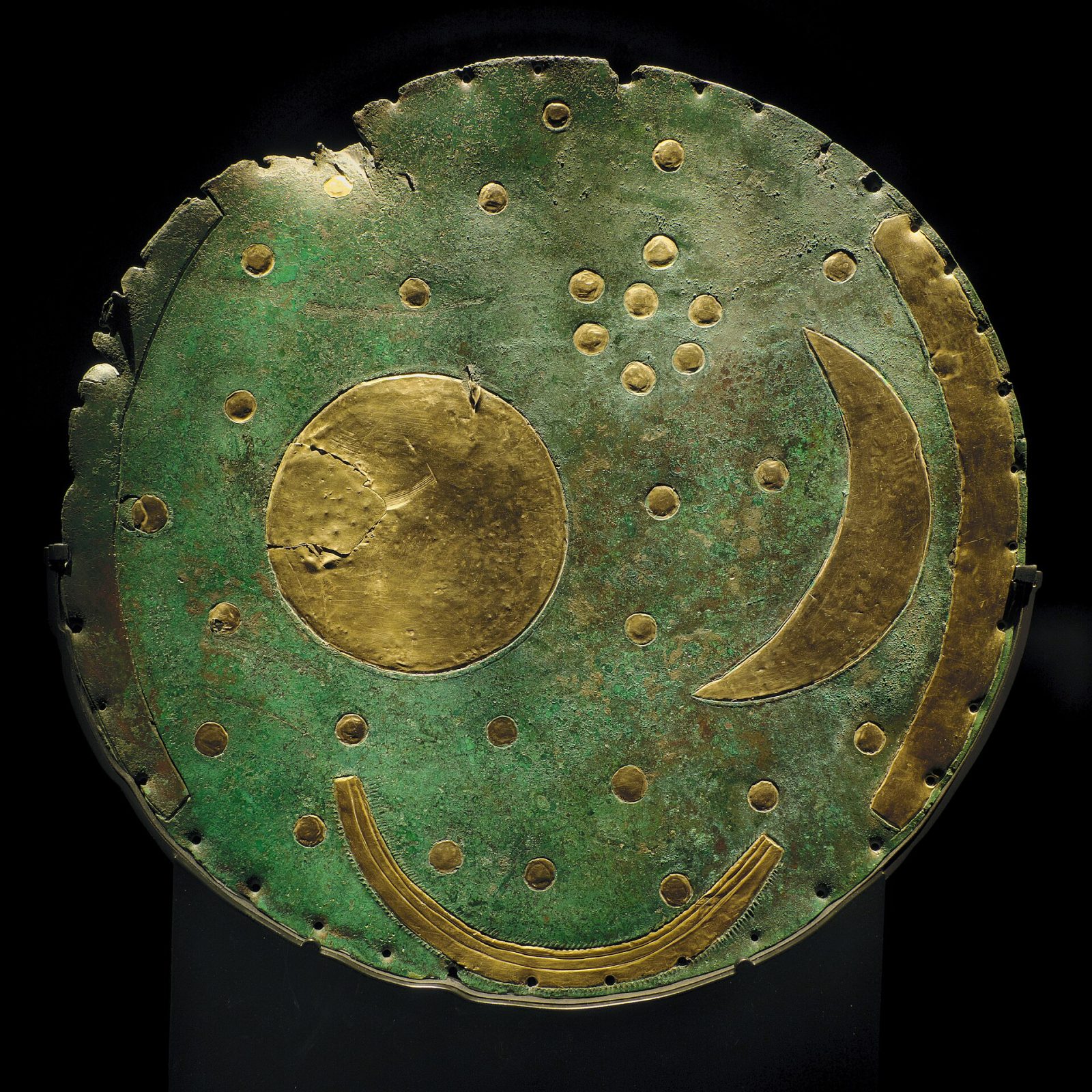
In 1999 two men digging illegally with metal detectors on a hilltop in eastern Germany found a bronze disc inlaid with a gold sun, moon and stars. It took a police sting in a Basel hotel to save it.
On 4 July 1999, two men searching with metal detectors on the Mittelberg, a wooded hill near the small town of Nebra in Saxony-Anhalt, eastern Germany, dug up a hoard of Bronze Age metalwork: two swords, two axes, a chisel, pieces of spiral arm-rings and a bronze disc about 32 centimetres across. They had no permission to dig there, and getting the disc out of the ground damaged it.
The next day they sold the whole find to a dealer for about 31,000 Deutschmarks. Over the next two and a half years it passed between dealers, and by the end it was being offered for around 700,000 Deutschmarks. On 23 February 2002 the buyer who turned up to a meeting in Basel, Switzerland, was Harald Meller, the state archaeologist of Saxony-Anhalt, working with Swiss and German police. The disc was seized on the spot. The finders and the dealers were later convicted and given suspended prison sentences.
What the police recovered is extraordinary. The disc weighs about 2 kilograms, and its gold inlays show a sun or full moon, a crescent moon and a scatter of stars, including a tight cluster usually read as the Pleiades. Two arcs added later along its edges each span about 82 degrees, close to the angle between where the sun sets at midsummer and at midwinter at that latitude. One of these has since been lost, a curved boat-like shape was added between them, and holes were punched around the rim. The disc was changed again and again before it was buried.
The State Museum of Prehistory in Halle dates the burial to about 1600 BC, and the disc may have been made a century or two before that. In 2020 two researchers argued that it is Iron Age instead, about a thousand years younger. The excavators answered in detail and most specialists keep the Bronze Age date, but the argument was only possible because the looters destroyed the evidence of how the hoard lay in the ground. Analysis of the metals has linked its copper to the Austrian Alps and its gold and tin probably to Cornwall.
The Nebra Sky Disc is on permanent display in the State Museum of Prehistory in Halle, and in 2013 it was added to UNESCO's Memory of the World register. It is often described as the oldest known concrete picture of the night sky.
Written for Global Finds from the State Museum of Prehistory in Halle and other published accounts. Photo: the Nebra Sky Disc in the State Museum of Prehistory, Halle, WFS.Berlin, Wikimedia Commons, CC0.
Approximate location51.28, 11.52View on map