The Eberswalde Hoard: Bronze Age gold taken to Moscow in 1945
Famous find Buried about 1000 to 800 BC · Found in 1913 See it on the timeline →
In 1913 a worker digging foundations at a brass works near Eberswalde, north-east of Berlin, found a clay pot holding 81 gold objects, the largest prehistoric gold hoard ever found in Germany. Since 1945 it has been in Moscow.
On 16 May 1913, a worker digging the foundations of a house on the grounds of the Hirsch copper and brass works at Messingwerk, near Eberswalde in Brandenburg, north-east of Berlin, struck a lidded clay pot about a metre down.
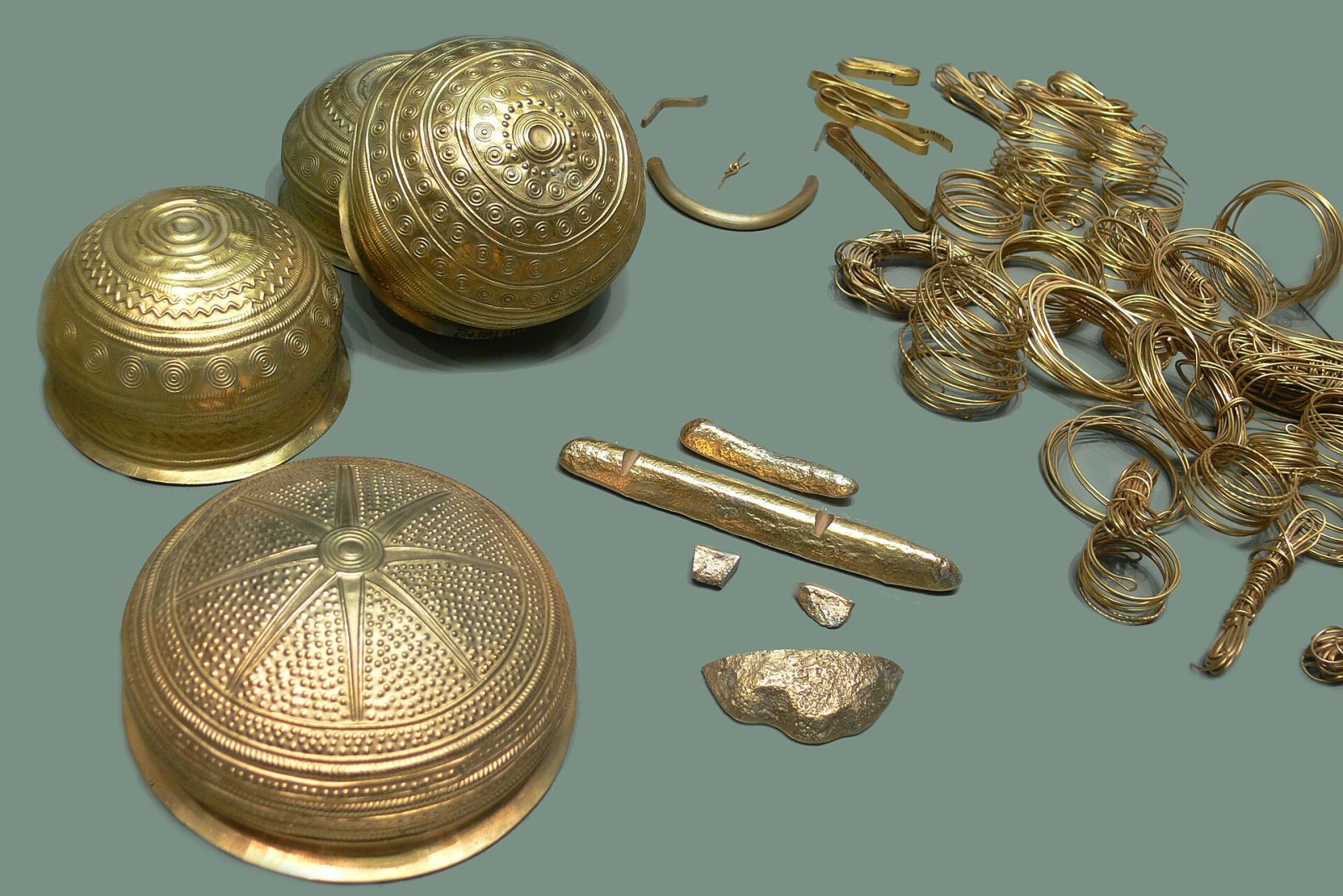
Inside were eight thin gold bowls, decorated with patterns punched and chased into the metal, and packed inside the bowls were 73 more gold objects: neck rings and bracelets, dozens of coiled wire spirals, a gold ingot, a piece shaped like a crucible and scraps of raw gold. The 81 objects weigh about 2.6 kilograms. It is the largest prehistoric gold hoard ever found in Germany and is dated to the Late Bronze Age, around the 10th or 9th century BC. The ingot and the scrap gold suggest that part of it was a goldsmith's stock.
The hoard went to the Berlin Museum for Prehistory and Early History, and electroformed copies were made the same year. During the Second World War the gold was stored for safety, from 1941 in the flak tower at Berlin Zoo. In 1945 it was handed over to the Red Army, together with other treasures including the gold that Heinrich Schliemann had excavated at Troy, and taken to Moscow. For decades its whereabouts were officially unknown.
It is now held by the Pushkin Museum in Moscow. Russia treats such wartime holdings as its property under a law passed in the late 1990s, while Germany says international law requires their return. In 2013 the hoard was shown in public for the first time since the war, in a Bronze Age exhibition at the Hermitage in St Petersburg, and the opening caused a diplomatic row when Angela Merkel planned to call for the return of the objects.
In Germany, visitors see replicas: in the Neues Museum in Berlin, in the museum at Eberswalde and in a display case at the findspot.
Written for Global Finds from the Prussian Cultural Heritage Foundation, Museum Eberswalde and other published accounts. Photo: replicas of the Eberswalde Hoard (the originals are in Moscow), Andreas Praefcke, Wikimedia Commons, public domain.
Approximate location52.85, 13.72View on map