The Hildesheim Treasure: Roman silver dug up by Prussian soldiers
Famous find Made about 50 BC to AD 50 · Found in 1868 See it on the timeline →
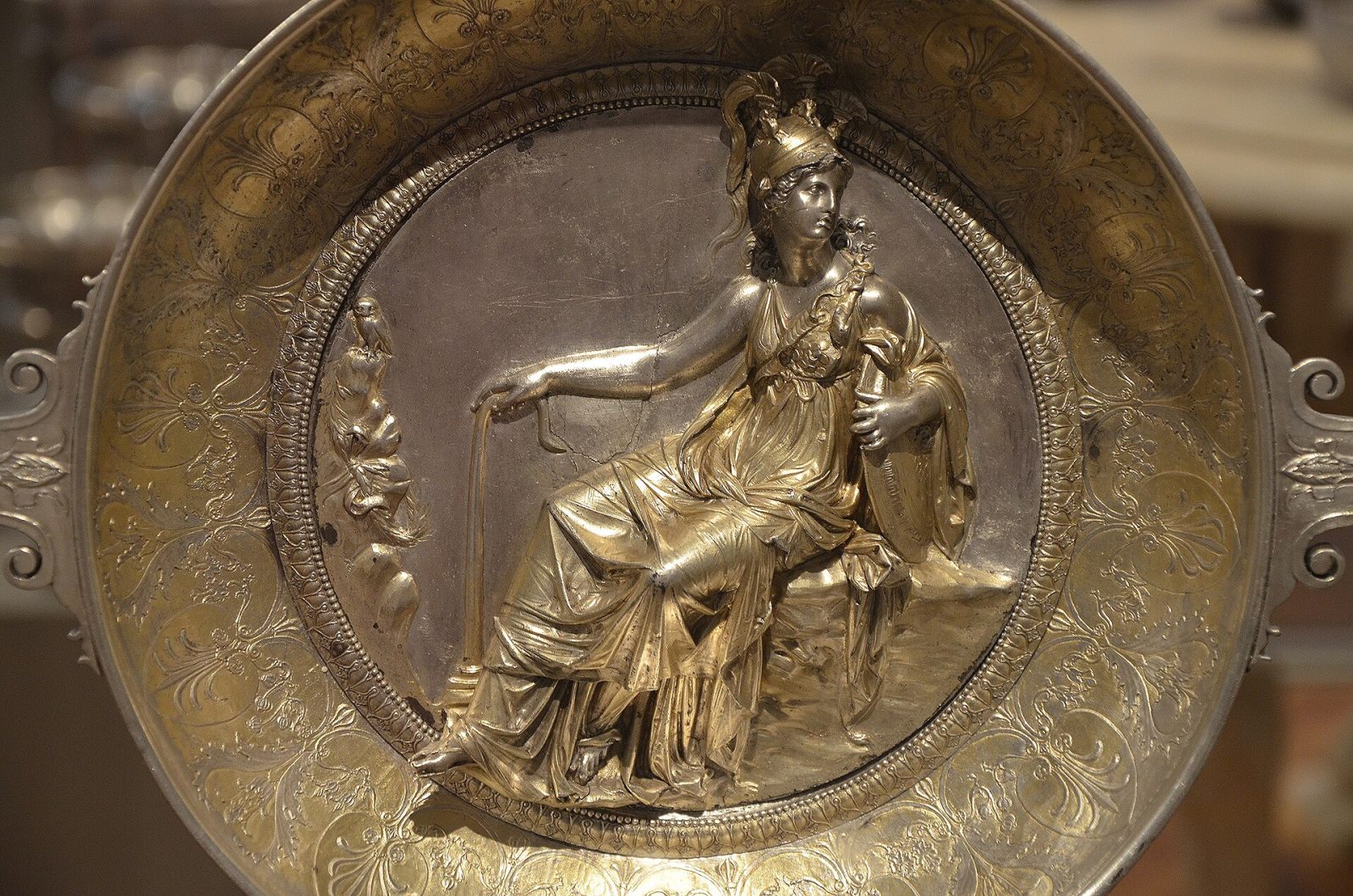
In 1868 soldiers digging on a hill outside Hildesheim in northern Germany struck a pit of Roman silver tableware, around 70 pieces in all and the largest Roman silver treasure found beyond the Empire's frontiers.
On 17 October 1868, soldiers of the Prussian army's 79th Infantry Regiment were digging on the Galgenberg, a hill just south-east of Hildesheim in Lower Saxony, to extend a rifle range. A young musketeer, August Armbrecht, struck metal well below the surface. It was a pit packed with Roman silver.
There were around 70 pieces (counts vary between sources) of silver for dining and drinking: bowls, cups, dishes and platters, a wine krater, a bucket, parts of a folding table and a candelabrum. The finest is the Athena bowl, about 25 centimetres across and weighing nearly 2 kilograms, with a gilded figure of the goddess seated at its centre. The medallion of Athena is thought to date from the 2nd century BC and was set into a new bowl in the time of the emperor Augustus. Most of the treasure was made between the late 1st century BC and the 1st century AD, and names scratched on some of the pieces show that they passed through the hands of several owners.
How a Roman banqueting service came to be buried in Germania, beyond the Roman frontier, is a mystery. It has been linked to Roman campaigns in the region under Augustus, including the destruction of Varus's legions in AD 9, and it has also been suggested that it was loot or a diplomatic gift. None of these can be proved.
The treasure went to the royal museums in Berlin the same year, and Hildesheim was given a replica in exchange. Armbrecht was rewarded with 10,000 thalers. He bought a farm and ran an inn that he named Zum Silberfund, At the Silver Find. The Paris firm Christofle later made electrotype copies of pieces from the treasure, which still turn up at auction.
The Hildesheim Treasure is in the collection of classical antiquities of the Berlin State Museums, displayed in the Altes Museum. In 2018, for the 150th anniversary of the find, some of the original pieces returned to Hildesheim for an exhibition.
Written for Global Finds from the Berlin State Museums, the Lower Saxony regional bibliography and other published accounts. Photo: the Athena bowl from the Hildesheim Treasure in the Altes Museum, Berlin, Carole Raddato, Wikimedia Commons, CC BY-SA 2.0.
Approximate location52.14, 9.97View on map
Source: Berlin State Museums