The Golden Horns of Gallehus: Iron Age gold stolen and melted down
Famous find Made about AD 400 · Found in 1639 See it on the timeline →
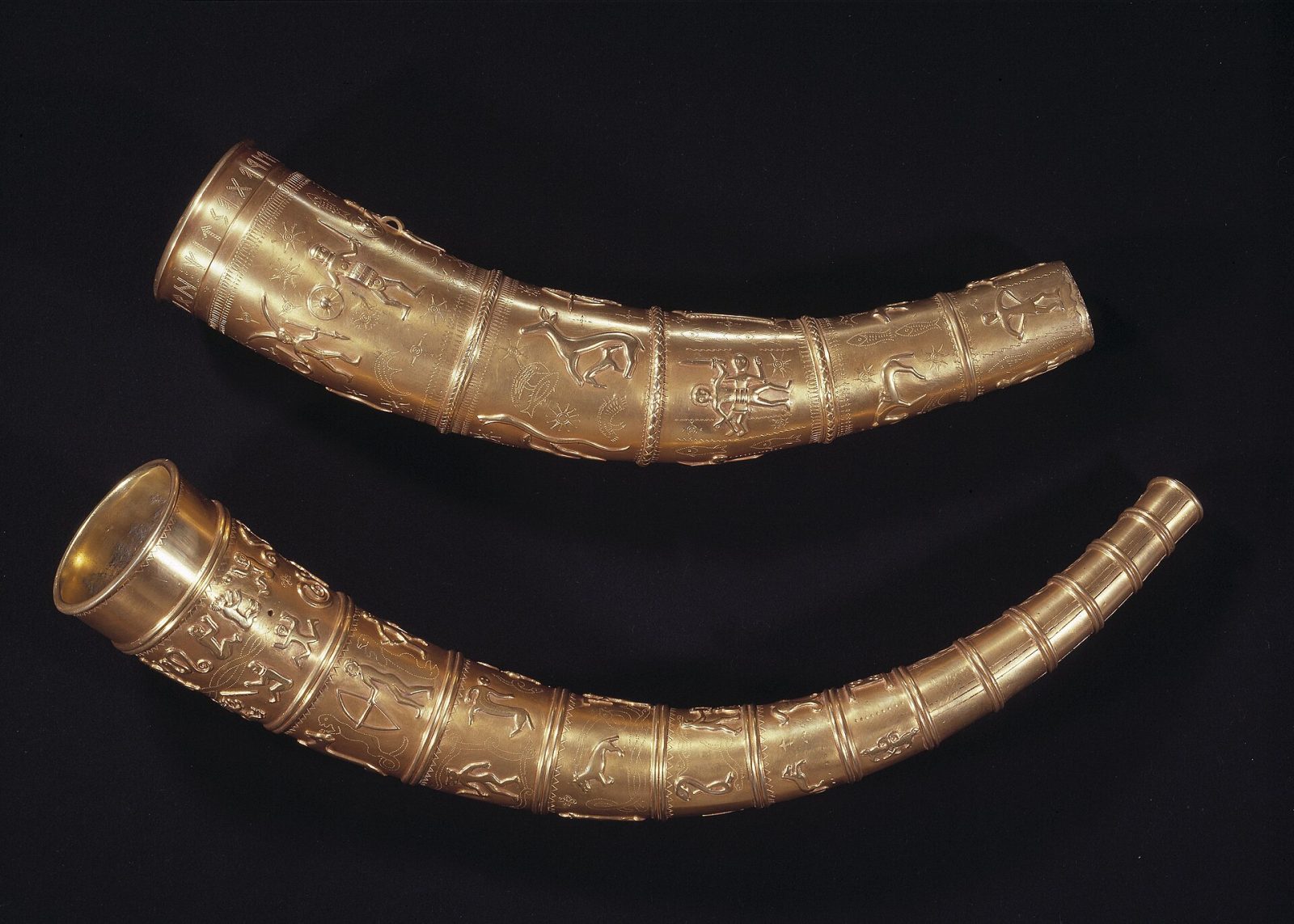
Two gold horns were found in the same Danish field nearly a century apart, one carrying one of the oldest sentences in a Germanic language. In 1802 they were stolen and melted down, and only drawings and copies survive.
On 20 July 1639, a young local woman, Kirsten Svendsdatter, was near Gallehus, close to Møgeltønder in southern Jutland, when she saw the end of a gold horn sticking out of the ground. Almost a century later, on 21 April 1734, a farmworker named Erik Lassen dug up a second horn only metres from the first. Both were given to the Danish king.
Each horn was made in two layers: an inner horn of gold mixed with silver, and an outer covering of rings of purer gold decorated with figures, animals and symbols. Together they weighed nearly 7 kilograms. The National Museum of Denmark dates them to about AD 400.
The second, shorter horn had a line of runes around its rim: ek hlewagastiz holtijaz horna tawido, meaning "I, Hlewagastiz, Holtijaz, made the horn". Holtijaz may mean son of Holt, or a man from a place called Holt. It is one of the earliest complete sentences known in any Germanic language, the family that includes English, and it even has the alliteration of early Germanic verse. Thanks to it, we know the name of a craftsman who lived 1,600 years ago.
In May 1802 a goldsmith and former coin forger, Niels Heidenreich, used a copied key to get into the Royal Kunstkammer in Copenhagen and stole both horns. He melted them down and turned the gold into jewellery and fake coins. He was caught the following year and spent decades in prison, but the horns were gone for ever. Earrings believed to have been made from their gold may be all that remains of them.
Copies were made from drawings of the horns made in the 17th and 18th centuries, and two sets are on display in the National Museum of Denmark in Copenhagen. Memorial stones mark the findspot near Gallehus. Even the copies have been targets: in 2007 thieves smashed a display case at Jelling and took a set, which was recovered two days later.
Written for Global Finds from the National Museum of Denmark, the Danish national encyclopedia and other published accounts. Photo: copies of the Golden Horns of Gallehus, Nationalmuseet, Wikimedia Commons, CC BY-SA 3.0.
Approximate location54.96, 8.81View on map
Source: National Museum of Denmark