The Gundestrup Cauldron: Iron Age silver from a Danish bog
Famous find Made about 150 to 1 BC · Found in 1891 See it on the timeline →
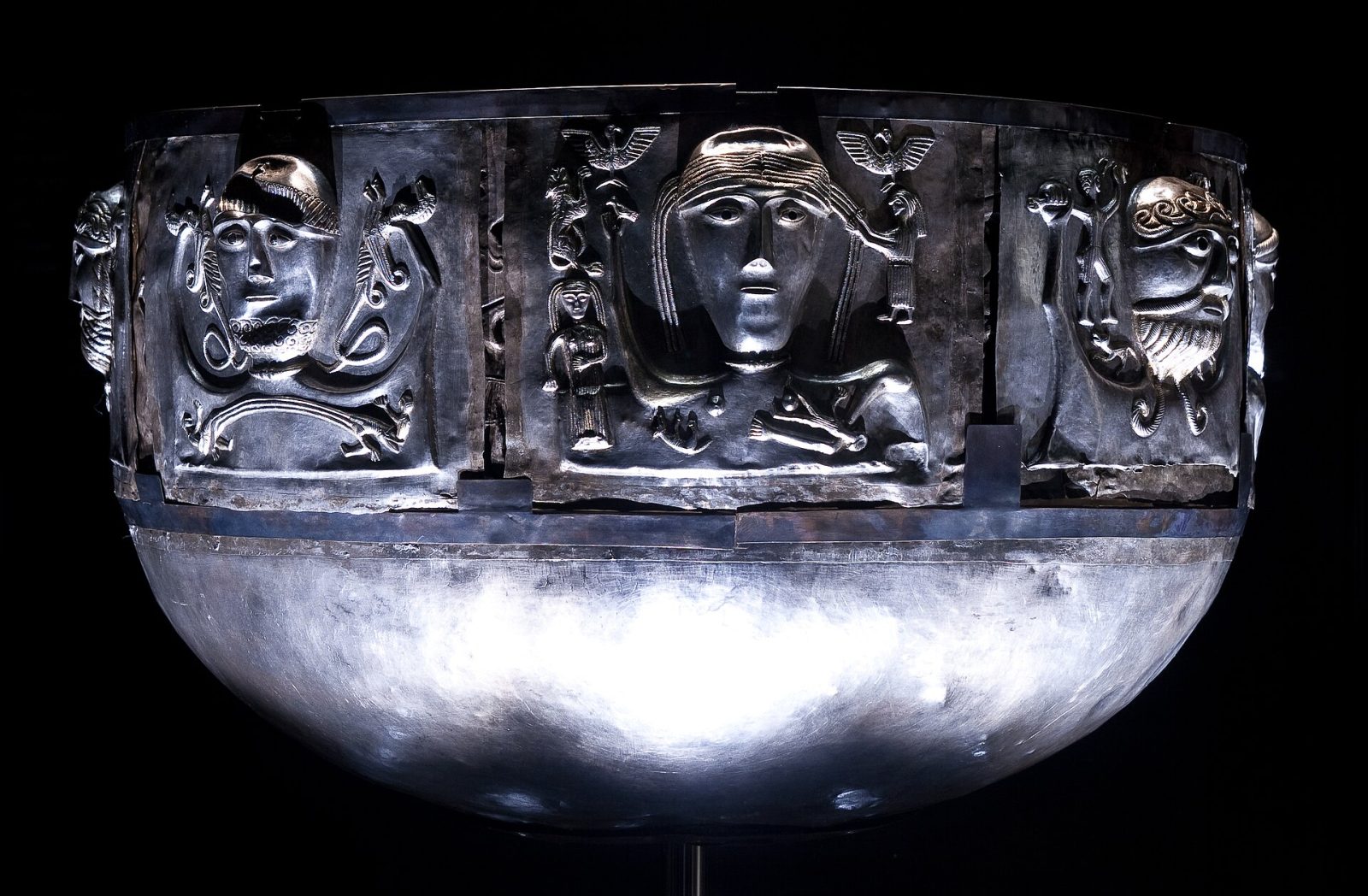
In 1891 peat cutters in north Jutland found a great silver cauldron, taken apart and stacked inside its own base. Its plates show gods, warriors and elephants, and nobody agrees where it was made.
On 28 May 1891, men cutting peat in Rævemose, a small bog near the hamlet of Gundestrup in Himmerland, north Jutland, came across a silver cauldron. It had been taken apart before it went into the bog, with its decorated plates stacked inside the bowl-shaped base. The National Museum of Denmark believes it was dismantled and placed there as an offering.
Put back together, it is the largest known piece of silverwork from Iron Age Europe: about 69 centimetres across, 42 centimetres high and almost 9 kilograms of gilded silver. It is made up of a base plate, seven outer plates (an eighth is missing) and five inner plates, all covered in figures. The most famous is an antlered man sitting cross-legged, holding a torc in one hand and a ram-horned serpent in the other, often identified as the Celtic god known as Cernunnos. Another plate shows a procession of warriors and a giant figure lowering a man into a vessel. The base shows a great bull. There are griffins and lions too, and elephants, animals no one in Iron Age Denmark is likely ever to have seen.
That mix is the puzzle. Much of the imagery looks Celtic, but the silversmithing techniques are those of Thrace, in the Balkans. The cauldron is usually dated to the last century or two BC, and one long-standing theory is that it was made in south-eastern Europe and carried north, perhaps by the Cimbri, a people from Jutland who raided across Europe at the end of the 2nd century BC. Others argue for a workshop in Gaul, and its date has been debated as well.
The cauldron still had surprises a century after it was found. Around the year 2000, researchers spotted small drawings scratched into the backs of the plates that nobody had noticed before.
The Gundestrup Cauldron is on display in the National Museum of Denmark in Copenhagen, and copies can be seen in museums elsewhere in Europe.
Written for Global Finds from the National Museum of Denmark, the Danish national encyclopedia and other published accounts. Photo: the Gundestrup Cauldron in the National Museum of Denmark, Knud Winckelmann, Wikimedia Commons, CC BY-SA 3.0.
Approximate location56.82, 9.55View on map
Source: National Museum of Denmark