The Bendegó Meteorite: five tonnes of space iron found by a cowherd boy in Brazil
Famous find Found in 1784; date of fall unknown · Found in 1784 See it on the timeline →
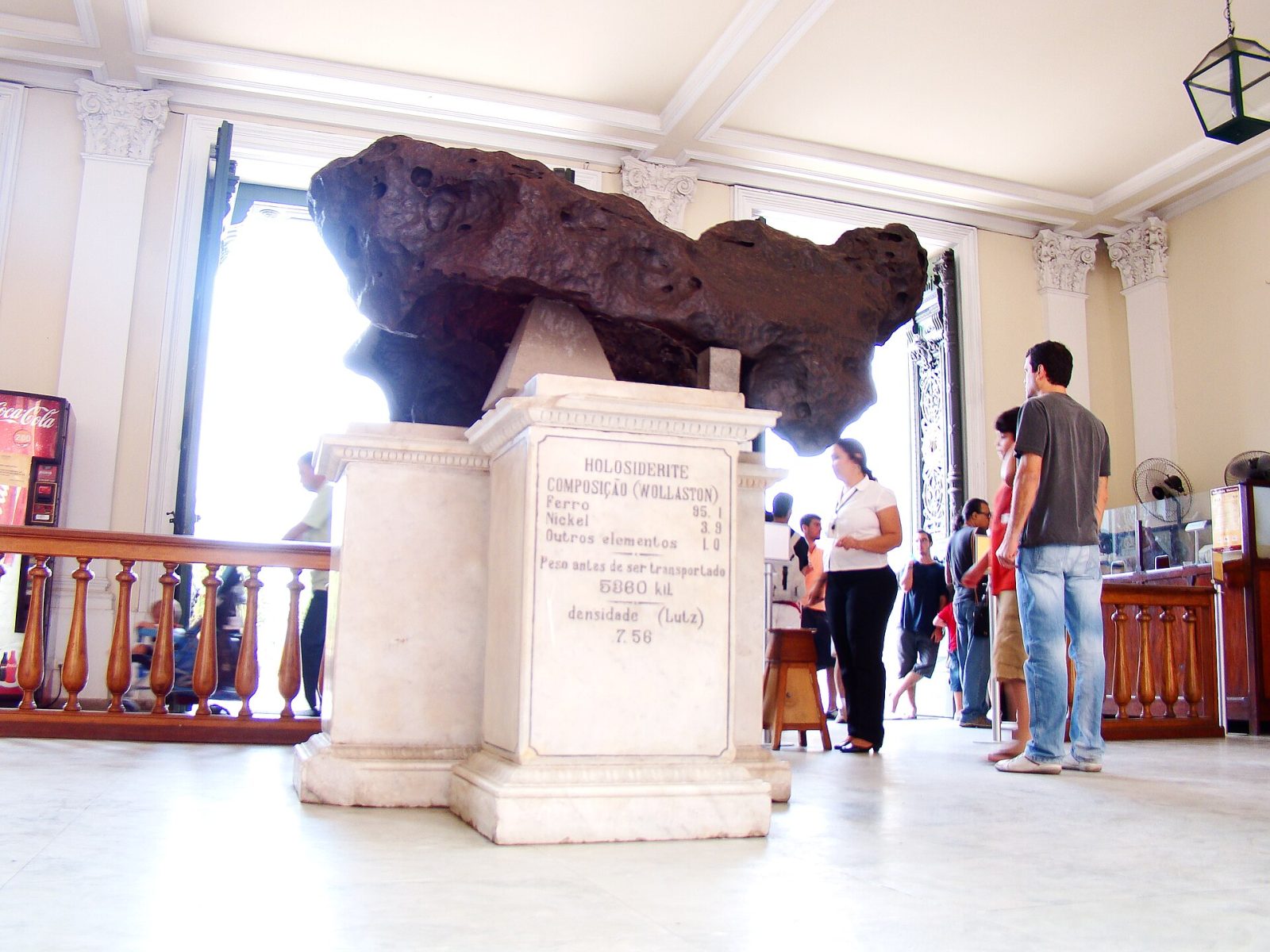
In 1784 a boy herding cattle near Monte Santo in Bahia, Brazil, came across a huge lump of metal. It was an iron meteorite weighing more than five tonnes. A first attempt to move it crashed into a creek bed, where it stayed for a century.
In 1784, a boy of the Motta Botelho family, herding cattle near Monte Santo in the backlands of Bahia, north-eastern Brazil, came across a huge, dark lump of what looked like iron lying on the ground. Sources name him as Domingos, though the inscription later placed beside the find calls him Joaquim. His family reported it, and word reached the governor of Bahia.
In 1785 the governor ordered it taken to the city of Salvador. It was loaded onto a heavy ox-cart, but the cart ran away down a slope and tipped the stone into the dry bed of the Bendegó creek, about 180 metres from where it was found. There it stayed for about a hundred years. Scientists came to chip off samples, and in 1816 the English chemist William Hyde Wollaston published an analysis showing that it was almost entirely iron, with a few per cent of nickel: metal from space.
In 1886 the Emperor Pedro II heard about the meteorite at the Academy of Sciences in Paris and decided it should be brought to the capital. A commission led by the engineer José Carlos de Carvalho reached the site in September 1887. The meteorite, about 2.2 metres long and weighing 5,360 kilograms, was dragged on a cart running on rails to the nearest railway station, then taken by train and ship to Rio de Janeiro, where it arrived on 15 June 1888. It is the largest meteorite ever found in Brazil.
When the meteorite was cut and polished, its iron showed the criss-cross Widmanstätten pattern that forms only when metal cools extremely slowly, over millions of years, inside an asteroid. When it fell to Earth is unknown.
The Bendegó meteorite has been on show at Brazil's National Museum in Rio de Janeiro since 1888. On 2 September 2018 a fire destroyed most of the museum's collections, but the meteorite came through essentially undamaged. In 2026 visitors could see it in its restored hall during temporary openings of the palace while restoration continues.
Written for Global Finds from Revista Pesquisa FAPESP (2018 and 2024), the National Museum of Brazil and Museu Nacional Vive (2026). Photo: the Bendegó meteorite in the National Museum, Rio de Janeiro, Alfonso Gómez Paiva, Wikimedia Commons, CC BY 4.0.
Approximate location-10.12, -39.26View on map
Source: Revista Pesquisa FAPESP