The Nimrud Lens: a 2,700-year-old piece of polished crystal that may be the world's oldest magnifying glass
Famous find Made about 750 to 710 BC · Found in 1850 See it on the timeline →
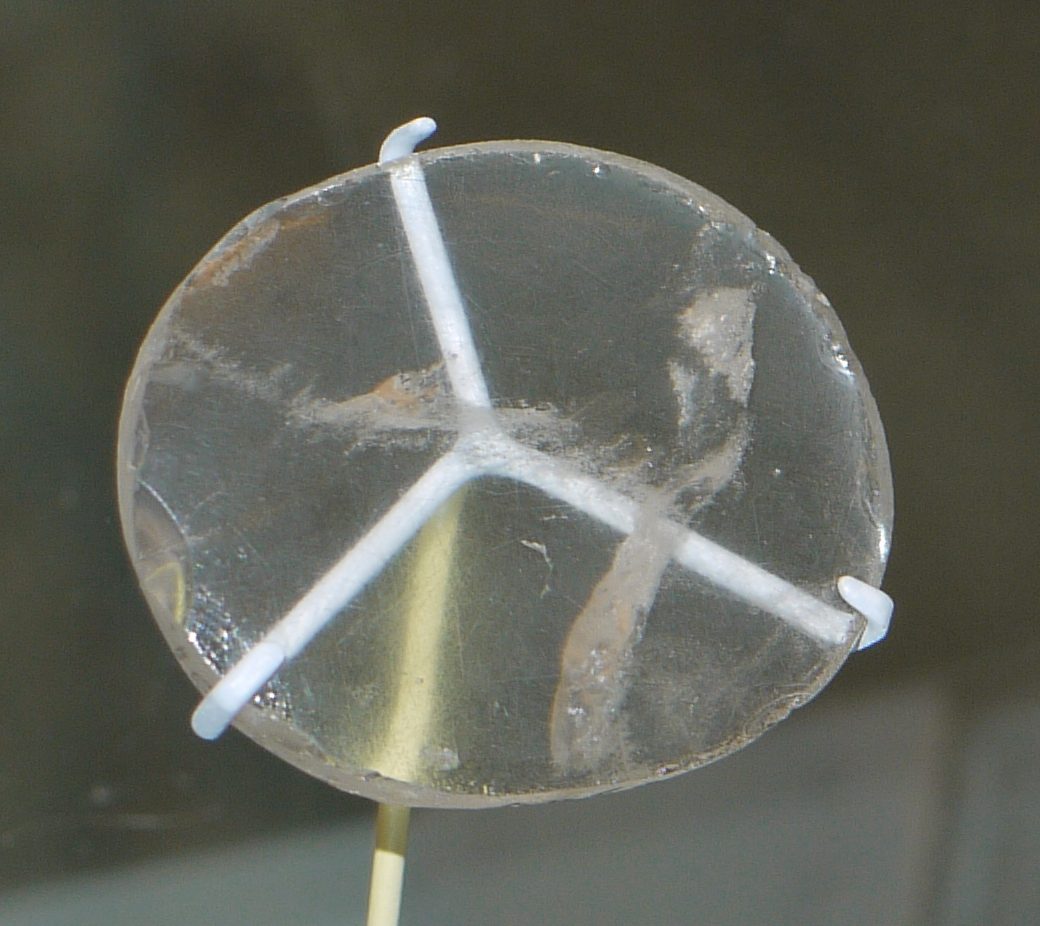
In 1850 Austen Henry Layard found a small oval of polished rock crystal in the Assyrian palace at Nimrud in Iraq. It magnifies and focuses light, and a famous scientist declared it the oldest lens in the world. Whether anyone used it as one is still argued over.
In 1850, the English archaeologist Austen Henry Layard was excavating the Assyrian royal city of Nimrud, ancient Kalhu, on the Tigris in northern Iraq. In a newly opened chamber of the North-West Palace, under fragments of decayed glass inlay, he found a group of glass bowls, one of them bearing the name of the Assyrian king Sargon II, and with them, as he wrote, a rock-crystal lens.
It is a small, slightly oval piece of clear quartz, 4.2 by 3.45 centimetres, flat on one side and gently convex on the other. It was shaped on a lapidary's wheel and is not perfectly smooth, and grinding opened about a dozen tiny cavities that once held liquid trapped inside the raw crystal. It still focuses light at about 12 centimetres from its flat face and magnifies about three times. The British Museum dates it to about 750 to 710 BC.
Layard showed it to Sir David Brewster, the Scottish physicist who invented the kaleidoscope. In a note printed in Layard's book of 1853, Brewster concluded that it had been ground deliberately as a lens and called it the earliest magnifying and burning glass known, although he added that it focused the sun's rays only imperfectly.
Not everyone agrees. The British Museum's curators think its optical qualities are probably accidental, and that it is more likely an inlay from a piece of furniture. In 1999 the Italian scholar Giovanni Pettinato went further the other way and suggested it was part of an Assyrian telescope used to study the stars, an idea most specialists reject. Assyrian craftsmen did carve very fine detail on seals and ivories, and some have argued that they needed magnifiers to do it, but no ancient text describes one.
The lens is held by the British Museum. The palace where it was found was badly damaged in 2015, when Islamic State fighters blew up much of Nimrud.
Written for Global Finds from A. H. Layard, Discoveries in the Ruins of Nineveh and Babylon (1853), with Sir David Brewster's note, and the British Museum. Photo: the Nimrud lens in the British Museum, Geni, Wikimedia Commons, CC BY-SA 4.0.
Source: A. H. Layard, Discoveries in the Ruins of Nineveh and Babylon (1853)