The Marajoara Urns: painted burial pots from the earth mounds of an Amazon island, first dug by a student in 1870
Famous find Marajoara culture, about AD 400 to 1400 · Found in 1870 See it on the timeline →
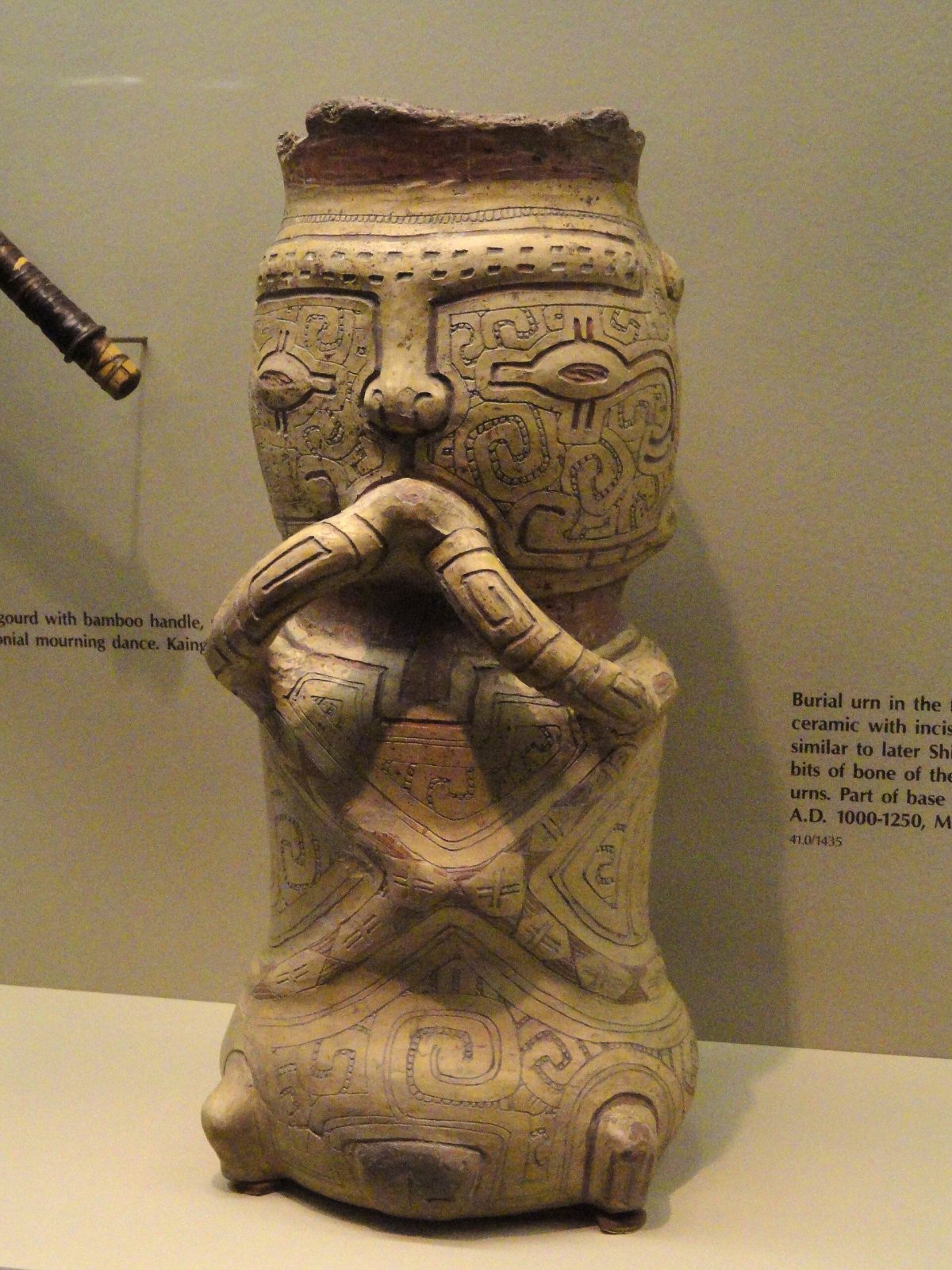
In October 1870 William Barnard, a Cornell student on Charles Hartt's expedition, dug into an earth mound on Marajó island at the mouth of the Amazon and found painted burial urns full of bones. They belonged to the Marajoara culture, which flourished from about AD 400 to 1400.
Marajó, an island nearly as large as Switzerland at the mouth of the Amazon in northern Brazil, floods for months every year. In 1870 the Brazilian naturalist Domingos Soares Ferreira Penna, who had founded the Museu Paraense in Belém four years earlier, told the American geologist Charles F. Hartt about "Indian cemeteries" on the island. On Hartt's Morgan Expedition from Cornell University, a 21-year-old student, William S. Barnard, dug into the mound of Pacoval in Lake Arari from 25 to 30 October 1870, and then at Guajará.
He found large burial urns of painted and modelled pottery. The bones inside had been placed there after the flesh was gone, a practice called secondary burial. Barnard's finds, more than 200 pieces, went to Cornell, and Hartt published them in The American Naturalist in 1871. Scientists from Brazil's own museums soon followed.
The Marajoara people built tesos, artificial mounds of earth raised above the seasonal floods, and lived on top of them, setting the urns of their dead into the floors of their houses. Their culture is usually dated to about AD 400 to 1400, though estimates vary. Later excavations, by Betty Meggers and Clifford Evans in 1948 and 1949 at the Camutins mounds and by Anna Roosevelt in the 1980s, showed that the island once supported a large population. The mounds have been dug for their pottery ever since the 1870s, and urns still appear at auctions abroad.
The main collections are in the Museu Paraense Emílio Goeldi in Belém, which displays archaeological pottery in its Amazonian Diversities exhibition. The urn in the photograph is in the American Museum of Natural History in New York; no record of where it was found has been published.
Written for Global Finds from M. Araújo and A. Sarraf Pacheco in the Boletim do Museu Paraense Emílio Goeldi (2023), Monteiro and Sanjad (2025), C. F. Hartt in The American Naturalist (1871) and B. Meggers and C. Evans (1957). Photo: a Marajoara burial urn of about AD 1000 to 1250 in the American Museum of Natural History, New York, Daderot, Wikimedia Commons, CC0.
Approximate location-0.67, -49.15View on map
Source: Boletim do Museu Paraense Emílio Goeldi (Araújo and Sarraf Pacheco, 2023)