The Loughnashade Horn: an Iron Age trumpet from the lake beside Navan Fort
Famous find 1st century BC · Found in 1794 See it on the timeline →
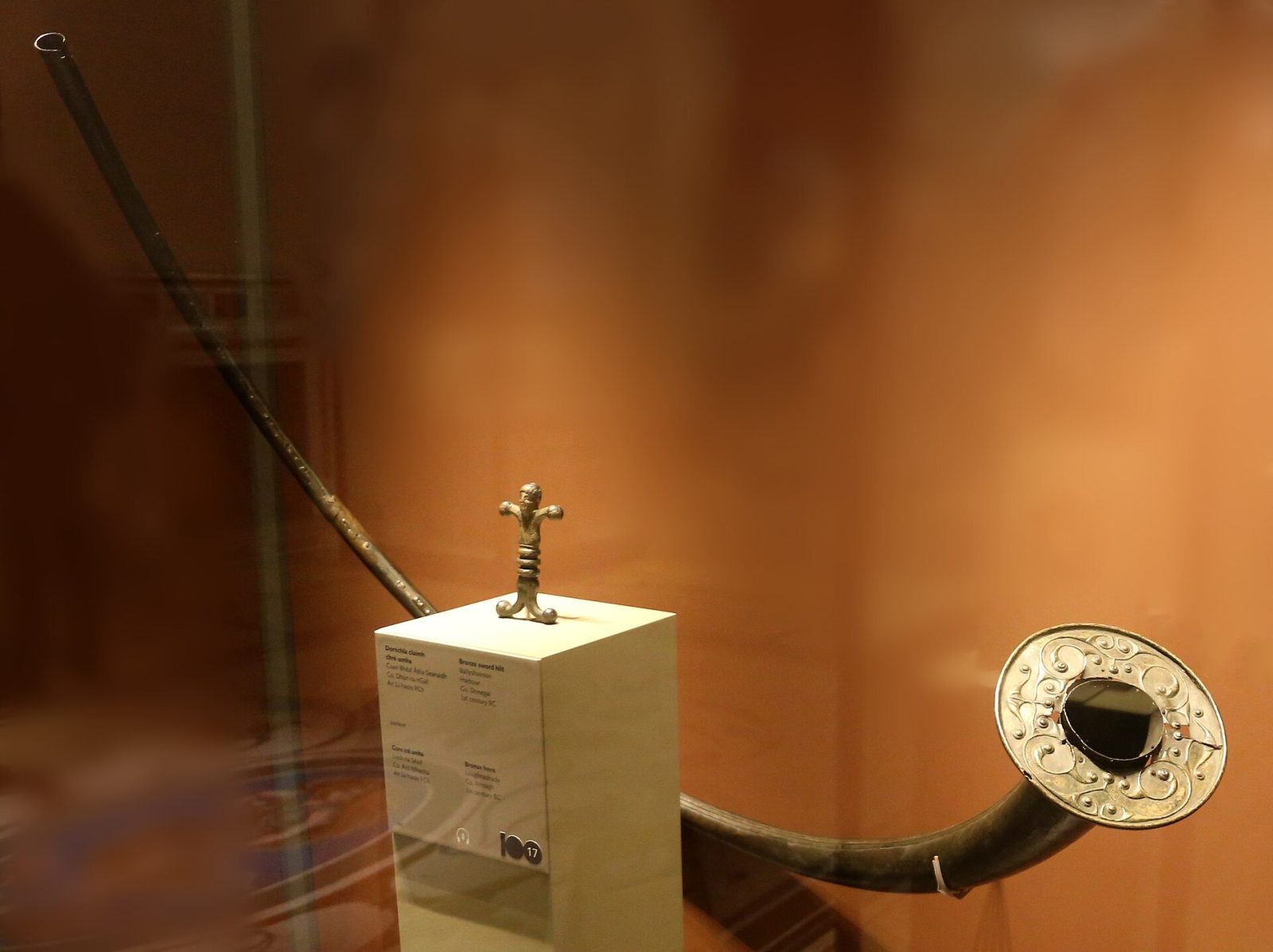
In 1794 men draining a small lake beside Navan Fort in County Armagh, the ancient royal seat of Ulster, found four great bronze horns. Only one survives: an Iron Age trumpet almost two metres long with a beautifully decorated bell.
In 1794, men digging drains in the boggy ground that had once been a small lake called Loughnashade, beside Navan Fort near Armagh, found four large bronze horns. Navan Fort, known in Irish legend as Emain Macha, was the royal centre of the ancient kings of Ulster, and the setting for many of the tales of Cú Chulainn. The lake's name is often translated as the lake of the treasures. An early description says that human skulls and bones were found with the horns, which suggests they had been placed in the water as offerings.
Of the four horns, only one survives. According to one account, one went to a collector in Scotland and may have been destroyed in a house fire, another was sold and a third disappeared. The fourth was eventually brought to Dublin. In 1809, the Belfast campaigner Mary Ann McCracken appealed for the horns to be kept in a museum, and her brother John drew them for Edward Bunting's collection of ancient Irish music.
The surviving horn is a curved trumpet made of thin sheets of hammered bronze, riveted together in four parts: two long tubes, a ring joining them, and a decorated disc around the mouth of the bell. It is almost two metres long. The disc is the masterpiece: raised decoration of flowing curves and lotus-bud shapes, the four quarters mirror images of each other, in the La Tène style of Iron Age Celtic art. One of the two tubes is made differently from the other, and was probably an ancient replacement, and the horn carries three ancient patches, so it was used and mended over a long time. The National Museum dates it to the 1st century BC.
Reconstructions have shown that the horn makes a deep, powerful sound, and that the decorated disc helps to project it. It would have been held upright above the player's head, perhaps sounding across the lake during ceremonies at the royal site.
The Loughnashade Horn is on display in the Treasury of the National Museum of Ireland, Archaeology, on Kildare Street in Dublin. A replica is shown at the Navan Centre beside Navan Fort.
Written for Global Finds from the National Museum of Ireland, Ancient Music Ireland and B. Raftery's study in Emania (1987). Photo: the Loughnashade Horn in the National Museum of Ireland, Sailko, Wikimedia Commons, CC BY 3.0.
Approximate location54.35, -6.69View on map
Source: National Museum of Ireland