The Lisnacrogher Scabbards: Iron Age bronze sword sheaths dug from a drained Antrim lough by turf cutters
Famous find Made about 300 to 200 BC · Found in 1882 See it on the timeline →
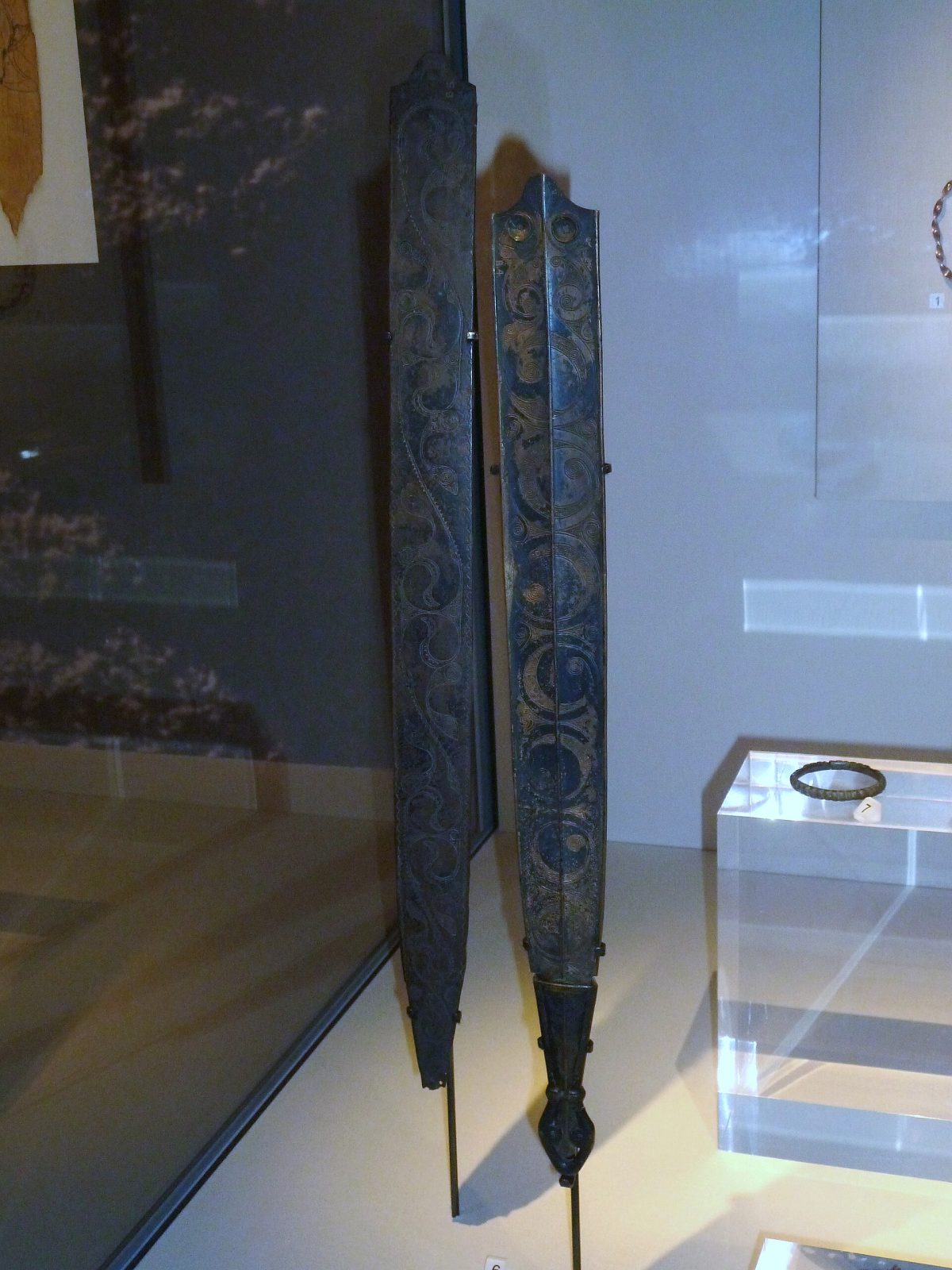
Around 1882, turf cutters working a drained lough at Lisnacrogher near Ballymena in Co. Antrim found the timbers of a crannog. Among the finds were bronze sword scabbards engraved with swirling Celtic designs, made about 300 to 200 BC and among the finest Iron Age metalwork from Ireland.
Around 1882, workmen cutting turf in the partly drained bed of a small lough at Lisnacrogher, near Broughshane about six kilometres north of Ballymena in County Antrim, came upon the oak timbers of a crannog, an artificial island built in the lake. By the autumn of 1883 most of the timbers had been carted away before any expert had seen them, and finds kept coming out of the ground throughout the 1880s. No individual finder is named in the records.
The antiquarian W. G. Wood-Martin described three bronze sword scabbards engraved with flowing spirals and running-wave scrolls in the La Tène style of Celtic art, and a fourth, plain sheath that still held its iron sword, rusted solidly inside it. Traces of red enamel survive on one scabbard and on its chape, the shaped metal tip, and the engraved lines may once have been filled with a black inlay. Other finds from the site include spear butts, a torc, bracelets and a bronze bowl.
The Ulster Museum dates the scabbards to about 300 to 200 BC. Decorated sheaths like these are a hallmark of Irish Iron Age art, so distinctive that scholars speak of an Irish scabbard style. What Lisnacrogher was has been argued over ever since the 1880s: a settlement or workshop on an island, or a sacred lake where weapons were offered to the water. Because so little was recorded when the timbers were removed, the question may never be settled.
Many of the finds passed into private hands. Several were in the museum of Canon John Grainger, rector of Broughshane, whose collection of some 60,000 objects went after his death in 1891 to the Belfast Natural History Society, a forerunner of the Ulster Museum. The scabbards are displayed in the Ulster Museum in Belfast.
Written for Global Finds from the Ulster Museum, W. G. Wood-Martin, The Lake Dwellings of Ireland (1886), and the Council for British Archaeology (2025). Photo: decorated scabbards from Lisnacrogher in the Ulster Museum, Notafly, Wikimedia Commons, CC BY-SA 3.0.
Approximate location54.93, -6.27View on map
Source: Ulster Museum