The Broighter Hoard: Irish gold, a tiny boat and a famous court case
Famous find 1st century BC · Found in 1896 See it on the timeline →
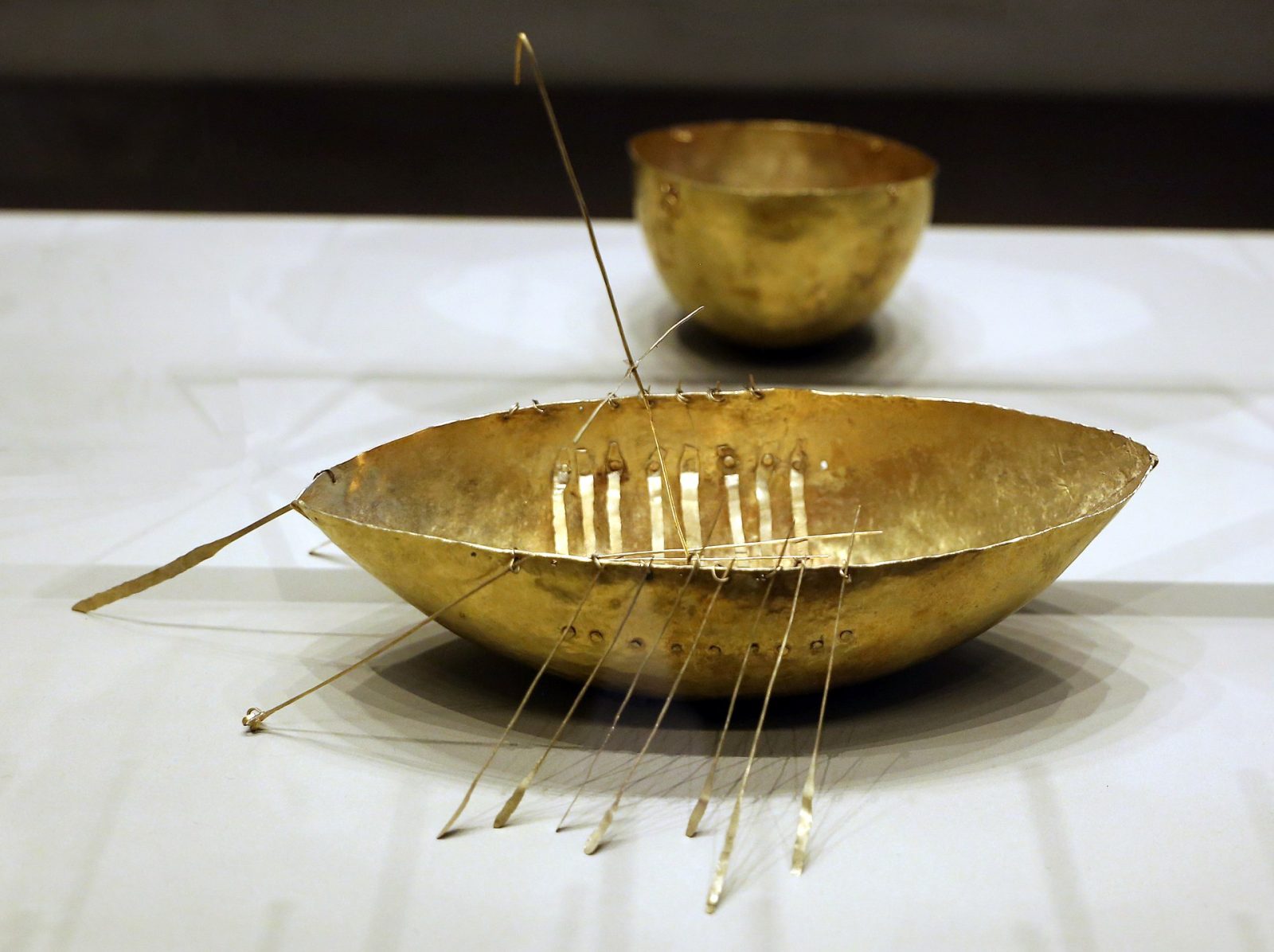
In 1896 two ploughmen near Limavady turned up a hoard of Iron Age gold, including a miniature boat complete with oars. A famous court case in 1903 decided it was treasure trove, and it went to Dublin.
In February 1896, two men ploughing a field on Joseph Gibson's farm at Broighter, near Limavady in County Londonderry, turned up a group of gold objects about two kilometres from the shore of Lough Foyle.
Everything was gold. There was a small boat about 18 centimetres long, complete with benches and oars; a little bowl with rings for hanging it up; necklaces of fine chain; twisted torcs; and a large hollow collar, a buffer-torc, decorated with the swirling designs of La Tène art. The collar is dated by its style to the 1st century BC, and the hoard is usually placed in that century.
The gold passed from the farm through a jeweller in Derry to the antiquarian Robert Day, and was then bought by the British Museum. The Crown and the Royal Irish Academy went to court to claim it. In Attorney-General v Trustees of the British Museum, heard in 1903, the museum argued that the gold had been a votive offering, thrown into the water for a sea god and deliberately abandoned, so it could not be treasure trove. The Crown, represented by Sir Edward Carson, argued that it had been hidden by someone intending to come back for it. Much of the case turned on whether the field had been under the sea when the gold went into the ground.
Mr Justice Farwell found for the Crown. The hoard was declared treasure trove and went to Dublin in 1903. It is now in the National Museum of Ireland in Kildare Street, with replicas in the Ulster Museum in Belfast.
The boat is the earliest known model of an Irish sea-going boat, and the collar is one of the finest pieces of Iron Age gold from Ireland. Whether the hoard really was an offering, perhaps to the sea god Manannán mac Lir, is still debated.
Written for Global Finds from the National Museum of Ireland, Antiquity and other published accounts. Photo: the Broighter gold boat in the National Museum of Ireland, Sailko, Wikimedia Commons, CC BY 3.0.
Approximate location55.07, -6.99View on map
Source: National Museum of Ireland