The Corbridge Lanx: a Roman silver tray found by a girl on the bank of the Tyne
Famous find Made in the 4th century AD · Found in 1735 See it on the timeline →
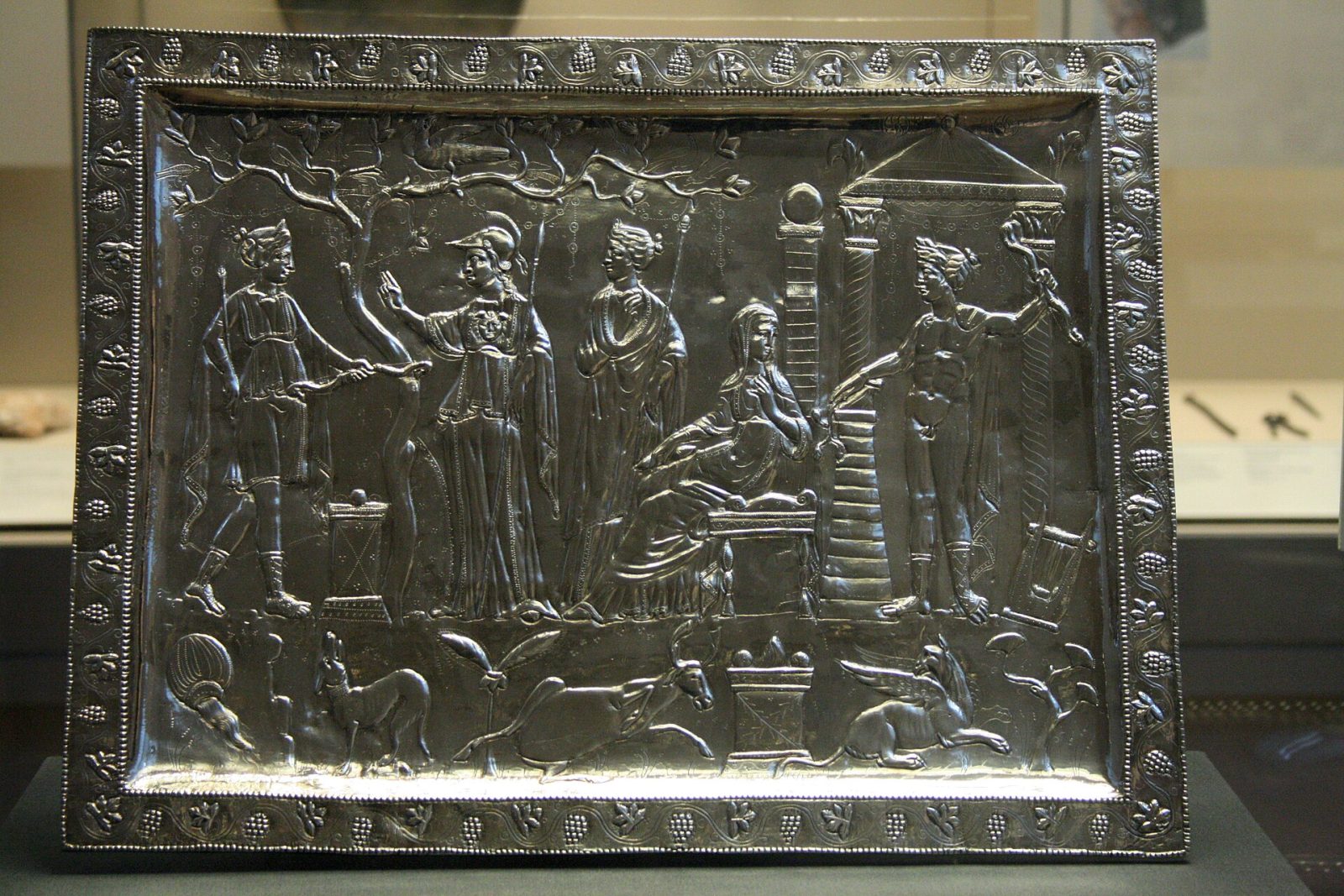
In 1735 a nine-year-old girl found a large Roman silver tray sticking out of the riverbank at Corbridge in Northumberland. Within months it was the subject of a court case over who owned it.
In February 1735, Isabel Cutter, aged nine, found a large silver object sticking out of the gravel and mud at the edge of the River Tyne at Corbridge in Northumberland, on the north bank a little below the bridge. Corbridge stands beside the site of the Roman town of Coria, just south of Hadrian's Wall.
It was a lanx, a large rectangular serving tray of solid silver, about 50 by 38 centimetres and weighing 4.6 kilograms. Its decoration, cast and then chased, shows the god Apollo standing at a shrine with his bow, his lyre at his feet, with the goddesses Artemis and Athena and two other women. The British Museum suggests the scene is the island of Delos, where Apollo and Artemis were born. Below them are an altar, a hound, a fallen stag and a griffin, and a vine scroll runs around the border. Scratched on the back is the tray's weight in Roman measure, a record of its value as bullion. It is usually dated to the 4th century AD, and one theory links it to the emperor Julian's attempt to revive the old gods in the 360s.
Isabel's father sold it to a Newcastle goldsmith, Isaac Cookson, for about £33. The Duke of Somerset, as lord of the manor, then claimed it as treasure trove and took the matter to court. By the end of 1735 he had won, and Cookson was compensated. The lanx passed down through the Dukes of Northumberland.
It seems the river was washing out a hoard. Other pieces of Roman silver were found at Corbridge and nearby Bywell between 1731 and 1760, but all of them except the lanx have since been lost, and at least one was melted down.
In 1993 the British Museum bought the Corbridge Lanx from the Duke of Northumberland for about £1.86 million, with £1.7 million from the National Heritage Memorial Fund and £150,000 from the Art Fund. It is on display in the British Museum.
Written for Global Finds from the National Heritage Memorial Fund, the Art Fund, Francis Haverfield's 1914 study in the Journal of Roman Studies and other published accounts. Photo: the Corbridge Lanx in the British Museum, Michel wal, Wikimedia Commons, CC BY-SA 3.0.
Approximate location54.97, -2.02View on map
Source: National Heritage Memorial Fund