The Trundholm Sun Chariot: the Bronze Age sun, ploughed up in a Danish bog
Famous find Made around 1400 BC · Found in 1902 See it on the timeline →
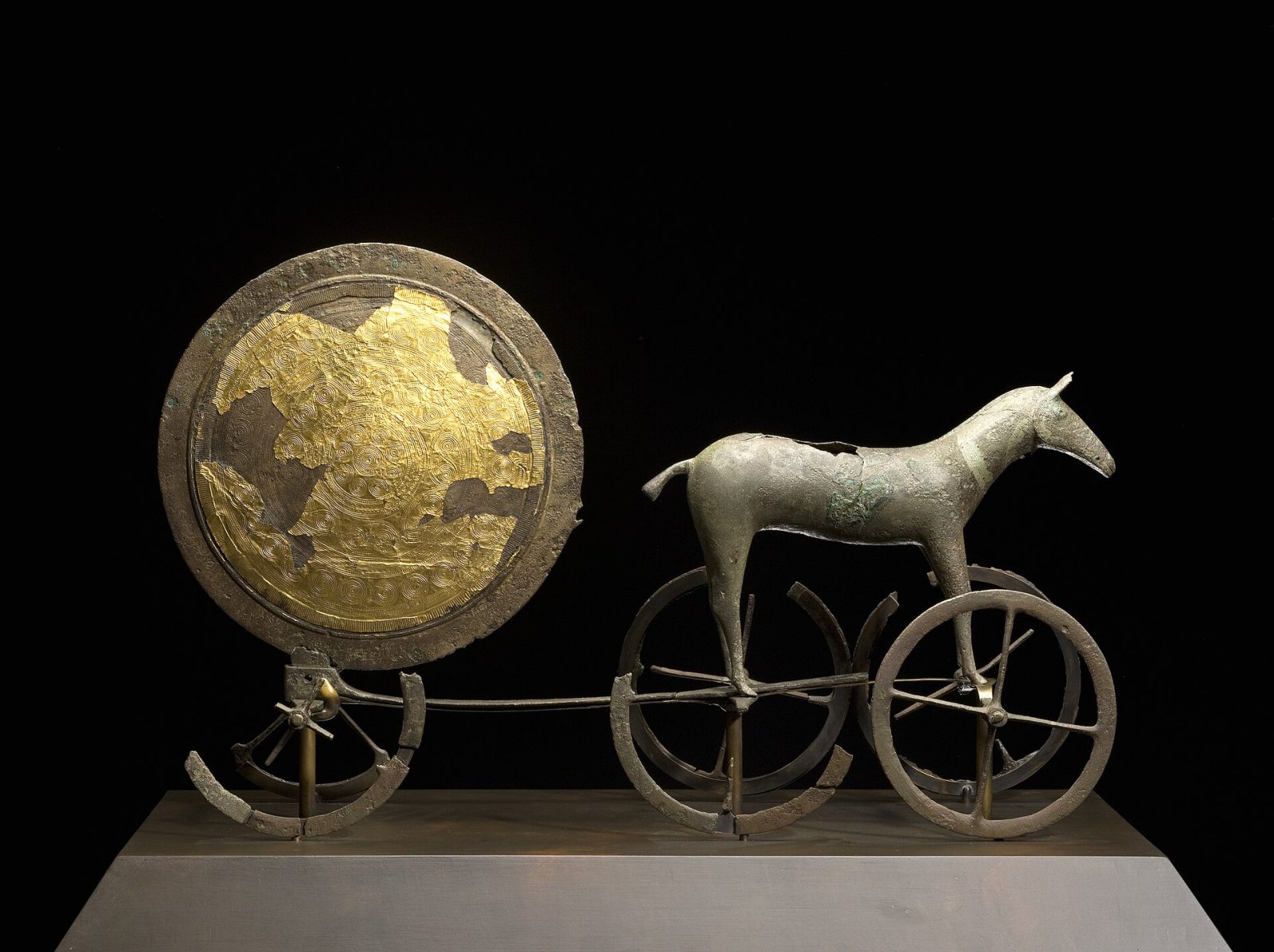
In 1902 a farmer ploughing a former bog on Zealand for the first time turned up a bronze horse pulling a sun disc gilded on one side. Nearly a century later, archaeologists with metal detectors found its missing pieces.
In September 1902, Frederik Willumsen was ploughing Trundholm Mose, a former bog in Odsherred in north-west Zealand, Denmark, for the first time, when the plough turned up pieces of bronze. Thinking they were an old toy, he took them home, and his children played with the horse. About a week later a neighbour told the National Museum.
Put back together, it is a bronze horse standing on wheels, pulling a bronze disc that also stands on wheels. One side of the disc is covered in gold and the other is plain bronze: the bright sun of the day and the dark sun of the night, as the museum describes them. The disc is about 25 centimetres across, decorated with circles, spirals and zig-zag bands, and the whole piece is about 54 centimetres long. It was cast by the lost-wax method, and damage on the horse's back shows the clay core it was cast around. The National Museum of Denmark dates it to around 1400 BC, in the Early Bronze Age, and its spiral ornament shows it was made in the north.
It is the most famous object from Bronze Age Scandinavia and is usually seen as a picture of the sun being carried across the sky, a belief at the heart of Bronze Age religion. It is generally thought to have been placed in the bog as an offering.
In 1998 archaeologists went back to the findspot with metal detectors and found 21 more pieces, parts of spokes, wheel rims and axles that had been missing since 1902. Conservators have since fitted them back on.
The Sun Chariot is on display in the National Museum of Denmark in Copenhagen. It has appeared on a Danish banknote, and in 2020 Queen Margrethe opened a visitor site at the findspot, now part of Geopark Odsherred.
Written for Global Finds from the National Museum of Denmark, the Danish national encyclopedia and other published accounts. Photo: the Trundholm Sun Chariot, National Museum of Denmark, Wikimedia Commons, CC BY-SA 3.0.
Approximate location55.89, 11.57View on map
Source: National Museum of Denmark