The Antikythera Mechanism: an ancient Greek computer from a shipwreck
Famous find Made in the 2nd century BC; lost at sea about 70 to 60 BC · Found in 1901 See it on the timeline →
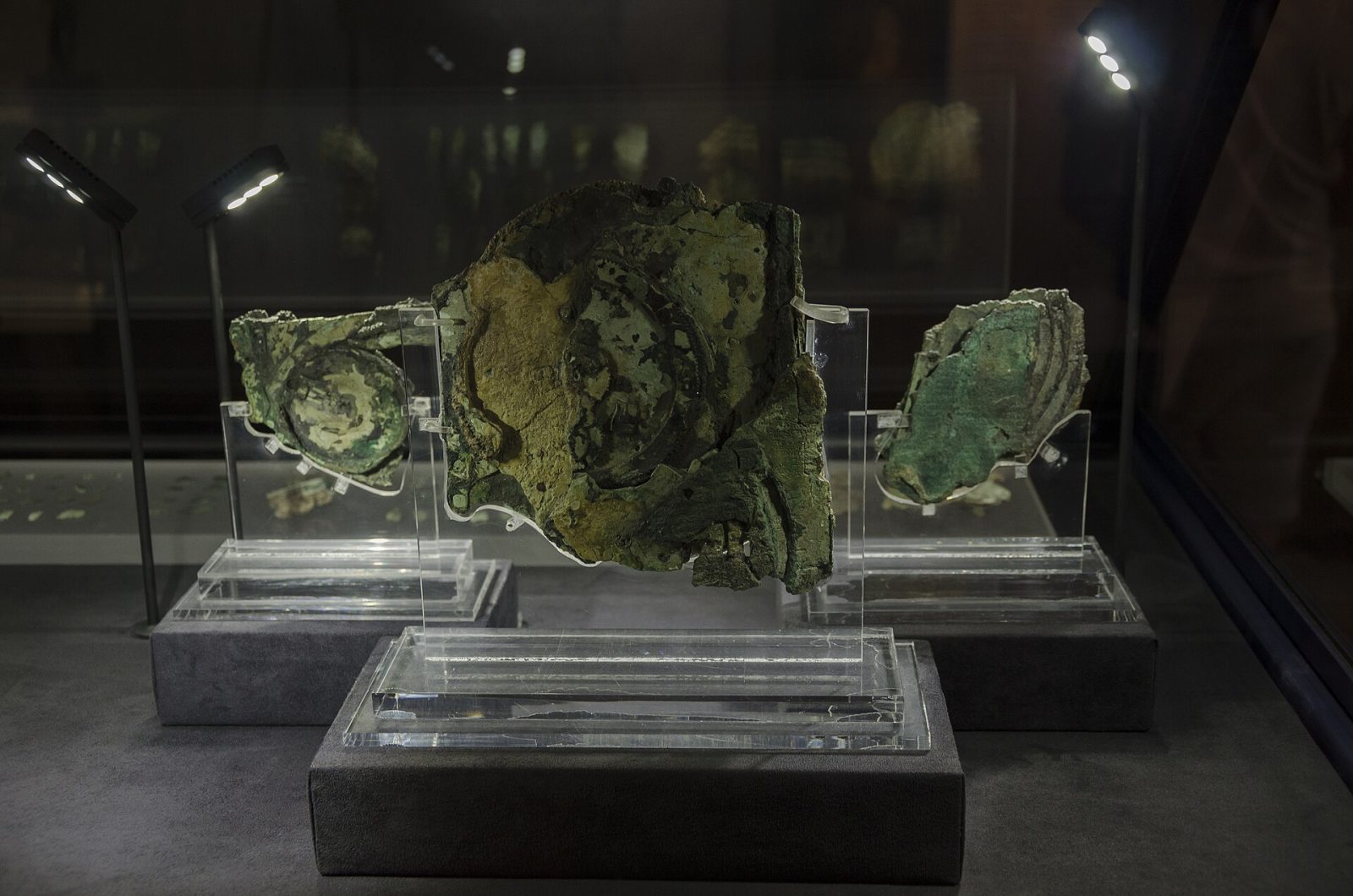
In 1901 sponge divers salvaging an ancient shipwreck off the Greek island of Antikythera brought up lumps of corroded bronze. Inside were gear wheels: the remains of a machine that modelled the heavens, built more than 2,000 years ago.
Around Easter 1900, sponge divers from the island of Symi found an ancient shipwreck in deep water off Antikythera, a small island between the Peloponnese and Crete. The Greek government organised a salvage, carried out by the divers in 1900 and 1901, often described as the first archaeological recovery of an ancient wreck from the seabed. As well as bronze and marble statues, they brought up some lumps of corroded bronze, probably in 1901.
In May 1902, Spyridon Stais, a former minister of education who had overseen the salvage, noticed gear wheels and Greek letters on two of the corroded pieces at the National Archaeological Museum in Athens. It was the start of more than a century of study.
What survives is 82 fragments, about a third of the original machine, with 30 bronze gear wheels. When complete it was a box roughly the size of a shoebox, with bronze dials on the front and back. It showed the positions of the Sun and Moon, the phase of the Moon and a calendar, predicted eclipses, and, according to its inscriptions, tracked the five planets known in antiquity. It even modelled the way the Moon appears to speed up and slow down as it moves across the sky. It was made in the 2nd century BC, and the ship is thought to have sunk in the first half of the 1st century BC.
Its full complexity was only revealed in 2005, when a British and Greek team used high-resolution X-ray scanning to look inside the fragments and read hidden inscriptions. Their results, published in the journal Nature in 2006, described it as the world's oldest known analogue computer. Nothing as mechanically complex is known from anywhere for more than a thousand years afterwards.
The Antikythera Mechanism is on display in the National Archaeological Museum in Athens.
Written for Global Finds from the journals Nature and Scientific Reports, Alexander Jones's history of its discovery and other published accounts. Photo: fragments of the Antikythera Mechanism in the National Archaeological Museum, Athens, Peulle, Wikimedia Commons, CC BY-SA 4.0.
Approximate location35.89, 23.31View on map
Source: Nature