The Rold Hoard: six Viking gold arm-rings found on a Danish field path
Made in the second half of the 10th century AD · Found in 2026 See it on the timeline →
In April 2026 a man walking on a field path near Rold in north Jutland spotted two gold arm-rings in the ground. A metal-detector survey by archaeologists found four more. Together they make the third-largest Viking Age gold find ever made in Denmark.
In late April 2026, a man walking along a field path near Rold, in Himmerland in north Jutland, noticed two heavy gold rings lying partly exposed in the ground beside the track. He took them to the archaeologists at Nordjyske Museer, the museums of North Jutland.
The archaeologists went back to the spot and carried out a systematic survey with metal detectors. It found a third gold ring almost exactly where the first two had lain, and three more about 15 metres away, stacked one on top of another, apparently where the rings had originally been buried.
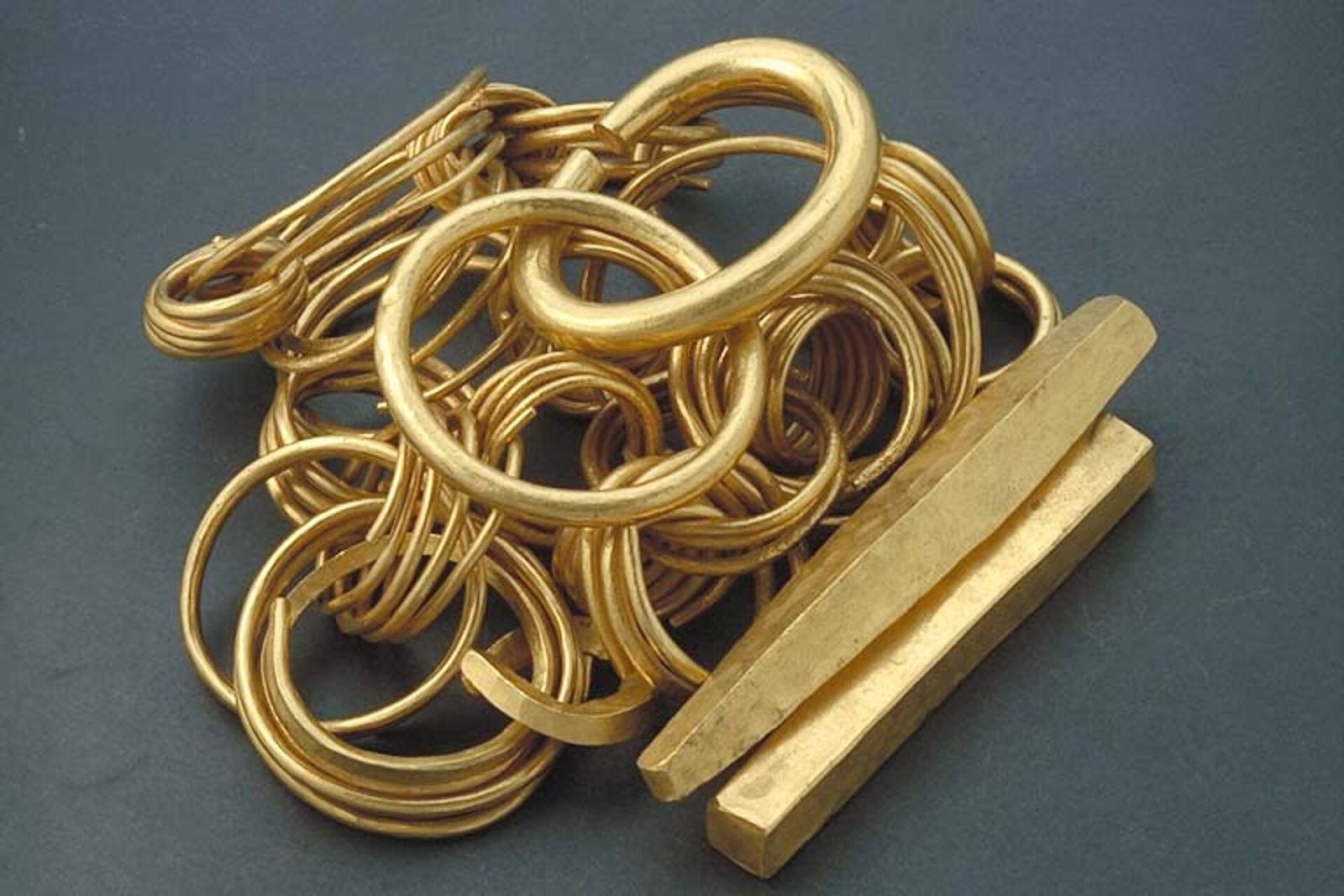
All six are arm-rings of solid gold, and all six are complete. Together they weigh 762.5 grams. Three are twisted from pairs of gold rods, three are smooth, and several have neatly wrapped closures; one has a smaller ring of the same kind attached to it, and another has flattened ends decorated with zigzags and triangles. Nordjyske Museer dates them to the Viking Age, around 900 to 1000, and the National Museum of Denmark to the second half of the 10th century.
That makes the Rold Hoard the third-largest Viking Age gold find ever made in Denmark, after the Tissø Ring, found on Zealand in 1977, and the Fæsted Hoard, found near Ribe in 2016. Torben Sarauw of Nordjyske Museer called it a completely unique find. Because gold was concentrated among the very top of Viking society, and because the rings were never cut up to be used as money, the archaeologists see them as symbols of wealth, rank and loyalty, the kind of gift a powerful lord gave to bind his followers to him. They date from the time when Harald Bluetooth was building the Danish kingdom, and a similar ring is known from the Viking ring fortress at Aggersborg.
Why the rings were buried is not known. They may have been hidden in a time of danger by someone who meant to come back, or placed in the ground as an offering.
The hoard has been declared danefæ, treasure that belongs to the Danish state. The finder and the landowner have not been named, and the findspot is on private land. The rings are on display in the National Museum of Denmark in Copenhagen until the end of 2026.
Reported by Medievalists.net (2 October 2026), with details from the National Museum of Denmark's press release and Videnskab.dk. Written for Global Finds from those reports.
Approximate location56.80, 9.87View on map
Source: Medievalists.net