The Hiddensee Hoard: Viking gold washed out by the storms of the Baltic
Famous find Made in the second half of the 10th century AD · Found in 1872 See it on the timeline →
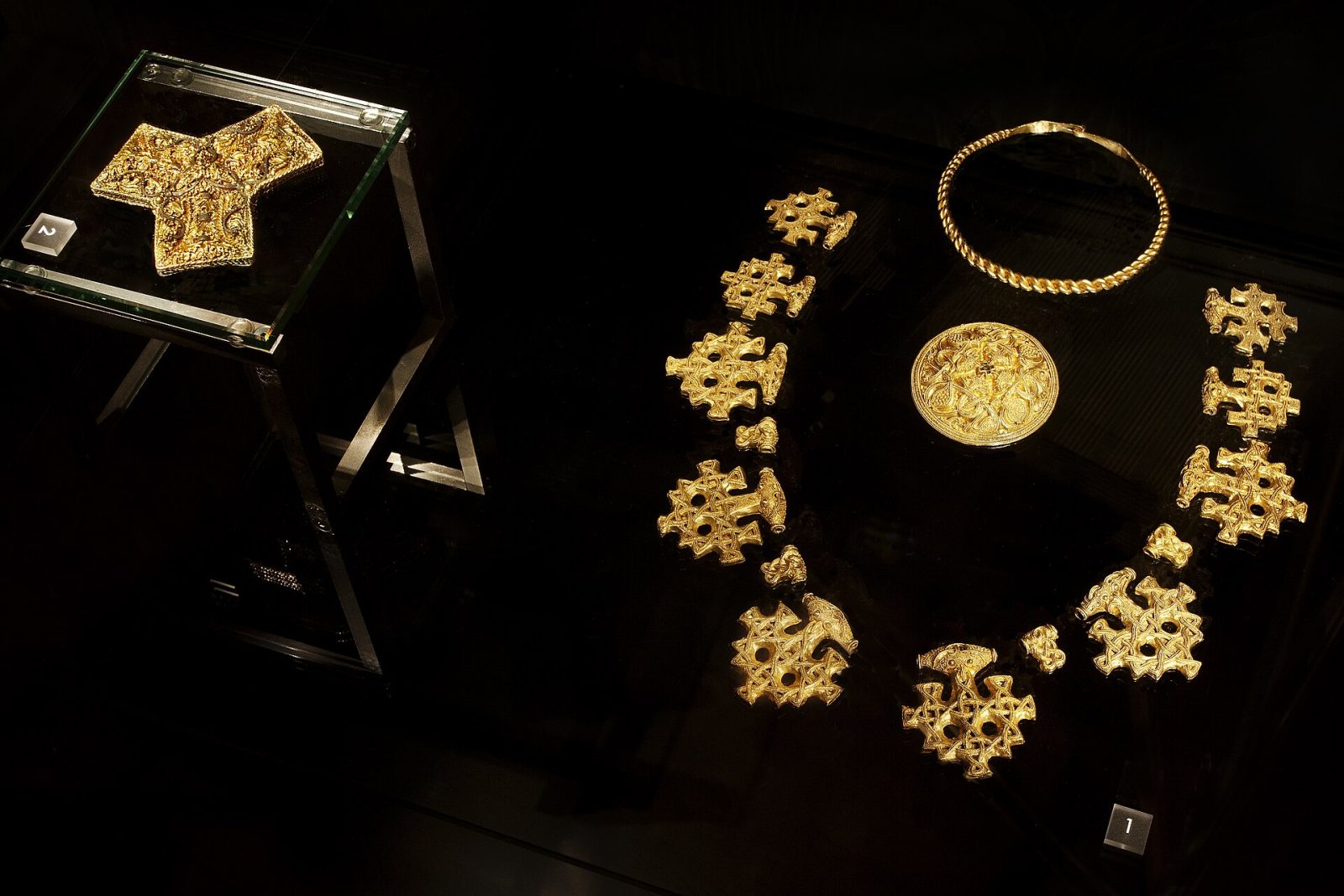
After storm floods in 1872 and 1874, islanders on Hiddensee in the Baltic picked up pieces of Viking gold on the beach. Gathered together, they make one of the finest sets of Viking jewellery ever found.
In November 1872, a great storm surge swept over Hiddensee, a long, narrow island off the Baltic coast of Germany, west of Rügen. In the months that followed, and again after another flood in February 1874, people on the beach near Neuendorf began to find pieces of gold. A sailmaker brought in seven pieces, a woman sold others to a goldsmith in Stralsund, and Rudolf Baier, founder of the museum in Stralsund, set about buying everything he could, paying by weight.
In the end 16 pieces were gathered together, about 600 grams of gold: a twisted neck ring of four gold wires, a round brooch decorated with four interlaced beasts around a cross, ten cross-shaped pendants with bird-head ends and fine filigree and granulation, and four hollow spacer beads. Mismatched spacers suggest that some pieces were never found. The jewellery was made in the second half of the 10th century, and its pendants can be read both as Christian crosses and as Thor's hammers, a mix of old and new beliefs.
How the gold came to be on the beach is not known: it may have been washed out of the dunes or brought in by the sea. Its quality has led some, including the Berlin State Museums, to suggest it belonged to the family of the Danish king Harald Bluetooth, who died around 980, but there is no proof of that.
The hoard became one of the treasures of Stralsund. It was copied many times, and East Germany gave copies as state gifts. The originals were lent to the great Viking exhibition shown in Copenhagen, London and Berlin in 2013 and 2014. They belong to Stralsund Museum, which has been refurbishing its home in the former Katharinenkloster, and they are due to return to display there. A replica can be seen in the museum on Hiddensee itself.
Written for Global Finds from the Landesmuseum Mecklenburg-Vorpommern, the Berlin State Museums, Stralsund Museum and other published accounts. Photo: the Hiddensee Hoard at the VIKING exhibition in Copenhagen, National Museum of Denmark, Wikimedia Commons, CC BY-SA 2.0.
Approximate location54.52, 13.09View on map