The Hackney Hoard: gold coins buried by a refugee family in the Blitz
Famous find Coins struck 1854 to 1913, buried 1940 · Found in 2007 See it on the timeline →
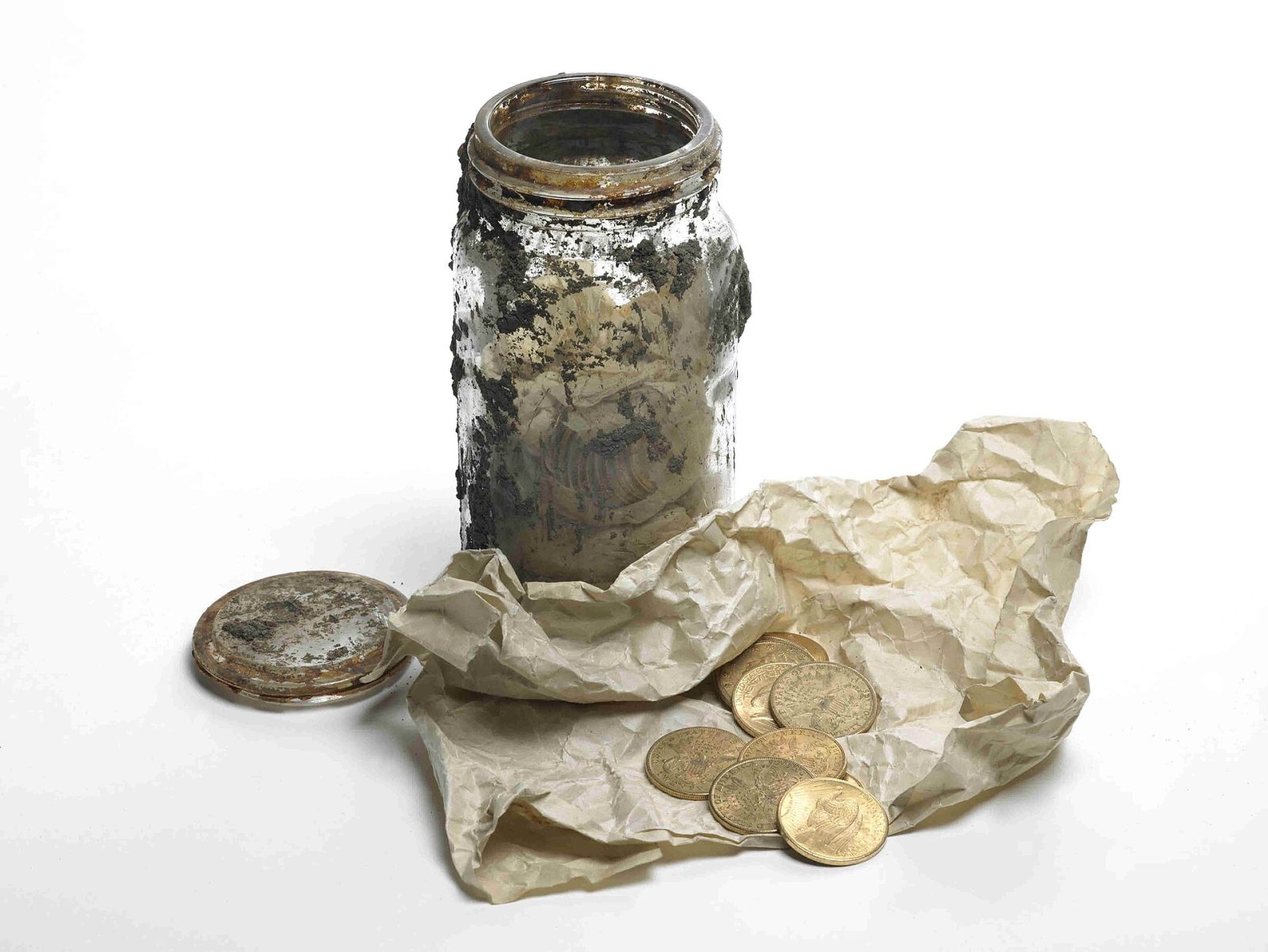
In 2007 people digging a pond in a Hackney garden found a jar of 80 American gold coins. They had been buried in 1940 by a German-Jewish refugee family, and a coroner returned them to the owner's son.
In the summer of 2007, Terry Castle and three others were digging a wildlife pond in a back garden on Bethune Road, in Stamford Hill in the London Borough of Hackney, when they found a glass preserving jar about 75 centimetres down. Inside, wrapped in greaseproof paper, were 80 United States $20 gold coins, known as double eagles, dated between 1854 and 1913.
The find was reported. The Treasure Act also covers gold and silver that was deliberately hidden and whose owner is unknown, however recent it is, so the coins went before the coroner, and the British Museum and the Museum of London set out to discover who had buried them.
The trail led to Martin Sulzbacher, a Jewish banker from Frankfurt who had fled to London with his family in 1938. In 1940, fearing a German invasion, the family buried their gold coins in the garden of the house in Bethune Road. Martin was interned as an enemy alien. In September 1940 the house was hit by a bomb, and the relatives who knew where the coins were hidden were killed. Builders on the site found one jar, holding 82 double eagles, in 1952, and those coins were returned to Martin, but the second jar stayed in the ground. Martin died in 1981.
In April 2011 the coroner, Dr Andrew Reid, ruled that Martin's son Max, then 81 and living in Jerusalem, had the stronger claim, so the coins were not Treasure and were his. It was the first time since the Treasure Act came into force in 1997 that an owner's heir had successfully claimed a find. Max Sulzbacher made a payment to the finder, gave one coin to Hackney Museum, where it is displayed with the jar, and kept two for the family. The rest were sold at auction in London in November 2011.
Written for Global Finds from Hackney Council, the Hackney Citizen and other published accounts. Photo: the Hackney Hoard in its jar, The Portable Antiquities Scheme, Wikimedia Commons, CC BY 2.0.
Approximate location51.57, -0.08View on map
Source: Hackney Council