The Waterloo Helmet: the only Iron Age horned helmet ever found
Famous find Made about 150 to 50 BC · Found in 1868 See it on the timeline →
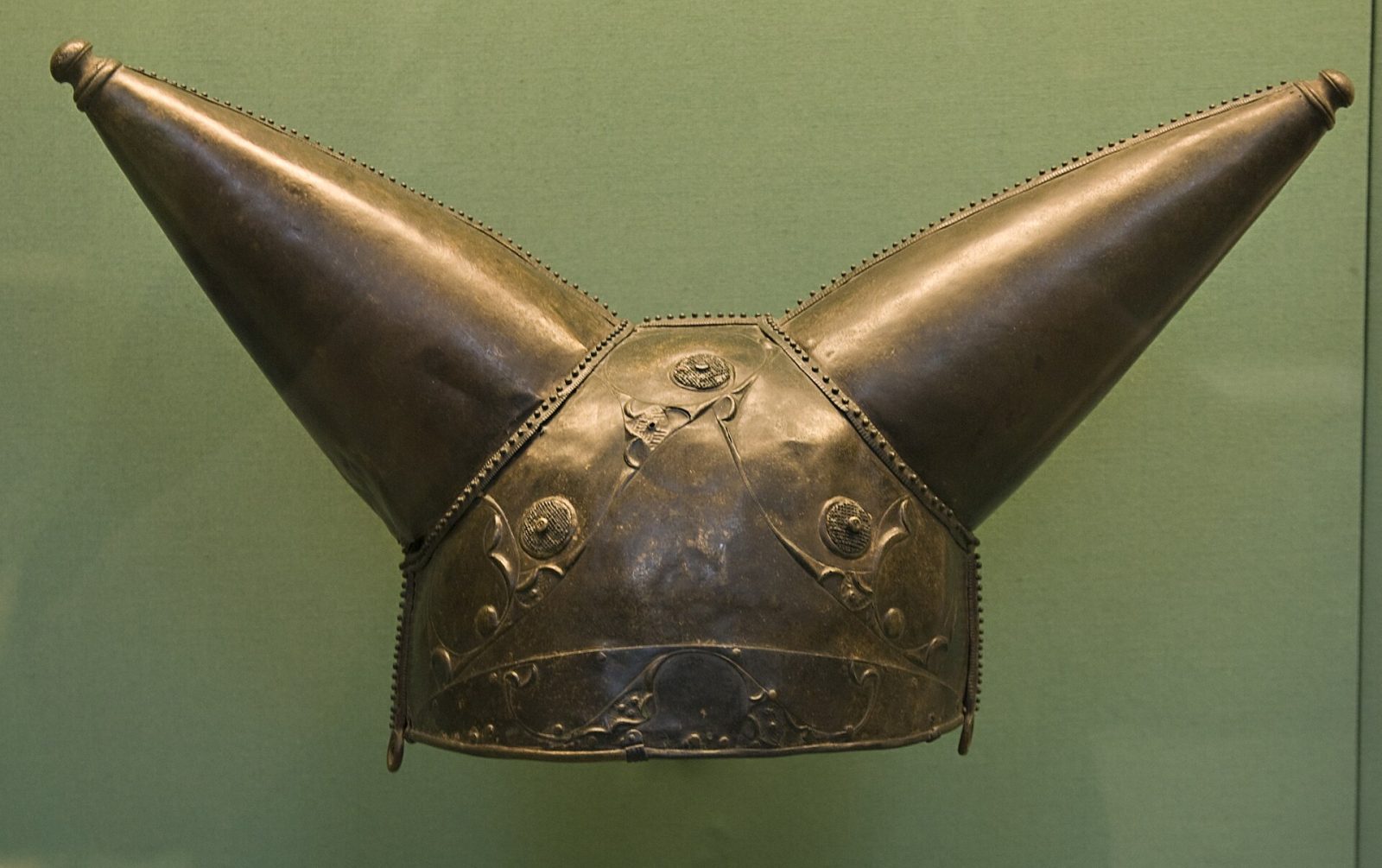
Dredged from the bed of the River Thames near Waterloo Bridge in the 1860s, this bronze helmet with two horns is, according to the British Museum, the only Iron Age horned helmet ever found anywhere in Europe.
In the 1860s, a bronze helmet with two cone-shaped horns was dredged from the bed of the River Thames near Waterloo Bridge in London. The Thames Conservancy, which looked after the river, lent it to the British Museum in 1868. Nobody recorded who found it or exactly when.
The helmet is made from two halves of sheet bronze riveted together, with a crescent-shaped piece fixed to the lower front and two conical horns with knobbed tips riveted on top. It is about 24 centimetres high. Both sides are decorated with raised swirling patterns in the La Tène style of Celtic art, like the decoration of the Snettisham Great Torc, and it once had six studs of red glass, five of which survive. When new, the polished bronze would have shone like gold. The British Museum dates it to about 150 to 50 BC, though other estimates are a little earlier.
According to the British Museum, it is the only Iron Age helmet with horns ever found anywhere in Europe. The horned Viking helmets of popular imagination are a 19th-century invention, so this helmet, made centuries before the Viking Age, is the real thing. It is quite small, about a modern hat size 7, and one suggestion is that it was made for a statue of a god rather than for a person.
Like the Battersea Shield, it is thought to have been placed in the Thames as an offering. It was never sold: the Port of London Authority, which took over from the Thames Conservancy, gave it to the British Museum in 1988. It is on display in Room 50.
Written for Global Finds from the British Museum and other published accounts. Photo: the Waterloo Helmet in the British Museum, Ealdgyth, Wikimedia Commons, CC BY-SA 3.0.
Approximate location51.51, -0.12View on map