The Witham Shield: an Iron Age shield with the ghost of a boar
Famous find Made about 400 to 300 BC · Found in 1826 See it on the timeline →
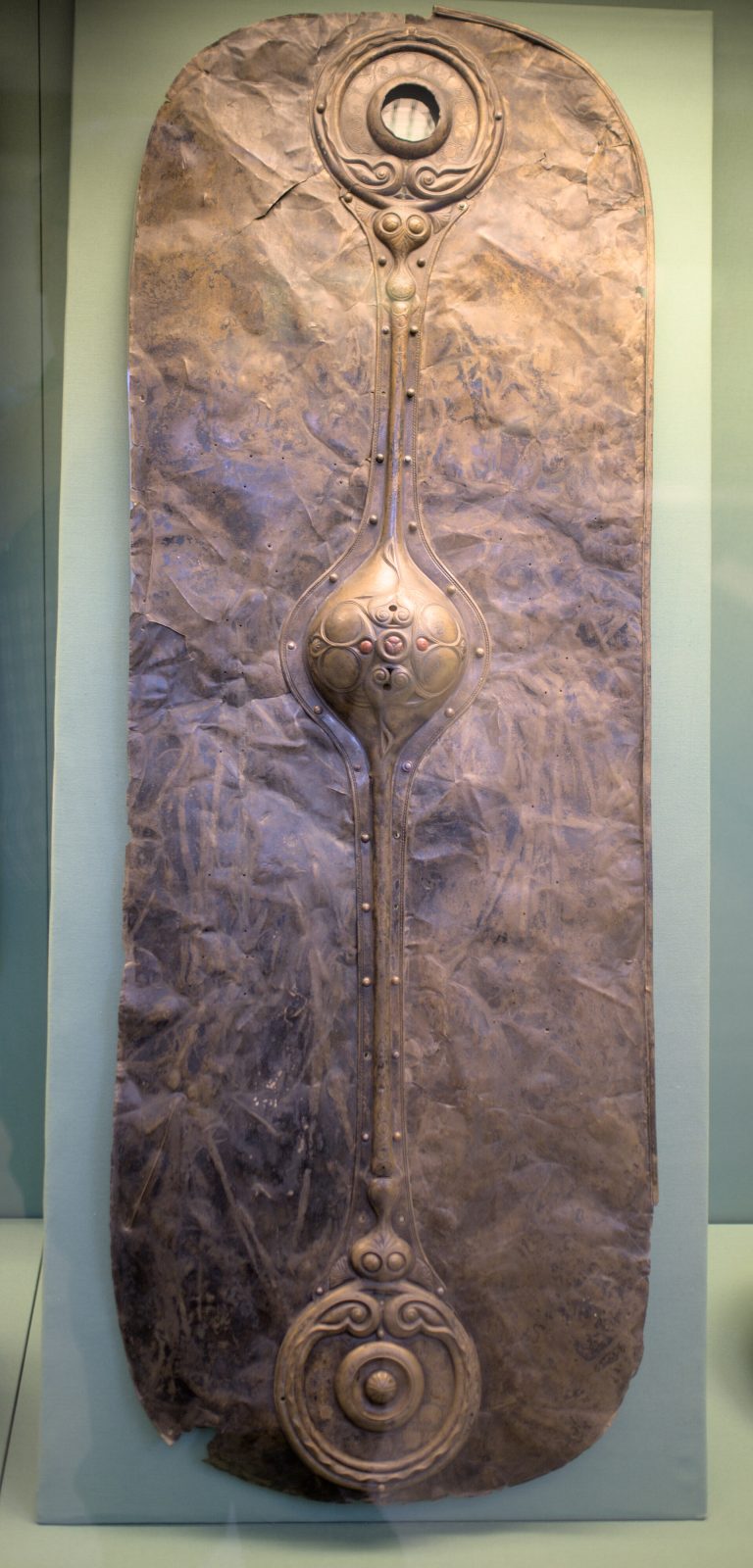
Dredged from the River Witham near Lincoln in 1826, this long bronze shield facing is a masterpiece of early Celtic art. A leather boar once fixed to it has vanished, leaving only its outline.
In 1826, while the River Witham was being dredged near Lincoln, probably between Stamp End and Washingborough, workmen brought up the bronze facing of an Iron Age shield. Nobody recorded the finder's name or the exact day.
The facing is about 1.1 metres long, made from two sheets of bronze only a fraction of a millimetre thick, joined at the middle. The wooden shield it once covered has long since rotted away. At its centre is a raised boss set with red coral, probably brought from the Mediterranean, and its ends are decorated with roundels based on the heads of birds, with engraved birds and stylised animal heads. The British Museum dates it to about 400 to 300 BC, others suggest the 3rd century BC, and it may have been reworked during its life.
When it was found, the outline of a long-legged boar could be seen across the shield, and it was drawn in 1863. The boar, probably cut from leather, had been riveted on. Today it survives only as rivet holes and a faint shadow in the colour of the metal.
Like many fine Iron Age weapons from the Witham, the shield is thought to have been placed in the river as an offering. Nearby at Fiskerton, archaeologists have excavated an Iron Age causeway that produced swords, spears and other objects, evidence that this stretch of river was a sacred place.
The shield first went to the Rector of Washingborough, on whose land it was found, and then to the London armour collector Samuel Rush Meyrick. After his death it was sold, and in 1872 the collector Augustus Wollaston Franks gave it to the British Museum, where it is on display. A replica can be seen in Lincoln, and the original went back there on loan in 2013.
Written for Global Finds from Lincoln Museum, the Society for Lincolnshire History and Archaeology and other published accounts. Photo: the Witham Shield in the British Museum, Bob Harvey, geograph.org.uk via Wikimedia Commons, CC BY-SA 2.0.
Approximate location53.23, -0.49View on map
Source: Lincoln Museum